
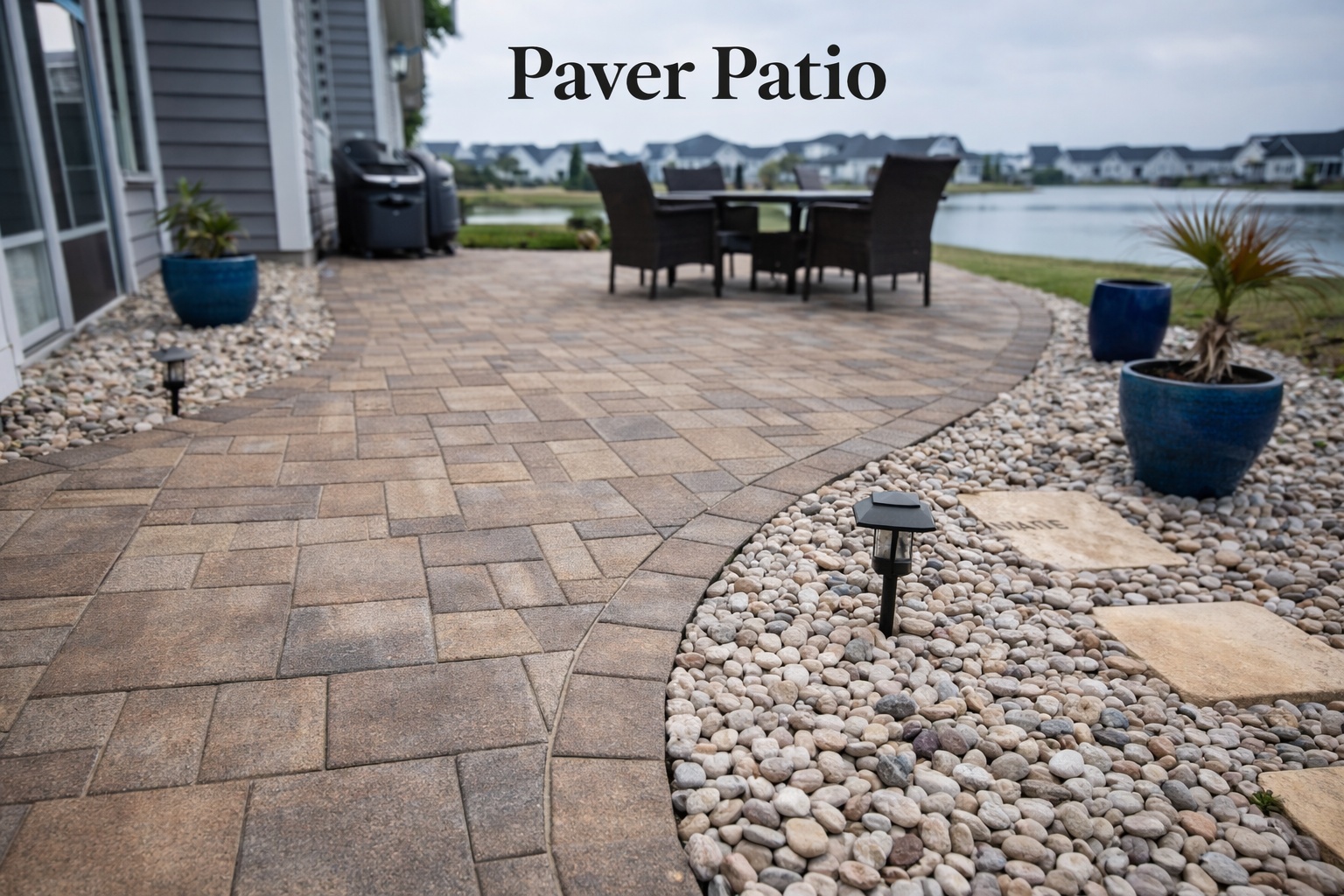
Your backyard has potential you might not be using.
For homeowners in Myrtle Beach, North Myrtle Beach, Little River, and throughout coastal Carolina, the outdoor season is long. The weather cooperates most of the year. The scenery — whether you’re backing up to a pond, a wooded lot, or a neighborhood green space — is worth showing off. And yet, so many backyards are just… grass. Maybe a concrete pad that’s starting to crack. Maybe a wood deck that needs another coat of stain.
A professionally designed outdoor living space changes all of that. And at the center of almost every great outdoor space is a paver patio.
This guide walks through everything you need to know about paver patios, seat walls, decorative rock landscaping, and how these elements come together in a full outdoor living design — specifically built for the coastal Carolina environment.
Why Paver Patios Work So Well in Coastal Carolina
Coastal environments are harder on outdoor materials than most people realize. The combination of sandy soil, heavy seasonal rain, high humidity, and salt air (closer to the coast) creates conditions that will expose every weakness in a poorly built outdoor surface.
Paver patios handle this environment exceptionally well — but only when installed correctly. Here’s why they’re the right choice for homes in this region:
They Flex With the Soil
Unlike poured concrete slabs, which are rigid and prone to cracking when the ground beneath them shifts, pavers are individual units set in sand. When soil movement happens — and in coastal Carolina’s sandy soil, it does — the paver surface adjusts without fracturing. If a section does settle unevenly over time, individual pavers can be re-leveled without replacing the entire surface.
They Handle Rain and Drainage Naturally
One of the most common problems coastal homeowners face is standing water. A properly installed paver patio is pitched to direct rainfall away from the home and toward appropriate drainage routes. The jointing sand between pavers also allows some water to filter through rather than pool on the surface — a meaningful advantage during heavy coastal rain events.
They Last Decades When Done Right
A concrete slab might give you 15-20 years before it needs significant repair. A wood deck in a humid coastal climate requires regular maintenance and can still deteriorate in 10-15 years without it. A quality paver patio, installed over a proper compacted gravel base, can last 30, 40, or even 50 years with minimal upkeep. Precision Hardscape & Construction recently revisited a patio installed in 2021 — and it looked exactly as it did on installation day. No shifting, no cracking, no settling. That’s what correct installation achieves.
They Add Real Property Value
Real estate agents in the Myrtle Beach and Grand Strand market consistently report that quality outdoor living spaces improve home resale value. Buyers respond to a well-designed backyard — especially in a region where outdoor living is possible nine or ten months of the year. A paver patio with an outdoor seating area, fire pit zone, or dining space makes a home genuinely more livable and more sellable.
Paver Patios vs. Other Outdoor Surfaces: A Honest Comparison
Pavers vs. Poured Concrete
Concrete is cheaper upfront, and that’s about where its advantages end in a coastal setting. Concrete is rigid — when sandy soil shifts beneath it, the slab cracks. Those cracks are difficult and expensive to repair cleanly. Concrete also absorbs heat and can fade over time. Pavers, by contrast, are repairable panel by panel, hold their color longer with sealing, and flex with soil movement rather than fighting it.
Pavers vs. Wood Decking
Wood decking has a natural look that many homeowners love — but coastal humidity is its enemy. Untreated or under-maintained wood warps, splinters, rots, and becomes a safety issue. Composite decking performs better but comes with its own cost and heat-retention issues. A paver patio requires no annual sealing, no board replacement, no splinter concerns, and no worry about moisture damage from below. Over a 10-year horizon, pavers typically cost less in maintenance than wood or composite decking.
Pavers vs. Gravel-Only Surfaces
Plain gravel areas have their place — they drain well and cost less to install. But they shift underfoot, can spread into lawn areas, and aren’t comfortable for barefoot use or furniture placement. A paver patio gives you a stable, level surface for furniture, foot traffic, and entertaining — while decorative gravel can be used around and adjacent to the patio as a complementary landscaping element.
Seat Walls: The Element That Makes a Patio Into a Space
One of the most underrated features in outdoor living design is the seat wall. A built-in seat wall — typically constructed from the same paver materials used on the patio surface — does several things at once:
- It defines the boundary of the patio space, creating a sense of enclosure and intention
- It provides built-in seating that never needs to be brought out of storage or replaced
- It can incorporate column pillars that serve as plant stands, lighting posts, or design anchors
- When built on a proper gravel footer, it remains perfectly stable for years without movement
In the 2021 lakefront project by Precision Hardscape & Construction, the curved seat wall wrapped around the fire pit area and created a natural separation between the lounge space and the dining area — all without any physical barrier that blocked the water view. That’s good design. The wall works with the space rather than against it.
For homes in Longs, Shallotte, Ocean Isle Beach, and Sunset Beach — where lots often have a natural backdrop worth preserving the sightlines to — a low seat wall is a far smarter choice than a fence or tall planter box.
Decorative Rock Landscaping: The Perfect Partner for Pavers
The finishing touch that transforms a paver patio from a construction project into a completed outdoor space is what happens along the edges. And in coastal Carolina, decorative rock landscaping is one of the best-performing choices.
Why Rock Works Better Than Mulch Near a Patio
Mulch has its place in garden beds — but along the edges of a paver patio, it creates problems. Mulch floats in heavy rain, migrating onto the paver surface and into the joints. It breaks down over time and needs to be replaced every one to two years. It can also harbor moisture against the patio edge, which accelerates joint sand erosion.
River rock and decorative stone stay put. They don’t float, don’t decompose, and don’t need to be replaced seasonally. They drain freely, which protects the patio edge. And they look crisp and clean year-round with almost zero maintenance.
Design Flexibility With Rock
Decorative rock comes in multiple sizes, colors, and textures. River rock — smooth, rounded stones in natural earth tones — pairs naturally with paver surfaces and complements coastal home styles. It can be used to fill transition zones between the patio edge and the lawn, to line planting beds, to create pathways, and to cover foundation areas around the home.
In the 2021 project, river rock landscaping beds lined the outer edge of the entire patio, with stepping stones integrated into the rock for foot traffic between the lawn and the patio. The result was a layered, designed look that made the whole backyard feel intentional — not just a patio dropped into a yard.
Designing an Outdoor Living Space That Works for Your Property
The best paver patio installations don’t just fill empty space — they respond to how the homeowner actually uses the backyard. Here are the questions Precision Hardscape & Construction considers when designing an outdoor living space:
- How do you want to use the space? (Dining, entertaining, fire pit, lounging, or all of the above?)
- What’s the primary view orientation? (Water, woods, neighbor fence, open sky?)
- How does foot traffic move from the house to the patio and around the yard?
- Where does water go when it rains heavily?
- Do you want lighting for evening use?
- Are there areas where grass is a headache to maintain that could become rock beds instead?
Answering these questions before installation begins is what separates a patio that homeowners love using from one that feels awkward or gets ignored. A curved patio with a seat wall fits a lakefront property differently than a rectangular patio fits a wooded lot in Calabash or a subdivision yard in North Myrtle Beach.
The design phase is where experience matters most — and it’s where Precision Hardscape & Construction earns its reputation for installations that hold up both structurally and aesthetically for years.
Maintenance: What It Actually Takes to Keep a Paver Patio Looking Great
One of the reasons homeowners choose paver patios is the low maintenance profile — but “low” doesn’t mean zero. Here’s a realistic picture of what upkeep looks like:
Sealing
Sealing a paver surface every two to four years protects the color, repels staining, and helps keep joint sand in place. It’s a straightforward process that most homeowners can do themselves or hire out easily. The 2021 project was sealed by the homeowners post-installation — and the color has held beautifully since.
Joint Sand Maintenance
Over time, rain can wash small amounts of joint sand from between the pavers. Occasionally adding polymeric sand to the joints keeps them tight and prevents weed growth. This is an occasional task, not an annual chore.
Weed Control
Weeds can establish in paver joints if the surface isn’t sealed and joint sand isn’t maintained. A properly sealed patio with tight joints leaves almost no room for weed growth. When decorative rock landscaping borders the patio — as in the lakefront project — landscape fabric beneath the rock adds another layer of weed suppression along the edges.
Spot Repairs
If a paver does ever get damaged — cracked by heavy equipment, stained beyond what sealing can address, or shifted by an unusual soil event — individual pavers can be removed and replaced without disturbing the surrounding surface. This is one of the most practical long-term advantages of pavers over concrete.
Work With Precision Hardscape & Construction LLC
If you’re ready to turn your backyard into a real outdoor living space, the team at Precision Hardscape & Construction LLC has the experience to design and build it right — the first time.
From custom paver patios and built-in seat walls to decorative rock landscaping and full drainage solutions, every project is built with the coastal Carolina environment in mind. That means proper base preparation, quality materials, and installations designed to look great and perform reliably for decades.
Want to see what that actually looks like? Read the full project story here — with photos from the site visit five years after installation.
Precision Hardscape & Construction LLC
Phone: (843) 222-5377
Serving homeowners in Myrtle Beach, North Myrtle Beach, Little River, Longs, Calabash, Sunset Beach, Ocean Isle Beach, and Shallotte.