
Project Spotlight
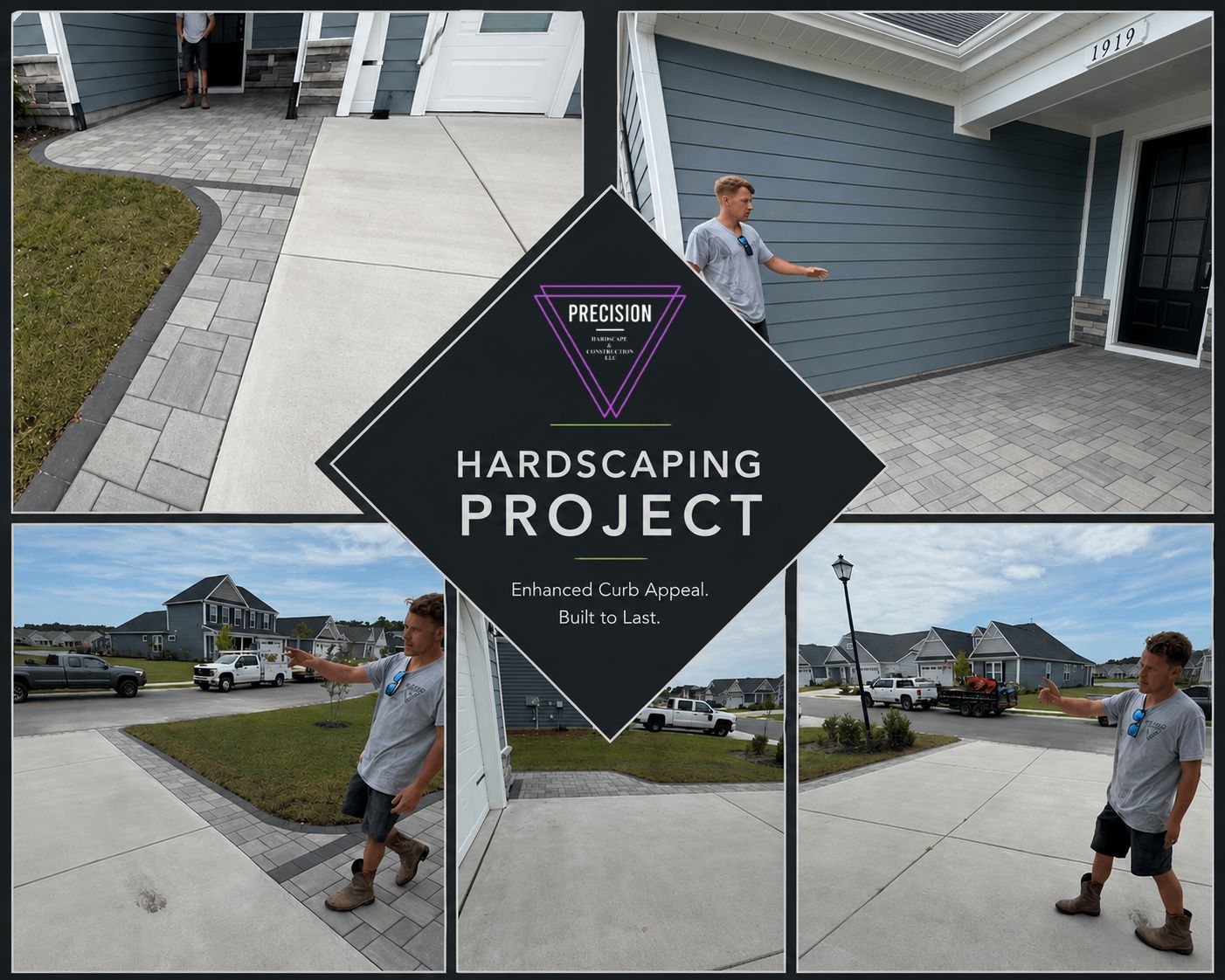
Matt Jones of Precision Hardscape & Construction recently completed a paver driveway extension for a homeowner in coastal Carolina — widening both sides of an existing concrete driveway, adding a paved path to the trash enclosure, and completely changing how the front of the home looks and functions.
A lot of homeowners never think about their driveway until it becomes a problem. Car doors swinging open into the lawn. Mulch tracking onto concrete every time someone gets out of a truck. Nowhere to pull off to the side when two vehicles need to pass. The driveway works — technically — but it’s tight, awkward, and does nothing for how the home looks from the street.
That’s exactly the situation Matt walked into on a recent project. The homeowner had a standard concrete driveway — functional, plain, and a little narrow for real everyday use. What they ended up with after Precision Hardscape & Construction finished the job was a wider, better-defined driveway with pavers running along both sides, a paved connection leading to the trash enclosure, and a front elevation that looked intentional rather than just poured-and-forgotten.
In this article, we’re going to break down what a driveway extension actually involves, why pavers are often the best material for widening an existing concrete driveway, what the installation process looks like, and how this kind of upgrade adds both function and value to a coastal Carolina home.
In This Article
- The Project Matt Walks Through in the Video
- Why Homeowners Extend Their Driveways
- Why Pavers Work So Well Alongside Existing Concrete
- How a Paver Driveway Extension Is Built
- Coastal Carolina Considerations for Driveway Projects
- The Curb Appeal Factor
- Common Mistakes to Avoid
- FAQ: Driveway Extensions in Coastal Carolina
- Work With Precision Hardscape & Construction
The Project Matt Walks Through in the Video
In the video walkthrough, Matt Jones gives a quick tour of the finished job the morning after completion. The before-state was a standard concrete driveway — wide enough for one car, with nothing on either side. The after-state tells a completely different story.
Precision Hardscape added a two-foot paver extension on the left side of the driveway and a two-foot paver extension on the right side. That might not sound like much until you’re actually standing there — two additional feet of usable, solid surface on each side of the car means you can open doors fully, step out without planting your foot in the grass, and move around the vehicle without squeezing past a bumper.
Beyond the driveway itself, the crew also installed a paved addition running from the driveway to the trash enclosure. This is one of those small details that makes a real difference in day-to-day livability. Dragging a trash bin across wet grass or loose mulch on a rainy morning is an annoyance. Having a clean, solid path to get to it makes the whole front of the property feel more finished and thought-out.
The home had an existing large stoop at the entry — and with the paver extension tying everything together, the entire front of the house now reads as a cohesive hardscape design rather than a plain slab next to a lawn.
As Matt put it in the walkthrough: “You can see it definitely helped this property out a lot and gave it more space up here on the driveway to step out the vehicle or even a little extra parking.”
Why Homeowners Extend Their Driveways
Driveway extensions are one of the most practical hardscape upgrades available, and they’re especially common in newer coastal Carolina subdivisions where builder-grade driveways are installed to minimum spec — just wide enough to meet code, not necessarily wide enough for comfortable real-world use.
Here are the most common reasons homeowners in Little River, Calabash, Sunset Beach, and the surrounding area call about driveway extensions:
Not Enough Room to Open Car Doors Fully
This is probably the most universal complaint. A standard single-car width driveway forces you to angle the door into the lawn, step into mulch, or squeeze past landscaping every time you get out of the vehicle. Two extra feet on either side eliminates that entirely.
Needing Space for a Second Vehicle
Not every household wants to build a full second driveway lane, but a widened extension can often accommodate a second car parked alongside the first — especially when the extension runs the full depth of the parking area.
Improving Access to Side Gates, Trash Areas, or Side Doors
This is exactly what happened on this project — adding a paved path to the trash enclosure. A similar approach works for side yard gates, detached garages, or secondary entry points. Instead of wearing a mud trail across the lawn, you get a clean, defined route.
Purely for Curb Appeal
Even when the driveway is technically functional, many homeowners want the front of the home to look more finished. A plain concrete slab surrounded by lawn is the default — a paver border or extension elevates it to something that looks designed.
Increasing Property Value Before a Sale
First impressions matter in real estate. A well-executed paver driveway extension is one of the highest-visibility improvements you can make to the front of a home, and it signals to buyers that the property has been maintained and upgraded with quality materials.
Why Pavers Work So Well Alongside Existing Concrete
One of the first questions homeowners ask is: why not just pour more concrete? It’s a fair question. Concrete is familiar, durable, and relatively inexpensive. But when you’re extending an existing concrete driveway, pavers almost always produce a better result — for several practical reasons.
No Awkward Seams or Color Mismatches
Fresh concrete poured next to old concrete never matches. The new section will be noticeably lighter or darker, and even after years of weathering, the seam between old and new is visible. Pavers don’t have this problem — they create a distinct visual border that reads as intentional design rather than a patch job.
A Finished, Designed Look
Pavers bring texture, color variation, and pattern to a driveway in a way that poured concrete simply can’t. The gray tones in a quality paver complement the cool gray of existing concrete beautifully, and the joint lines add visual interest that makes the whole driveway look more intentional.
Flexibility and Repairability
If a utility line ever needs to be accessed below the surface, or if settling causes a low spot over time, individual pavers can be lifted, the base corrected, and the surface relaid without jackhammering and repouring an entire section. With concrete extensions, any repair leaves a visible scar.
Better Drainage Behavior
In coastal Carolina — where heavy rain events are common and many neighborhoods sit on sandy soil — drainage is always a consideration. Paver joints allow some water infiltration and help direct flow in ways that a solid concrete slab may not. When properly graded, a paver extension can actually improve surface drainage rather than creating a new runoff problem.
For more on how Precision Hardscape approaches drainage as part of every installation, see our drainage solutions page.
How a Paver Driveway Extension Is Built
A driveway extension isn’t complicated, but it does require proper execution at every layer. The difference between a paver extension that holds up for twenty years and one that starts rocking and shifting inside of three is almost entirely in the base preparation — something that’s easy to cut corners on and very hard to fix later without pulling everything up.
Step 1: Excavation
The existing ground is excavated to a depth that accommodates the gravel base, bedding sand layer, and paver thickness — typically around 6 to 8 inches below finished grade for a driveway application. In coastal Carolina’s sandy soil, proper depth and compaction are especially important because loose sandy ground has very little natural load-bearing capacity on its own.
Step 2: Gravel Base Installation and Compaction
A crushed stone base is installed in lifts and compacted with a plate compactor. This is the foundation that everything above it depends on. A properly compacted gravel base distributes the weight of vehicles evenly and prevents the differential settling that causes pavers to rock or develop lips over time.
Step 3: Edge Restraint Installation
Plastic or metal edge restraints are spiked into the ground along the outer perimeter of the paver area. These are critical — without them, the pavers on the edges gradually migrate outward over time, opening joints and creating an unstable surface. Edge restraints lock the whole field in place.
Step 4: Bedding Sand and Screeding
A layer of coarse bedding sand — typically about one inch — is spread over the compacted base and screeded to a consistent depth and grade. The pavers sit directly on this layer, which allows for minor elevation adjustments and helps the pavers seat evenly.
Step 5: Paver Installation and Cutting
Pavers are laid in the chosen pattern, cut precisely at edges where they meet the existing concrete or the perimeter restraints. The transition where new pavers meet the existing concrete driveway is one of the most visible details in a driveway extension — clean cuts and tight joints here make the finished project look polished rather than patched.
Step 6: Joint Sand and Compaction
Polymeric jointing sand is swept into the joints and the surface is run over with a plate compactor to set the pavers into the bedding layer. The polymeric sand hardens slightly when wet, locking the joints against ant intrusion, weed seed germination, and erosion while still allowing the minimal flex that makes pavers so durable under load.
🏗️
Proper Base Depth
6–8 inches of excavation for driveway-load applications in coastal Carolina’s sandy soil.
🔒
Edge Restraints
Spiked perimeter restraints prevent edge migration and keep the surface locked in for the long term.
💧
Drainage-Aware Grading
Every extension is graded to move water away from the home’s foundation and off the driveway surface.
✂️
Clean Cuts at Transitions
Precise cuts where pavers meet existing concrete define the quality of the finished job.
Coastal Carolina Considerations for Driveway Projects
Installing hardscape in the coastal Carolinas involves a few conditions that don’t apply everywhere. If you’re in Little River, Calabash, Sunset Beach, Ocean Isle Beach, or any of the surrounding communities, these factors should inform how your driveway extension is designed and built.
Sandy Soil Requires More Base Work
Sandy coastal soil compacts well but has much lower bearing capacity than clay or loam. This means the gravel base layer needs to be adequate depth and thoroughly compacted before any bedding sand or pavers go down. Contractors who shortcut base preparation because “it’s just a driveway extension” create problems that show up within a few years — rocking pavers, settled edges, and open joints.
Heavy Rain Events Demand Good Grading
Coastal Carolina gets significant rainfall, often in intense events rather than slow steady rain. A driveway extension that isn’t graded properly will pond water, push it toward the foundation, or send it across the lawn in uncontrolled sheets. Every project Precision Hardscape builds is graded with drainage as a primary design consideration — not an afterthought.
Newer Subdivision Driveways Are Often Minimum-Spec
Many of the newer developments in Brunswick County, Horry County, and the Grand Strand area were built with builder-grade driveways — just wide enough to meet the subdivision’s minimum requirements. That’s fine for the builder, but it often means homeowners are living with a driveway that doesn’t actually suit the way they use the property. Driveway extensions are one of the most common requests Precision Hardscape gets from homeowners in these subdivisions.
HOA Considerations
If your home is in an HOA-governed community — as many coastal Carolina developments are — check your HOA documents before starting any driveway project. Most HOAs have guidelines on approved materials, colors, and impervious surface limits. Precision Hardscape can help you navigate this and select pavers that will meet HOA aesthetic requirements while still delivering the practical upgrade you’re after.
The Curb Appeal Factor
It’s worth spending a moment on what this type of project actually does for how a home looks — because the impact is bigger than most homeowners expect before they see it finished.
A plain concrete driveway is a starting point, not a design statement. It gets the job done, but it doesn’t do anything to define the property or make the home feel well-considered from the street. When you add a paver extension — even a modest two-foot border on each side — the whole front elevation changes.
The paver texture and color add visual weight to the driveway that makes it feel like it was designed rather than poured. The transition where pavers meet concrete creates a defined edge that frames the driveway and connects it visually to the rest of the front yard hardscape. And when the extension ties into a walkway to the front entry or a paved path to a side gate, the effect compounds — suddenly the whole front of the home has a cohesive hardscape design rather than a series of disconnected elements.
In the project Matt walked through, the connection between the driveway extension and the existing stoop at the front entry is what makes the design work. The pavers create a visual thread that ties everything at the front of the home together.
For homeowners who are also thinking about paver walkways, front entry upgrades, or broader front-of-home hardscape design, our paver walkways and driveway services page is a good place to explore the full picture of what’s possible.
Common Mistakes to Avoid With Driveway Extensions
Most driveway extension problems trace back to one of a handful of avoidable mistakes. If you’re planning a project — or evaluating quotes from contractors — these are the things worth paying attention to.
Insufficient Base Depth
The most common shortcut in paver installation is not going deep enough with the base. In a coastal Carolina sandy soil context, this is especially problematic. A base that’s been undersized will settle unevenly, causing pavers to rock, dip, or develop tripping hazards within a few years. Ask your contractor specifically what base depth they’re planning and why.
No Edge Restraints
Some contractors skip edge restraints to save time and materials. This is a false economy. Without edge restraints, the outer rows of pavers migrate outward over time, especially under vehicle loading. The joints open, the surface destabilizes, and eventually the whole edge needs to be reset.
Poor Grading Away From the Foundation
Every paved surface near a home should slope away from the foundation. An extension that grades back toward the house — even slightly — will direct rainfall toward the foundation, increasing the risk of moisture intrusion, mold, and long-term structural issues. This is a basic installation standard, but it requires intentional planning at the layout stage.
Using Walkway Pavers for a Driveway Application
Not all pavers are rated for vehicular load. Pavers designed for walkways and patios are typically thinner than pavers designed for driveways. Using the wrong product in a driveway application can result in cracking and failure under repeated vehicle weight. Always confirm that the pavers specified for your extension are rated for driveway use.
Choosing Based on Price Alone
A very low quote for a paver driveway extension is almost always a sign that something’s being cut — usually the base work, which you won’t be able to see once the job is done. The base is where the work happens, and it’s what determines whether your extension holds up for five years or twenty. It’s worth asking detailed questions about what the base preparation involves before signing anything.
FAQ: Driveway Extensions in Coastal Carolina
Cost varies depending on the size of the extension, the paver product selected, and site conditions like access and existing grades. Because paver extensions involve excavation, base material, edge restraints, bedding sand, pavers, and jointing material — all installed by a trained crew — they’re a professional installation, not a DIY project. The best way to get an accurate number is to call Matt at (843) 222-5377 for a site visit and quote.
For comfort — meaning enough room to fully open a car door and step out without stepping onto a lawn or landscape bed — two feet on each side of an existing driveway is the minimum that makes a noticeable difference. If you’re adding space for a second vehicle or widening for truck access, more may be appropriate. The right answer depends on your specific driveway, vehicles, and yard layout.
Yes, and this is actually one of the most common applications. The existing concrete acts as a natural edge restraint on one side, and the pavers are installed with their own base preparation beside it. The key is ensuring the paver surface is finished flush with or very slightly above the concrete edge — not below it where water can pool, and not so far above it that there’s a trip hazard at the transition.
A properly installed paver driveway extension should last 20 to 30 years or more with normal maintenance. The lifespan is almost entirely determined by the quality of the base preparation. Pavers themselves are extremely durable — it’s the base that makes or breaks longevity. Individual pavers that crack or settle can be replaced without disturbing the rest of the surface.
Permit requirements vary by municipality and county. In some areas, small driveway additions don’t require a permit. In others, any expansion of impervious surface — including pavers — may require review. HOA communities may also have their own approval process separate from municipal requirements. Precision Hardscape can help you understand what’s required in your specific location.
Gray-toned pavers — ranging from warm charcoal to cool slate — are the most popular choice for extending existing concrete driveways because they complement without matching. The goal is usually to create a defined visual border, not to blend the pavers into the concrete. Products in charcoal gray, ash gray, or mixed-tone blends tend to photograph well and hold their appearance over time.
Precision Hardscape & Construction serves homeowners throughout the coastal Carolinas, including Little River SC, Calabash NC, Sunset Beach NC, North Myrtle Beach SC, Myrtle Beach SC, Ocean Isle Beach NC, Shallotte NC, and Longs SC. Call (843) 222-5377 to confirm service availability for your specific location.
Ready to Expand Your Driveway?
Whether you need a two-foot border on each side, a full driveway widening, or a paved path to a side gate or trash enclosure, Matt Jones and the Precision Hardscape team can help. Every project starts with a site visit so you can see exactly what’s possible and get a straight number — no guesswork.
(843) 222-5377
Precision Hardscape & Construction LLC — Matt Jones
Serving homeowners in Little River, Calabash, Sunset Beach, North Myrtle Beach, Myrtle Beach, Ocean Isle Beach, Shallotte, and Longs.