
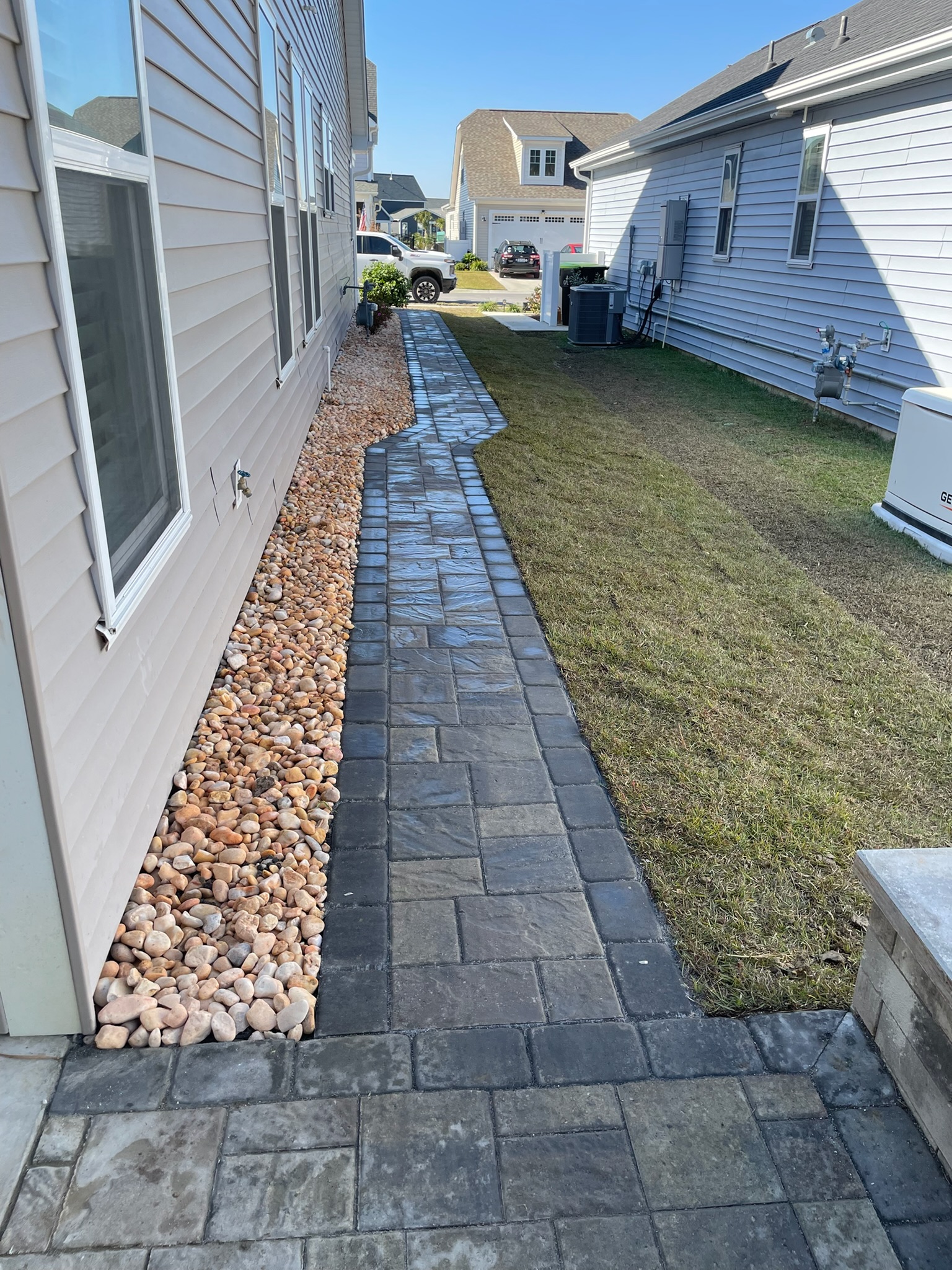
Every yard has that one route — the worn dirt line to the trash cans, the muddy strip beside the house, the shortcut across the lawn everyone takes anyway. A paver walkway takes the path your family already walks and makes it permanent, clean, and good-looking. Here’s how we design and build walkways for homes in Little River, Calabash, Sunset Beach, and across the coastal Carolinas.
Walkways don’t get the attention patios do, but ask anyone who’s lived with a good one: it’s the hardscape they use the most. It’s the dry-shoes route to the garden hose in January, the clean path guests follow around the house instead of tracking through the garage, the connection that makes a backyard fire pit feel like part of the property instead of an island in the grass.
In our part of the Carolinas, walkways also solve a problem that almost every house here shares: the side yard. Narrow, shaded, squeezed between the house and the fence, catching all the roof runoff — it’s the strip where grass gives up and mud takes over. Some of our favorite recent projects turned exactly those spaces into the best-looking few feet on the property. This article covers where walkways earn their keep, how we build them to stay flat in sandy soil, and the design decisions that separate a path that looks custom from one that looks like an afterthought.
In This Article
- The Side-Yard Problem (and the Walkway That Fixes It)
- Where Walkways Earn Their Keep Around a Coastal Home
- Design Choices: Width, Curves, Borders, and Color
- How a Paver Walkway Is Built to Stay Flat in Sandy Soil
- Walkways on Slopes: Steps, Walls, and Grade Changes
- What Maintenance Really Looks Like
- Frequently Asked Questions
The Side-Yard Problem (and the Walkway That Fixes It)
Walk through any neighborhood in North Myrtle Beach or Sunset Beach and look between the houses. You’ll see the same thing over and over: a narrow strip of ground that’s part mud, part struggling grass, part exposed roots — because between the shade of two houses and the concentrated runoff from two rooflines, turf never had a chance there.
On a recent project, we took a side yard exactly like that and rebuilt it as a system: a paver walkway with a contrasting border running the length of the house, flanked by river rock beds against the foundation. The walkway gives the homeowners a clean, level route from front yard to back in any weather. The rock beds catch and disperse roof runoff so it stops carving channels in the soil. And the strip that used to be the ugliest part of the property now looks deliberately designed — because it is. If you like that pairing, we broke down the rock side of it in our guide to decorative rock landscaping for coastal homes.
That combination — hard surface for feet, rock for water — is one of the most practical upgrades we install, and it works on nearly every side yard in the area.
Where Walkways Earn Their Keep Around a Coastal Home
The best walkway layout starts with an honest look at how you already move around the property. These are the routes we’re asked to build most:
Front Entry Walks
Driveway to front door. The first hardscape guests touch — and the one that sets the tone for the whole house.
Side-Yard Connectors
Front to back without cutting through the garage — and no more mud strip beside the house.
Destination Paths
Patio to fire pit, porch to garden, pool to gate. Paths that tie backyard features into one connected space.
Utility Routes
Trash cans, HVAC units, sheds, hose bibs. Unglamorous — and used every single day.
One pattern we see constantly in golf-course and pond-lot communities around Calabash and Longs: the fence-line path. Homeowners with aluminum fencing want a clean route along it — to a gate, a dock, or just around the perimeter — and a curved paver path with a contrasting border turns the fence line into a feature you see from every window on that side of the house.
Design Choices: Width, Curves, Borders, and Color
Width
A comfortable single-file path runs about three feet; four feet lets two people walk together and feels noticeably more generous. Utility routes can be narrower; front entry walks should rarely be. In a tight side yard, we typically run the walk as wide as the space allows and let rock or planting beds take up the remainder — a slightly wider path with slim beds reads better than a skinny ribbon floating in mulch.
Curves
Straight walks read formal and work well along fences and foundations. Gentle curves read custom and relaxed — and they’re practical, letting the path swing around trees, utilities, and downspouts without awkward jogs. The rule we follow: curve with a reason. A path that wanders for the sake of wandering annoys the people who walk it twice a day.
Borders
A contrasting border course — charcoal against a tan field, for example — is the single design move that most makes a walkway look finished. It frames the path, hides minor edge cuts, and visually ties the walk to other borders on the property, like a patio band or driveway edge. Most of the walkways we build get one.
Color and Texture
Coastal light is bright, and lighter paver blends stay cooler underfoot and hide pollen and salt-air dust better than very dark surfaces. We usually pull tones from the house — brick, siding, roof — so the path looks like it was always part of the plan rather than a catalog choice dropped into the yard.
How a Paver Walkway Is Built to Stay Flat in Sandy Soil
A walkway that dips, heaves, or grows gaps between pavers wasn’t built wrong at the surface — it was built wrong underneath. Our process is the same discipline we bring to patios, scaled to the path:
Excavation. We dig out the full footprint below the organic layer. Roots and topsoil left under a path are future low spots — they decompose and settle, and the pavers follow.
Compacted stone base. Crushed stone goes in and gets mechanically compacted in lifts. In sandy coastal ground this base is what spreads foot traffic and cart loads so individual pavers can’t rock or sink. It’s also where we build in the pitch, so the finished walk sheds rain instead of holding puddles.
Bedding, laying, and edge restraint. A screeded bedding layer of sand, then the pavers in the chosen pattern with border courses set first. Edge restraint along every open side is non-negotiable — it’s what keeps the field locked tight so joints can’t spread. Walkways have more edge per square foot than any other hardscape, which is exactly why cheap paths fail at the edges first.
Joint sand and compaction. Sand is swept and vibrated into the joints, locking the surface into a single flexible unit. That flexibility is pavers’ quiet superpower in our soil: the surface can accommodate tiny ground movements without cracking, which is more than a thin poured path can say. (For big utility runs and driveways, poured concrete still has its place — we compared the two honestly in our concrete driveways and walkways guide.)
Walkways on Slopes: Steps, Walls, and Grade Changes
Not every lot is flat, even at the beach. When a walkway has to travel downhill — from a raised deck to the yard, or across a sloped side lot — the path becomes a small engineering project.
Gentle grades can be handled with the pitch of the path itself. Steeper transitions call for built paver steps, and cross-slopes often need a low wall on the downhill side to hold the path level. On one sloped project, we ran the walkway from the deck stairs down along the fence with a low retaining wall carrying the downhill edge — the path stays level and dry, the slope stays put, and the wall doubles as a clean border for the planting bed above it. If your path problem is really a slope problem, our article on retaining walls and garden walls covers that side of the build.
What Maintenance Really Looks Like
A properly built paver walkway asks very little of you. Sweep it. Rinse it when pollen season paints everything yellow. Top up joint sand every few years, and consider sealing if you want colors to stay rich and joints extra-firm. If something heavy ever does leave a low spot, individual pavers lift out, the bedding gets releveled, and the same pavers go back — no patches, no color mismatch, no saw cutting. That repairability is a real long-term advantage over monolithic surfaces.
You can see finished walkways — side-yard runs, fence-line curves, and slope builds — throughout our project gallery, and the full range of what we build on our services page.
Frequently Asked Questions
Ready to Improve Your Outdoor Space?
If you’re picturing a paver walkway, side-yard path, or garden path for a home in Little River, Calabash, Sunset Beach, North Myrtle Beach, Ocean Isle Beach, Shallotte, Longs, or Myrtle Beach, call Matt Jones and walk the route with him — he’ll tell you exactly what it takes to build it right.
Precision Hardscape & Construction LLC — built right the first time.