
Paver Landing and Steps: How a Custom Entry Transforms Your Backyard
Most homeowners think about the patio itself — the size, the pattern, the color. But there’s one element that can make or break how the whole space feels the moment you step outside: the landing and steps.
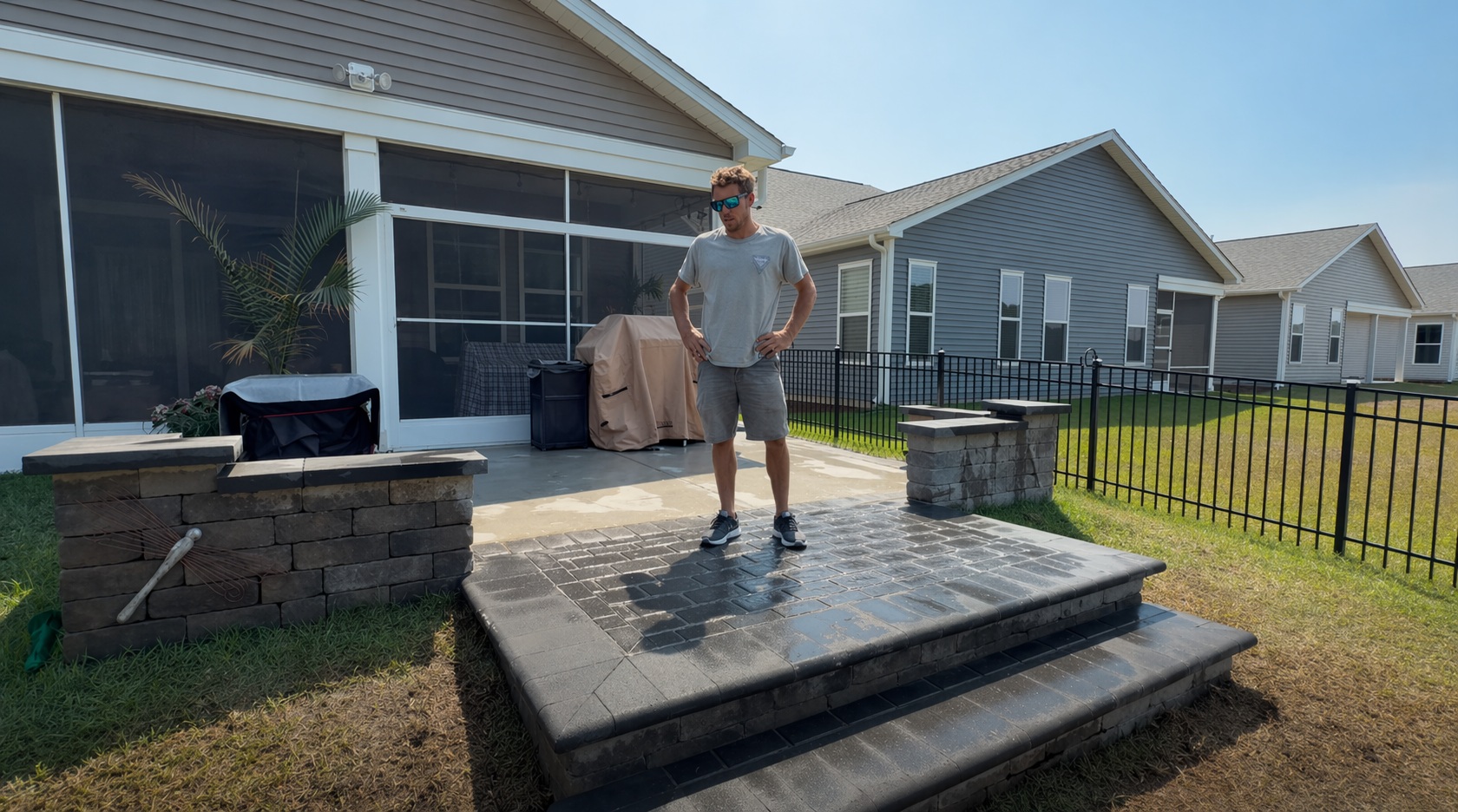
We recently wrapped up a project for a homeowner here in the Myrtle Beach area that’s a great example of how much a well-built paver landing changes the character of a backyard. The client had an existing concrete porch but needed a proper outdoor entry — something that felt intentional, looked sharp, and gave their family a comfortable, wide step to land on every time they walked out the back door.
Here’s a look at what we built, why we made the choices we did, and what you should know if you’re thinking about adding paver steps or a landing to your own home.
The Project: A Custom Charcoal Paver Landing with Full-Nose Coping
The goal was to build a raised paver landing that would serve as a real entry point off the screened porch — something that sits slightly above grade, anchors the back of the home visually, and makes it easy and safe to step down into the yard.
We used charcoal gray midnight pavers for the landing surface itself. That deep, cool tone works particularly well in coastal Carolina backyards — it reads as sophisticated without competing with the home’s siding or the surrounding landscape.
For the front edge of the step, we installed bell guard full-nose coping. Coping is the finished edge piece — it gives the step a clean, rounded lip that’s easy on the eye and safer underfoot than a sharp cut edge. The full-nose profile wraps around the face of the step, which is the detail that separates a polished installation from something that just looks like stacked blocks.
On the bottom step, we added a row of four-inch Holland pavers behind the coping to widen the tread. This is one of those small decisions that makes a big difference in everyday use. A wider tread gives you more room to plant your foot comfortably, which is especially important for families with kids or anyone navigating the step with something in their hands.
Why a Paver Landing Is More Than Just a Step
When you step out of a screened porch or back door, you need somewhere to actually land before you’re down in the yard. That in-between space — the platform between your door threshold and the grass — is a landing, and it does more work than most people realize.
A well-designed landing gives you a flat, stable surface to pause on. It keeps foot traffic from wearing a muddy path right at the exit. It creates a visual anchor that makes your porch or patio look intentional and finished. And when it’s built from pavers, it’s going to hold up for decades — even in coastal conditions where the ground shifts, water moves, and humidity takes a toll on lesser materials.
Homes in the Myrtle Beach, North Myrtle Beach, and Little River area deal with a lot of rain and sandy soil. Without a stable, properly compacted base under a landing, you’ll see settling — edges that drop, gaps that open up, or steps that tip forward. That’s why the base preparation matters just as much as what you see on top.
What Is Paver Coping — and Why Does It Matter?
Coping is the finishing piece along the exposed front edge of a paver step. On this project we used a full-nose coping profile, which means the top surface rounds over and continues down the face of the step. It’s sometimes called a bullnose edge.
Here’s why coping is worth paying attention to:
- Safety. A rounded edge is less likely to catch a toe or cause a trip than a sharp cut edge, especially on an outdoor step where bare feet are common in the summer.
- Durability. Sharp cut edges on pavers chip over time, especially in outdoor environments. A formed coping piece is designed to take edge wear.
- Appearance. Coping gives the step a finished, intentional look. Without it, steps can look like they just stopped — like a block wall that was never completed.
- Water management. The rounded profile helps direct water off the edge of the step rather than letting it pool at the nose, which matters a lot in a climate with as much rainfall as coastal Carolina gets.
On this project, the bell guard coping matched the charcoal midnight pavers both in color and texture, so the whole step reads as a single, cohesive unit.
Tread Depth: The Detail That Changes How Steps Feel
On this project, we extended the bottom step tread by adding a row of four-inch Holland pavers behind the coping. This widened the surface you actually step on — which is called the tread depth.
In residential construction, there are minimum tread depth standards for a reason: a step that’s too shallow feels uncomfortable and increases the risk of slipping. Outdoor paver steps are a little more forgiving than interior stairs because you’re not descending a full staircase, but tread depth still matters — especially on a raised landing where the step is the main transition between two elevations.
A deeper tread also gives you visual weight. The step looks more substantial, more like part of the architecture and less like an afterthought tacked onto the edge of the landing.
This is the kind of detail that clients often notice without being able to name it. The step just feels right. That’s usually the sign of a good design decision.
Building Paver Steps Alongside Existing Concrete
One common situation we see in the Myrtle Beach area: a homeowner has an existing concrete porch or patio that’s in decent shape, but there’s no real transition to the yard — just a concrete edge that drops off to the grass.
In those cases, a paver landing built in front of the existing concrete can solve the problem cleanly. You don’t need to tear out the concrete. The new paver landing connects to the existing slab, creates a finished outdoor entry, and adds a step down to yard level.
The key is making sure the paver base is properly installed so the landing doesn’t settle away from the concrete over time. This is where compacted gravel base depth and edging restraints matter — both of which are standard parts of a professional installation.
Pavers and concrete coexist well when the transition is handled thoughtfully. The paver surface actually has an advantage in coastal conditions because it’s a flexible system — individual units can absorb minor ground movement without cracking, unlike a solid concrete slab that can develop stress fractures.
Designing Paver Steps for Coastal Carolina Homes
If you’re considering a paver landing or steps for your home in the Myrtle Beach, Sunset Beach, or Ocean Isle Beach area, a few design considerations are worth thinking through before you start.
Paver Color and the Coastal Environment
Lighter pavers show salt residue and pollen more visibly. Darker tones like charcoal and midnight gray tend to stay looking clean longer between washes and wear better visually in a coastal landscape that already has a lot of competing colors — green grass, blue sky, beige siding. They also tend to complement black aluminum fencing, which is common in newer coastal Carolina neighborhoods.
Landing Size
A landing that’s too small feels uncomfortable — you step out and immediately have to step down, which defeats the purpose. A good rule of thumb for a residential back-door landing is at least five feet of clear depth, so two people can stand on it comfortably or you can set something down while you fish for your keys.
Step Rise
The rise — the vertical height of each step — should typically fall between six and seven and a half inches for outdoor steps. Too low and the step looks odd and can catch water. Too high and it’s uncomfortable to climb, especially for older family members or guests.
Drainage
Any paved surface needs to slope slightly away from the house — typically an eighth of an inch per foot is the standard. This keeps water from pooling at your door and from working under the porch structure. In coastal areas where heavy rain is a regular occurrence, getting drainage right from the start saves a lot of headaches down the road.
The Difference a Proper Entry Makes
It’s easy to underestimate how much a well-built paver landing changes the way you experience your own backyard. When you step outside and land on a solid, level paver surface — something that looks like it belongs there — the whole space feels more complete.
For the client on this project, the landing tied together their screened porch, their backyard fence, and the open lawn area in a way that gave the whole yard a sense of flow and purpose. That’s the goal with every paver landing we install — not just to build steps, but to create a transition that makes the space feel cohesive from every angle.
From a property value standpoint, curb appeal improvements — even in the backyard — consistently return solid value. A finished paver entry with professional coping and well-proportioned steps signals to any future buyer that the home has been cared for and thoughtfully maintained.
Thinking About Paver Steps or a Landing for Your Home?
Whether you need a simple step off your porch or a full custom landing with coping and masonry columns, Precision Hardscape & Construction LLC can build it right. We work with homeowners across Myrtle Beach, North Myrtle Beach, Little River, Longs, Calabash, Sunset Beach, Ocean Isle Beach, and Shallotte.
(843) 222-5377
Call or text to discuss your project