
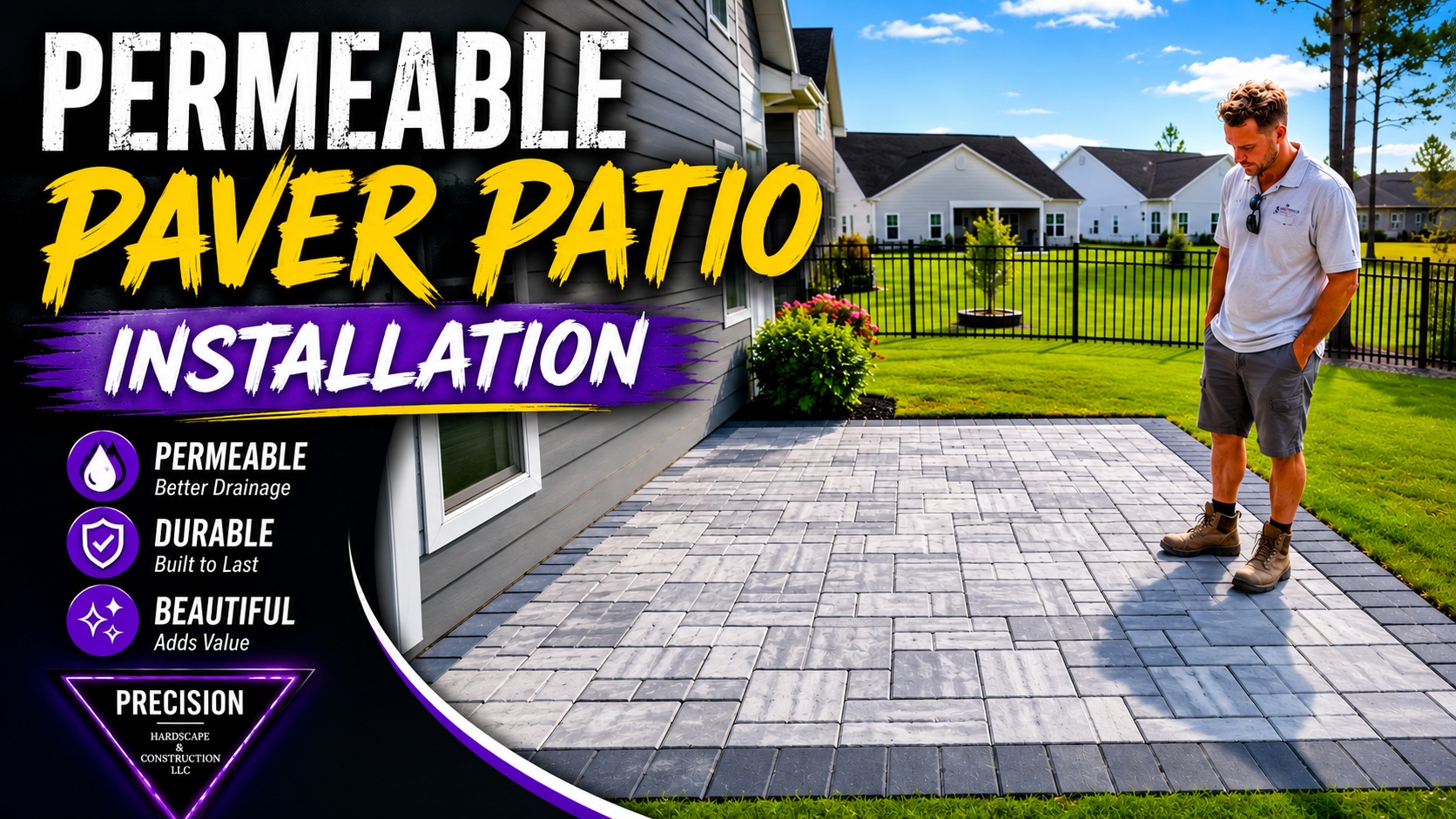
Project Spotlight
Matt Jones of Precision Hardscape & Construction recently completed a permeable paver patio in Sunset Beach, NC — an installation where proper drainage isn’t just good practice, it’s a local requirement. The result: a clean, functional outdoor living space that handles water the right way from the ground up.
Drainage is the issue that drives more hardscape decisions in coastal Carolina than almost anything else. It shapes what materials get used, how a base gets built, and whether a finished patio holds up long-term or starts causing problems the first time a heavy rain rolls through. In some communities along the coast, it’s not just a best practice — it’s required by local ordinance before a permit gets issued.
That was exactly the situation on this project. The homeowner in Sunset Beach wanted a patio off the back of the house — somewhere to grill, hang out, and add real usable space to the yard. But Sunset Beach has drainage requirements that dictate how hardscape installations handle stormwater. A standard patio with a solid base and surface runoff alone wasn’t going to meet the standard. The solution was a permeable paver installation: pavers set over a clean open-graded gravel base that allows water to pass straight through the surface and infiltrate into the ground below, rather than sheeting off across the yard.
In this article we’re going to break down what permeable paver patios actually are, why they matter in a coastal environment, how they’re built correctly, and what the difference looks like between a permeable installation done right and one that fails quietly over time.
In This Article
- The Project Matt Walks Through in the Video
- What Permeable Pavers Actually Are
- Why Permeable Hardscape Matters in Coastal Carolina
- How a Permeable Paver Patio Is Built
- Permeable vs. Standard Paver Patio: What’s the Difference?
- Sunset Beach and Coastal Carolina Drainage Requirements
- Does Permeable Mean Less Attractive? Not Even Close.
- Common Mistakes That Make Permeable Patios Fail
- FAQ: Permeable Paver Patios in Coastal Carolina
- Work With Precision Hardscape & Construction
The Project Matt Walks Through in the Video
In the video, Matt Jones gives a quick walkthrough of a just-completed patio project at a home in Sunset Beach. The patio is a clean, open-air slab off the back and side of the house — a practical outdoor space for grilling, relaxing, and actually using the yard.
What makes this project notable isn’t just the finished look — it’s what’s underneath. The entire installation was built as a permeable system: pavers set over a clean open-graded gravel base that allows rainwater to pass straight through the surface rather than running off across the yard. As Matt explains in the video, in Sunset Beach that’s not optional. It’s a requirement. Local drainage standards mean that new hardscape installations need to handle stormwater on-site, and a permeable paver system is one of the most effective ways to meet that standard while still delivering a finished outdoor living space the homeowner can actually enjoy.
Looking at the photos, the patio is large enough to serve as a genuine outdoor living area — plenty of room to set up seating, run a grill, and move around comfortably. The paver color is a cool gray with natural variation in tone, which reads well against the blue-gray siding of the home. The installation runs tight to the house foundation and extends out into the yard with clean, defined edges.
One detail visible in the close-up photo is the flexible drainage pipe at the base of the downspout near the back door — a reminder that this entire project was designed around water management, not just aesthetics. The patio surface, the base, and the site drainage all work together as a system.
As Matt put it: “We got our clean gravel base, and this thing is waterproof — water can run right through it. No drainage issues, and in Sunset Beach that is a requirement.”
What Permeable Pavers Actually Are
Permeable pavers are a hardscape system designed to allow water to pass through the surface and into the ground below, rather than running off across the yard or into storm drains. The concept sounds simple — and the finished surface looks like any other paver patio — but the engineering underneath is what makes it work.
There are two main approaches to permeable paver systems:
Permeable Paver Units
Some permeable systems use specially designed paver units that have built-in gaps, channels, or a porous concrete body that allows water to infiltrate through the paver face itself. These are common in commercial and municipal applications.
Standard Pavers Over an Open-Graded Base
The more common residential approach — and what Precision Hardscape used on this Sunset Beach project — is installing standard concrete pavers over an open-graded clean gravel base, with wider joints filled with clean stone rather than polymeric sand. Water infiltrates through the joints between the pavers and drains into the gravel reservoir below, where it slowly percolates into the soil. This approach delivers full permeability using familiar, durable paver products that look identical to a standard patio.
The key distinction from a standard paver installation is the base. A conventional paved patio uses a compacted dense-graded aggregate base — tightly packed stone that sheds water rather than absorbing it. A permeable system uses clean, single-sized crushed stone (sometimes called “clean stone” or “washed stone”) that has no fine particles to clog the voids. That open structure is what creates the drainage reservoir beneath the surface.
Why Permeable Hardscape Matters in Coastal Carolina
Coastal Carolina isn’t the easiest environment for hardscape. The combination of sandy soil, a high water table in many areas, intense seasonal rainfall, and relatively flat topography creates drainage challenges that homeowners in other parts of the country simply don’t deal with to the same degree. Add in the fact that most newer coastal developments were built on land that was previously wetland, scrubland, or forest — with natural infiltration capacity that disappears once a neighborhood goes in — and stormwater management becomes a real issue at the community level.
Sandy Soil Has High Infiltration Capacity — When You Don’t Block It
The good news about coastal Carolina’s sandy soil is that it actually drains very well when water can reach it. The problem with conventional hardscape is that it intercepts rainfall before it ever gets to the soil — shedding it across the surface and concentrating runoff into low spots, swales, and neighbors’ yards. A permeable system works with the soil’s natural capacity rather than around it, letting rain infiltrate where it lands instead of sending it somewhere else.
Reducing Runoff Reduces Problems Downstream
Every square foot of impervious surface — concrete, standard asphalt, conventional pavers — adds to the volume of runoff that has to go somewhere after a storm. In densely developed coastal communities, that runoff ends up in drainage swales, retention ponds, and ultimately coastal waterways. Permeable hardscape reduces the homeowner’s contribution to that runoff, which matters both for the individual yard and for the broader watershed.
Foundation Protection
One of the most practical benefits of a permeable patio installed close to the house — like the Sunset Beach project — is that it doesn’t concentrate water against the foundation. Conventional patios that slope back toward the house, or that shed so much runoff that the perimeter becomes saturated, accelerate moisture intrusion and long-term foundation problems. A permeable system infiltrates water in place, reducing the pressure on the foundation perimeter.
For homeowners dealing with existing drainage issues around the yard or foundation, our drainage solutions page covers the full range of options Precision Hardscape installs across the coastal Carolina service area.
How a Permeable Paver Patio Is Built
The installation process for a permeable paver patio is similar to a standard installation in sequence but meaningfully different in the materials used at each layer. Getting those material choices right is what makes the system actually work.
Step 1: Excavation
The area is excavated to a depth that accommodates the gravel reservoir, bedding layer, and paver thickness. For a permeable patio, the base is often deeper than a conventional installation — sometimes 8 to 12 inches — because the gravel reservoir needs volume to hold and slowly release water during heavy rain events.
Step 2: Geotextile Fabric
A permeable geotextile fabric is typically installed at the bottom of the excavation and up the sides before the stone goes in. This prevents fine soil particles from migrating up into the gravel reservoir over time, which would gradually clog the voids and reduce infiltration capacity. The fabric is permeable itself — it lets water pass freely while filtering out the fines.
Step 3: Open-Graded Base Installation
Clean, single-sized crushed stone — typically a #57 or #2 washed stone — is installed in the base reservoir. This is the critical difference from a conventional paver base. No compacted dense-graded aggregate, no crusher run, no material with fine particles that would fill the voids. The open structure of clean stone is what creates the drainage capacity. This layer is installed and lightly compacted — enough to stabilize it but not enough to close the voids.
Step 4: Bedding Layer
A thin bedding layer of clean chip stone or coarse aggregate goes on top of the base reservoir. Unlike a conventional installation that uses bedding sand, a permeable system uses chip stone here to maintain the open drainage path all the way up through the profile.
Step 5: Paver Installation
Pavers are laid in the chosen pattern with slightly wider joints than a conventional installation — typically 3/8 inch rather than the standard 1/8 to 1/4 inch. These wider joints are what allows water to enter the system at the surface. Edge restraints are installed at the perimeter to hold everything in place.
Step 6: Joint Fill with Clean Stone
Instead of polymeric jointing sand — which would seal the joints and block infiltration — the joints are filled with clean chip stone or a permeable jointing material. This keeps the entire drainage path open from surface to subgrade.
🪨
Clean Gravel Base
Single-sized washed stone with no fines — the open voids are the drainage system.
🧱
Wider Paver Joints
Slightly wider gaps between pavers let water enter the system at the surface.
🌧️
On-Site Infiltration
Water drains where it lands — no runoff sheeting across the yard or toward the foundation.
📋
Code Compliant
Meets Sunset Beach and coastal Carolina stormwater requirements for new hardscape.
Permeable vs. Standard Paver Patio: What’s the Difference?
From the street — or from a chair on the patio — a permeable paver installation looks identical to a conventional one. The pavers are the same products, the patterns are the same, and the finished surface feels and performs the same underfoot. The difference is entirely in the base and joint system.
| Feature | Standard Paver Patio | Permeable Paver Patio |
|---|---|---|
| Base Material | Compacted dense-graded aggregate | Open-graded clean stone (no fines) |
| Joint Fill | Polymeric sand (seals joints) | Clean chip stone (keeps joints open) |
| Water Behavior | Sheds water across surface | Infiltrates water through surface |
| Runoff Generated | High — sheds most rainfall | Low to zero — infiltrates on-site |
| Stormwater Compliance | May not meet coastal requirements | Meets Sunset Beach and similar codes |
| Surface Appearance | Identical to permeable | Identical to standard |
| Maintenance | Occasional re-sanding of joints | Periodic joint stone top-up; avoid sealing |
The takeaway: if your site or municipality requires permeable hardscape, you’re not giving up anything in terms of how the patio looks or performs as a living space. You’re just choosing a base system that handles water differently — and in coastal Carolina, that difference matters a great deal.
Sunset Beach and Coastal Carolina Drainage Requirements
Sunset Beach, like a number of coastal Carolina communities, has stormwater management requirements that affect what kinds of hardscape installations are permitted. These rules exist because the town sits in a sensitive coastal environment — close to tidal waterways, with limited natural drainage capacity and a high water table that leaves little margin for concentrated runoff.
When a homeowner in Sunset Beach wants to add a patio, driveway extension, or other hardscape feature, the project may need to demonstrate that it doesn’t increase the net impervious surface area of the property — or that it handles stormwater in a way that compensates for the new hardscape. Permeable pavers are one of the most practical ways to meet that standard for a residential patio project.
This isn’t unique to Sunset Beach. Homeowners in Ocean Isle Beach, Calabash, and other coastal Brunswick County communities are increasingly running into similar requirements as local governments tighten stormwater standards in response to development pressure and flooding concerns. And even where it’s not yet required, permeable hardscape is often the smartest design choice for sites that already have drainage challenges.
Know Before You Build
If you’re planning a hardscape project in Sunset Beach, Ocean Isle Beach, Calabash, or anywhere along the Brunswick County coast, it’s worth confirming what stormwater requirements apply to your property before you commit to a design. Precision Hardscape works with homeowners through this process — understanding what the local standards require and designing a system that meets them while delivering the outdoor space the homeowner actually wants.
Does Permeable Mean Less Attractive? Not Even Close.
This is probably the most common misconception homeowners bring to a conversation about permeable pavers. There’s a mental image of “permeable” that involves open-grid plastic cells filled with gravel or patchy grass — the kind of thing you see in commercial parking lots or stormwater detention areas. That’s not what a residential permeable paver patio looks like.
Look at the photos from the Sunset Beach project. The finished patio is clean, cohesive, and genuinely attractive. The pavers have a contemporary large-format look with natural color variation across the gray tones that reads beautifully against the blue-gray siding. The surface is smooth, level, and completely functional as an outdoor living space — there’s no visual difference between this and any other well-built paver patio.
The slightly wider joints filled with chip stone are virtually invisible at normal viewing distance. What you see is the paver surface — and the paver surface looks like exactly what it is: a quality hardscape installation.
Homeowners who are thinking about adding an outdoor living space alongside a permeable patio — seating areas, pergolas, outdoor kitchens — can explore the full range of what Precision Hardscape builds on our outdoor living spaces page.
Common Mistakes That Make Permeable Patios Fail
A permeable paver system that’s been installed incorrectly can look fine for a year or two and then gradually stop draining — becoming, in effect, a conventional impervious surface with a less stable base. Here’s what goes wrong and why.
Using Dense-Graded Aggregate in the Base
The most fundamental mistake in permeable paver installation is using a compacted dense-graded base — standard crusher run or compacted gravel — instead of open-graded clean stone. Dense-graded aggregate is specifically designed to shed water. It has no infiltration capacity. A patio built over it with chip stone joints is not actually permeable, regardless of what the contractor calls it.
Sealing the Pavers
Paver sealers are commonly applied to conventional patios to enhance color and protect against staining. On a permeable installation, applying a penetrating sealer can partially or completely block the infiltration path through the joints. If your patio is a permitted permeable system, sealing it may actually put you out of compliance. Always confirm with your contractor before applying any sealer to a permeable installation.
Polymeric Sand in the Joints
Polymeric jointing sand is the right product for a conventional paver installation — it hardens to lock joints and resist weeds. But on a permeable system, it defeats the purpose. Polymeric sand seals the joints, blocking the primary infiltration path. The joint fill in a permeable installation must remain open — clean chip stone or a permeable jointing aggregate only.
No Geotextile at the Base
Without a geotextile fabric at the base of the excavation, fine soil particles gradually migrate upward into the gravel reservoir over time — a process called “pumping.” This slowly fills the voids in the stone and reduces infiltration capacity. A permeable system without geotextile at the subgrade interface will lose performance over the years even when the surface looks fine.
Silt and Debris Accumulation
Permeable pavements require periodic maintenance to keep joints clear of accumulated fine particles, organic debris, and sediment. A patio that’s never cleaned and maintained will gradually clog — especially in a coastal environment with pine needles, leaf litter, and windblown sand. Blowing or vacuuming debris off the surface and periodically refreshing the chip stone in joints keeps the system performing the way it was designed to.
For more on how Precision Hardscape designs and installs complete paver patio systems — permeable and conventional — across the coastal Carolina service area, visit our patio services page.
FAQ: Permeable Paver Patios in Coastal Carolina
Sunset Beach has stormwater management requirements that may require new hardscape installations to handle drainage on-site. Permeable pavers are one of the most practical ways to meet that standard for a residential patio. Requirements vary based on project size and site conditions — Precision Hardscape can help you understand what applies to your specific property before you start planning.
Not in any meaningful way. The pavers are the same products used in conventional installations. The joints are slightly wider and filled with chip stone rather than polymeric sand, but at normal viewing distance the surface looks identical to any other quality paver patio. The difference is entirely in the base and joint system — not the finished appearance.
Absolutely. A permeable paver patio functions exactly like a conventional patio as an outdoor living space. It holds furniture, supports grills and outdoor kitchens, and handles normal foot and light vehicle traffic without any issue. The permeable base system is completely invisible in use.
The main maintenance task is keeping the joints clear of accumulated debris — pine needles, leaves, and windblown sand can gradually reduce infiltration if they’re allowed to pack into the joints. Blowing or vacuuming the surface periodically keeps things clear. Periodically refreshing the chip stone in joints maintains performance. Do not apply a paver sealer to a permitted permeable installation, as this can block the joints and reduce infiltration.
A permeable installation can be modestly more expensive than a conventional one due to the deeper excavation and the cost of clean washed stone versus dense-graded aggregate base. However, the difference is typically not dramatic, and in situations where it satisfies a municipal drainage requirement, it may save you the cost and complexity of a separate drainage solution. Call Matt at (843) 222-5377 for a site visit and accurate quote for your specific project.
Yes. Precision Hardscape installs permeable paver systems throughout the coastal Carolina service area, including Little River SC, Calabash NC, Ocean Isle Beach NC, Shallotte NC, North Myrtle Beach SC, Myrtle Beach SC, and Longs SC. Call (843) 222-5377 to discuss your project and confirm service for your location.