
Project at a Glance
Project type: Residential backyard patio
Size: 420 square feet
Material: Techo-Bloc Blu 60 pavers
Design detail: Contrast border with glacier center field
Finish: Polymeric sand joints, professional sod re-establishment
Contractor: Precision Hardscape & Construction LLC — (843) 222-5377
Most homeowners shopping for a new patio focus on the obvious questions — how big, how much, how long. But experienced contractors know the outcome of any patio install comes down to something less obvious: the details. The material choice. The joint compound. The border treatment. The way the finished patio meets the surrounding lawn.
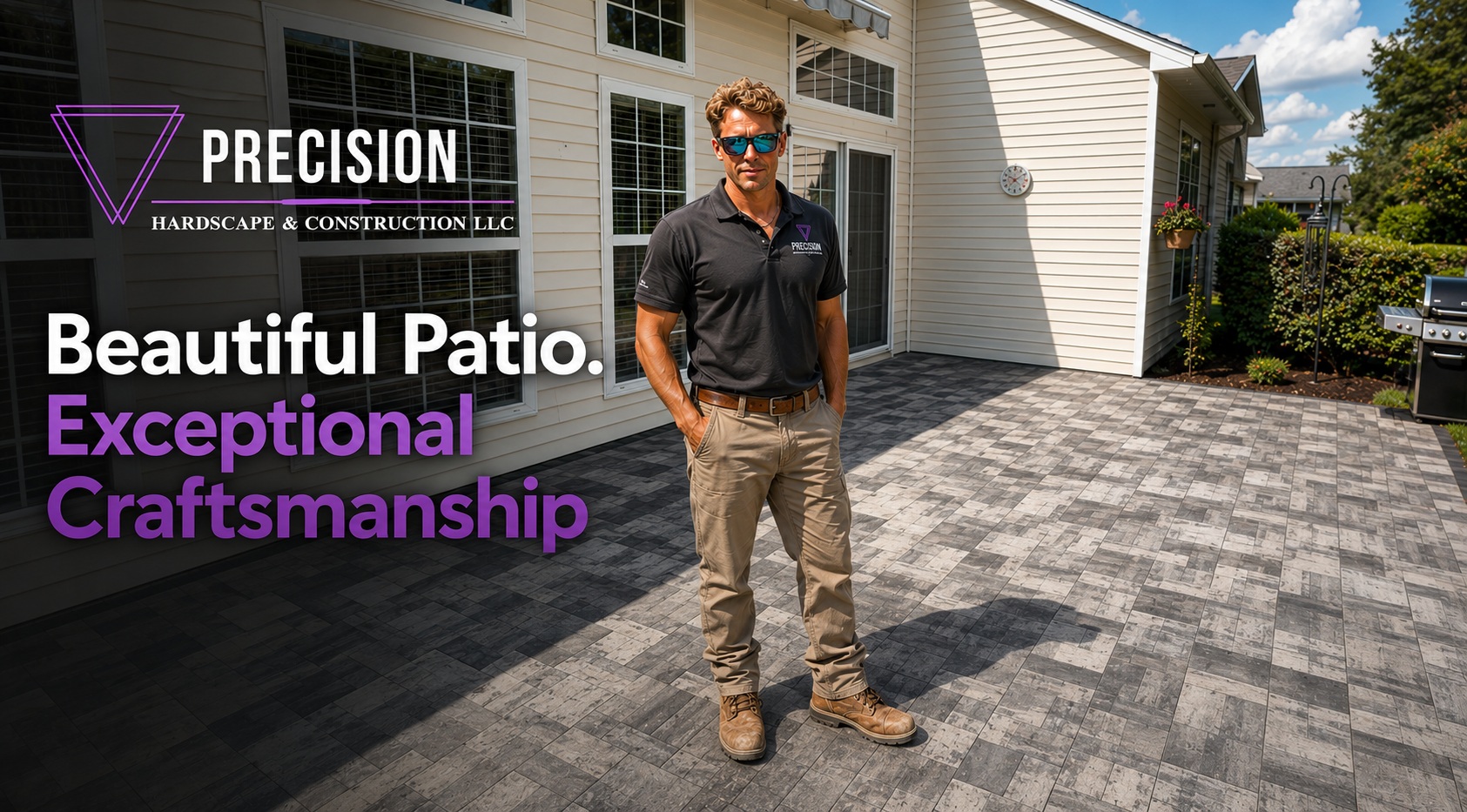
In this project, Matt Jones and the team at Precision Hardscape & Construction installed a 420-square-foot backyard patio using Techo-Bloc Blu 60 pavers — a large-format concrete paver chosen for its clean, modern look and proven durability. The design features a contrast border framing a glacier-toned center field, polymeric sand joints, and a careful sod finish that ties the patio seamlessly into the surrounding yard.
The result is a backyard that feels intentional — not just a patch of pavers dropped in the grass, but an outdoor living space that looks like it belongs. This article breaks down what went into this project and why the choices Matt made produce results that hold up over time in the coastal Carolina climate.
In This Article
- The Project Matt Walks Through in the Video
- Why Techo-Bloc Blu 60? Understanding Large-Format Pavers
- The Contrast Border: How One Design Choice Changes Everything
- Polymeric Sand: The Finish Detail Most Homeowners Don’t Know to Ask About
- What’s Under the Pavers Matters as Much as What’s on Top
- The Sod Touch-Up: Why the Finish Around a Patio Matters
- Patio Installation in Coastal Carolina: What’s Different Here
- Paver Patio vs Concrete: Which Is Right for Your Yard?
- Frequently Asked Questions
- Ready to Build Your Backyard Patio?
The Project Matt Walks Through in the Video
The video above is a quick walkthrough Matt recorded right after finishing this backyard patio. It’s a 420-square-foot install — a solid size for a functional outdoor living space — built using Techo-Bloc Blu 60 pavers with a contrast border and a glacier-toned center field.
“Nice glacier paver in the center, man, it really turned out great,” Matt says in the video. That’s not just satisfaction with the finished look — it’s a reference to the specific color palette and how the two-tone design reads in the finished space. The darker contrast border creates a defined frame around the lighter center field, giving the patio a finished, intentional appearance rather than a flat single-color install.
Beyond the aesthetic, this project follows the same principles Matt applies to every install: proper base preparation, correct jointing material, and attention to the details that determine whether a patio still looks clean five or ten years from now. The rest of this article explains each of those elements and why they matter.
Why Techo-Bloc Blu 60? Understanding Large-Format Pavers
The Techo-Bloc Blu 60 is a large-format concrete paver — roughly 24 inches by 16 inches — produced by Techo-Bloc, one of the leading hardscape material manufacturers in North America. The “60” in the name refers to the 60mm thickness, which puts it in the heavy-duty category suitable for both pedestrian and vehicular surfaces.
For a residential patio, the Blu 60 delivers a specific aesthetic: clean lines, large slab-like proportions, and a surface texture that reads as modern without being cold or industrial. Compared to smaller brick-format pavers, the larger format means fewer visible joints across the surface — which gives the finished patio a more contemporary, streamlined look.
Techo-Bloc products are also known for manufacturing consistency — uniform dimensions, predictable surface texture, and reliable color distribution through the full depth of the paver. That consistency matters on a 420-square-foot install. When you’re laying a large area, even minor variation between units creates visible disruption in the pattern. Quality materials eliminate that problem before it starts.
Large Format
Fewer joints across the surface give the patio a clean, contemporary appearance — less busy than small-format brick patterns.
60mm Thickness
Heavy-duty construction handles foot traffic and outdoor furniture weight without flexing, chipping, or cracking over time.
Full-Depth Color
Color runs through the entire thickness of the paver — minor surface wear doesn’t change the appearance the way painted or sealed surfaces can.
Available in Contrast Colors
Multiple colorways allow for border/field contrast designs within a single product line — no mixing manufacturers or matching depths.
For homeowners in Little River, Calabash, and the surrounding coastal Carolina area, Techo-Bloc Blu 60 is a material that holds up to the humidity, temperature swings, and heavy rainfall this region sees. Concrete pavers in the 60mm range don’t crack under freeze-thaw cycles — and while coastal Carolina doesn’t see severe winters, the combination of heat, moisture, and sandy soil puts stress on outdoor surfaces that lower-quality materials can’t handle long term.
The Contrast Border: How One Design Choice Changes Everything
The contrast border on this patio is one of the most visually impactful design details in the finished project — and one that homeowners often underestimate until they see it in person.
A contrast border uses a different color paver along the perimeter of the patio, creating a defined frame around the main field. In this project, the darker border color surrounds the glacier-toned center field — a cool, light-gray Blu 60 colorway. The border runs as a single row (or sometimes double row, depending on the design) around the entire patio edge.
This design approach accomplishes several things at once. Visually, it gives the patio a polished, finished appearance — the kind of detail you see in high-end hardscape installations. Structurally, border pavers act as a soldier course that locks the field pattern in place and prevents edge creep over time. Practically, the contrast makes it easy to read the patio shape from a distance, which helps the space feel intentional rather than informal.
It’s also one of those details that photographs beautifully — which matters if you’re planning to sell the property at some point. Curb appeal and outdoor living improvements are among the highest-return upgrades a homeowner in the Myrtle Beach and North Myrtle Beach market can make.
Running Bond vs. Border Patterns
The center field on a large-format patio like this is typically laid in a running bond pattern — offset joints, similar to how bricks are stacked, but scaled up significantly with a paver this size. The running bond creates visual flow across the surface and is one of the most structurally sound laying patterns for concrete pavers.
The border pavers are typically laid perpendicular to the field pattern — known as a soldier course. This perpendicular orientation reinforces the patio edge, ties the two color zones together, and creates a clean line that doesn’t require any cut pavers at the transition.
Polymeric Sand: The Finish Detail Most Homeowners Don’t Know to Ask About
Matt highlights polymeric sand as a key finish element on this project — and it deserves its own explanation, because this is a material that makes a significant difference in long-term performance but rarely gets mentioned in contractor sales conversations.
Polymeric sand is a jointing material used to fill the gaps between pavers. Unlike regular sand — which washes out in rain, shifts with freeze-thaw cycles, and allows weed seed germination in the joints — polymeric sand contains a polymer binder that activates with water and cures into a semi-rigid bond. Once set, it resists washout, resists ant tunneling, resists weed infiltration, and holds the paver joints in place across the full surface.
In coastal Carolina’s climate — frequent heavy rain, high humidity, and a long growing season — polymeric sand is the right call on any quality patio installation. Without it, joint sand washes out after the first serious storm, weed seeds blow in and take root, and ants establish nests under the surface that eventually destabilize the paver bed. These aren’t hypothetical issues; they’re common problems on patios where the wrong jointing material was used.
Proper polymeric sand application also requires the right technique: sweep it into joints dry, compact the surface, remove excess material from paver faces, then apply a light water mist to activate the polymer. Do it wrong and you get polymer haze on the paver surface, or incomplete bonding in the joints. Matt’s team does this correctly as standard practice — it’s the kind of thing that separates a professional installation from a DIY or low-bid result.
What’s Under the Pavers Matters as Much as What’s on Top
One of the most persistent misconceptions about paver patios is that the pavers themselves are the critical element. They’re visible, they’re what you specify, they’re what shows in the final photos. But experienced hardscape contractors know the real determinant of a patio’s long-term performance is the base beneath.
A standard residential patio base consists of several layers, each with a specific function:
Excavation & Subgrade
Existing soil is excavated to depth and graded to direct water away from structures. The subgrade is compacted to provide a stable foundation for everything above.
Gravel Base
Crushed stone base material — typically 4 to 6 inches for a residential patio — provides drainage, distributes load, and resists settling. Compacted in lifts for maximum density.
Bedding Sand
A thin layer of coarse bedding sand — usually 1 inch — is screeded to a precise level. This layer allows minor elevation adjustments during paver placement and conforms to paver base irregularities.
Edge Restraints
Plastic or aluminum edge restraints are spiked into the base material along the patio perimeter. Without them, the paver field gradually migrates outward under foot traffic and freeze-thaw pressure.
In coastal Carolina — specifically in sandy soil areas around Little River, Calabash, and Sunset Beach — subgrade stability requires extra attention. Sandy soil compacts differently than clay-heavy inland soils, and drainage through the base is faster, which can cause settlement if the base isn’t properly established. This is where cutting corners has consequences. A 420-square-foot patio on an undersized base looks fine at installation but starts showing settling, tipping, and gaps within a year or two.
Matt’s process accounts for coastal soil conditions at every project. The base depth, compaction method, and drainage grade are all established before the first paver is set.
The Sod Touch-Up: Why the Finish Around a Patio Matters
Matt specifically calls out the sod touch-up work in his video walkthrough. It might sound like a minor finishing detail, but it’s one of the things that separates a project that looks professionally completed from one that just looks installed.
Patio installation disrupts the turf around the project footprint. Equipment moves across the yard. Material gets staged on the grass. Excavated soil gets spread or hauled away. By the time the patio surface is complete, the surrounding lawn often shows compacted bare areas, disturbed edges, or low spots where the grade was altered to establish drainage.
Laying sod in those areas — rather than leaving them to seed in naturally or expecting the homeowner to handle it separately — produces a finished result on day one. The patio edge transitions cleanly into healthy grass, the yard looks like the project was planned and executed as a whole, and the homeowner isn’t left with a bare dirt perimeter to manage through the rest of the growing season.
It’s also a practical drainage consideration. Bare soil around a patio edge erodes in rain, which eventually works its way under the edge restraints and affects the base integrity. A healthy sod perimeter stabilizes the soil and protects the installation.
For homeowners in Ocean Isle Beach, North Myrtle Beach, and coastal areas with warm-season turf like Bermuda or Zoysia, sod establishes quickly in the growing season and knits in within a few weeks. The end result is a backyard that looks complete — not mid-project — when Matt and the crew pull off the property.
Patio Installation in Coastal Carolina: What’s Different Here
Installing a paver patio in Little River, Calabash, or Sunset Beach is not the same as installing one in Charlotte or Raleigh. The coastal environment creates conditions that affect material selection, base design, and drainage planning in ways that inland contractors may not account for.
Sandy Soil and Drainage
Coastal Carolina’s sandy soil drains quickly — which sounds like an advantage for patio construction, but creates challenges for base stability. Sand compacts differently than clay soils and requires proper base aggregate to prevent settlement. Gravel base depth may need to increase in sandy soil areas to establish a firm, consistent support layer.
Rain Events and Surface Drainage
This region receives significant rainfall — often in intense short-duration events. A patio needs to be graded to move water away from the house foundation and off the surface quickly. Even a well-installed patio can create drainage problems if the grade wasn’t properly established. Matt plans drainage grade from the start of every project, not as an afterthought.
Humidity and Organic Growth
Coastal humidity accelerates organic growth on outdoor surfaces — algae, mold, and moss can develop on patio pavers faster than in drier climates. Quality concrete pavers like Techo-Bloc resist this better than natural stone, and polymeric sand joints eliminate the soil medium that would otherwise allow organic growth in the seams.
Homeowners in Shallotte, Longs, and other inland coastal communities see the same conditions. The combination of sandy soil, heavy rain, and persistent humidity is the baseline environment for every project Precision Hardscape installs — and every material and technique decision is made with that environment in mind.
Paver Patio vs Concrete: Which Is Right for Your Yard?
Homeowners comparing options often end up choosing between poured concrete and a paver installation. Both can work — but they perform differently over time, especially in coastal Carolina conditions.
| Factor | Concrete Patio | Paver Patio |
|---|---|---|
| Cracking | Common; control joints reduce but don’t eliminate cracking | Individual pavers flex independently — cracks don’t propagate across the surface |
| Repairability | Difficult; patches are visible and rarely match original finish | Individual pavers can be removed and reset without visible repair marks |
| Design Options | Limited; stamped or stained finishes available but add cost | Wide range of colors, patterns, sizes, and border treatments |
| Drainage | Impermeable; requires careful grading to avoid pooling | Joints allow some permeability; permeable paver options available for full infiltration |
| Longevity | 15–25 years before significant degradation; cracks often appear within 5–10 | 30+ years with proper base installation and occasional re-sanding |
| Curb Appeal | Clean initially; tends to gray and stain over time | Retains color and texture; can be pressure washed and re-sanded to refresh appearance |
For most homeowners in coastal Carolina who want a backyard patio that performs well over the long term and looks as good in ten years as it does on install day, pavers are the better investment. The Techo-Bloc Blu 60 system specifically is engineered for durability and consistent appearance — qualities that matter especially in an environment as demanding as the coastal Carolinas.
Frequently Asked Questions
Techo-Bloc Blu 60 is a large-format concrete paver — roughly 24 by 16 inches — with 60mm thickness. Compared to standard brick-format pavers, the larger size means fewer visible joints, a more contemporary appearance, and a heavier individual unit that resists shifting under traffic. Techo-Bloc is a premium manufacturer known for consistent color, precise dimensions, and surface textures engineered for outdoor durability.
A properly installed paver patio with a correctly compacted base, edge restraints, and quality jointing material should last 30 or more years. The pavers themselves don’t wear out — the base is what determines longevity. In coastal Carolina’s sandy soil and wet climate, base depth and drainage grade are especially important to get right from the start.
Polymeric sand is a jointing material that contains a polymer binder — when activated with water, it cures into a semi-rigid compound that resists washout, weed growth, and ant tunneling. In coastal Carolina where heavy rain events are common and the growing season is long, polymeric sand is the right jointing material for any quality patio installation. Regular sand washes out quickly and allows weed establishment in the joints.
For comfortable outdoor entertaining, most design guides recommend a minimum of 300 to 400 square feet for a space that accommodates a dining table, seating, and a grill. This project at 420 square feet is right in the sweet spot — functional, spacious, and proportional to a typical residential backyard in Little River, Calabash, or Sunset Beach. For larger gatherings or additional features like an outdoor kitchen, 500 to 700 square feet becomes more practical.
Yes — and this is one of the advantages of paver patios over poured concrete. Individual pavers can be removed cleanly for post footings, fire pit bases, or utility lines without visible evidence of the work. If you’re planning future additions, mention that during the design phase so base prep and grade can be planned around the eventual footprint. Precision Hardscape installs pergolas, fire features, and outdoor kitchens and can plan patio installations to accommodate them.
Paver patio maintenance is straightforward. Rinse or pressure wash the surface once or twice a year to remove organic debris and algae. Inspect joints annually and add polymeric sand as needed if gaps appear. Pull any weeds that establish at the perimeter early before they spread. With polymeric sand joints properly installed from the start, most homeowners find minimal maintenance is needed beyond periodic cleaning.
Yes. Precision Hardscape handles excavation, base prep, paver installation, jointing, and finish work including sod replacement in disturbed turf areas. The goal is a project that looks complete on the day the crew leaves — not one that requires the homeowner to coordinate additional lawn work separately. Matt and his team handle the full scope from start to finish.
Ready to Build Your Backyard Patio?
If you’re thinking about a new patio — whether it’s a simple backyard space like this one or a larger outdoor living project with a pergola, fire feature, or outdoor kitchen — Matt Jones and the team at Precision Hardscape & Construction can help you plan it and build it right.
From material selection to base prep, drainage planning to the final sod touch-up, every project is handled with the same standard you see in this video. No shortcuts on the base. No cheap jointing material. No half-finished edges.
Call Matt today to talk through your project and get a quote.
Precision Hardscape & Construction LLC
(843) 222-5377
Serving homeowners in Little River, North Myrtle Beach, Myrtle Beach, Longs, Calabash, Sunset Beach, Ocean Isle Beach, Shallotte, and surrounding coastal Carolina communities.