
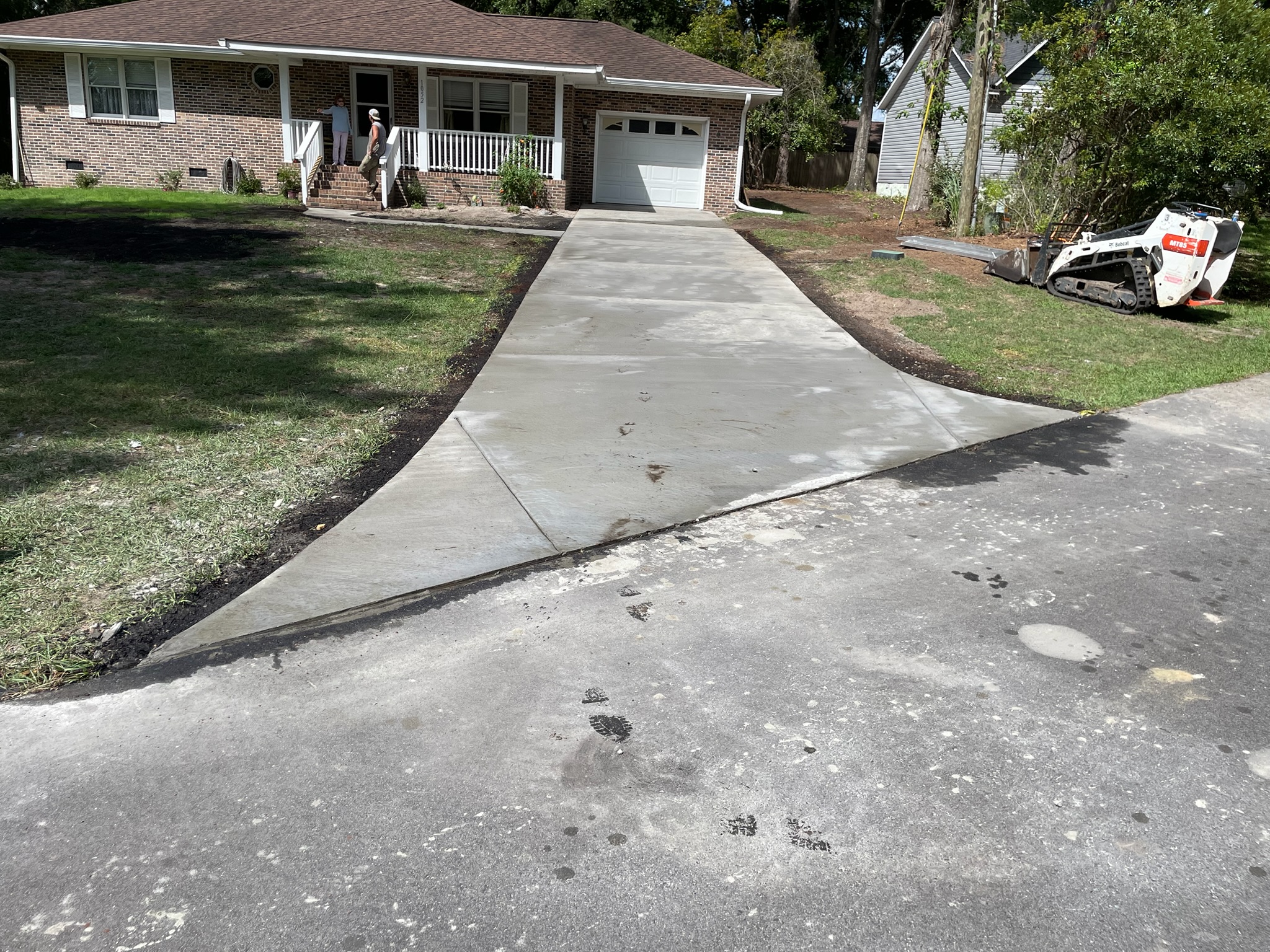
Your driveway is the biggest hardscape surface on your property — and usually the most neglected. A cracked, stained, or sinking driveway drags down the look of the whole house, while a fresh, properly poured one changes your curb appeal overnight. Here’s what actually goes into a concrete driveway or walkway that holds up to coastal Carolina conditions.
Concrete looks simple. It’s the material everyone recognizes and thinks they understand — you pour it, it hardens, you park on it. But if you’ve driven through older neighborhoods in Little River, Longs, or Shallotte, you’ve seen what happens when the parts you can’t see get shortcut: slabs cracked through the middle, sections settling at different heights, edges crumbling where the base washed out underneath.
We pour concrete driveways and walkways throughout the coastal Carolinas, and the difference between a slab that lasts thirty years and one that fails in three has almost nothing to do with the concrete itself. It comes down to what’s under it, how it’s finished, where the joints go, and how the water around it is managed. This article walks through all of it, so whether you hire us or anyone else, you know what to look for.
In This Article
- When It’s Time to Replace a Driveway (Not Patch It)
- The Part You Never See: Base Preparation in Sandy Soil
- Pour Day: Thickness, Reinforcement, and Finishing
- Control Joints: Why Good Concrete Cracks Where We Tell It To
- Concrete Walkways: Connecting the Way You Actually Move
- Concrete vs. Pavers: An Honest Comparison
- Curing and Caring for New Concrete
- Frequently Asked Questions
When It’s Time to Replace a Driveway (Not Patch It)
Not every crack means replacement. Hairline surface cracks are cosmetic, and a single settled corner can sometimes be addressed on its own. But some symptoms tell you the problem is under the slab, and no surface fix will hold:
Multiple wide cracks with height differences across them mean the base has moved. Sections that rock or sound hollow when driven over mean voids have formed underneath — usually from water washing out the base, which happens fast in sandy coastal soil. Crumbling, scaling surfaces mean the original finish or mix was poor, and patches will never bond well or match. Standing water on the slab means it was poured without proper pitch, and that water is working on the base every time it rains.
When a homeowner in the North Myrtle Beach area calls us about a driveway like that, replacement is usually the honest recommendation — patching a failed base is paying twice. On one recent project at a brick ranch home, we removed the original failing driveway completely, rebuilt the base, and poured a new full-width drive with a connecting walkway to the front steps. The house looked years newer from the street the day we pulled the forms.
The Part You Never See: Base Preparation in Sandy Soil
Concrete is strong in compression but weak in bending. That means a slab is only as good as the support beneath it — pour four inches of perfect concrete over a soft or uneven base, and the ground itself will crack the slab for you.
Around Calabash, Sunset Beach, and Ocean Isle Beach, we’re building on sand. Sand actually makes a decent subgrade when it’s confined and compacted — it drains well and doesn’t heave like clay. What it won’t tolerate is loose spots, organic material left in the excavation, or water running underneath the slab edge. So our base process looks like this:
We excavate to remove topsoil, roots, and any soft material, then grade the subgrade to match the finished slope of the driveway — the pitch is built into the ground before the concrete ever arrives. We compact the subgrade mechanically, add crushed stone where the soil needs improvement, and compact again. Forms are set to exact elevations so the finished slab sheds water away from the house and garage. That last detail matters more here than almost anywhere: our storms drop serious volume, and a driveway that drains toward the garage door will remind you of it every summer afternoon.
Pour Day: Thickness, Reinforcement, and Finishing
A residential driveway slab is typically poured at four inches thick, with thicker sections where heavier vehicles will sit. We use a mix specified for exterior flatwork, and reinforcement appropriate to the pour. Then comes the part that’s genuinely a craft: finishing.
Concrete has a window. Screed it, float it, edge it, joint it, and broom it — each step at the right moment as the slab sets up. Finish too early and you trap bleed water under the surface, which causes scaling later. Finish too late and you’re fighting material that’s already made up its mind. A broom finish is standard for driveways and walkways because it adds traction — important when coastal humidity and summer storms keep surfaces wet — while still looking clean and uniform.
Edges get hand-tooled so they’re rounded and durable instead of sharp and chippy. It’s a small detail you stop noticing after a week, but it’s the difference between edges that stay crisp for decades and edges that flake the first time a trailer wheel rides over them.
Control Joints: Why Good Concrete Cracks Where We Tell It To
Here’s the thing nobody tells homeowners: all concrete cracks. It shrinks slightly as it cures, and that shrinkage creates stress that has to go somewhere. The skill isn’t preventing cracks — it’s deciding where they happen.
Control joints are the straight grooves you see in every well-built slab. Each one is a deliberate weak line, cut deep enough that when the slab shrinks, the crack forms neatly inside the joint instead of wandering across the surface. Joint spacing is calculated from the slab thickness, and the panels between joints are kept close to square. When you see a driveway with random diagonal cracks running through it, you’re usually looking at joints that were spaced too far apart, cut too shallow, or cut too late.
On our pours, the joint layout is planned before the truck arrives — lined up with the geometry of the drive, spaced to the slab design, and cut on schedule. It’s invisible engineering that decides how the driveway looks in year ten.
Concrete Walkways: Connecting the Way You Actually Move
Walkways are where concrete quietly improves daily life. We pour a lot of them: front walks connecting driveways to porch steps, curved paths wrapping the side of the house, and utility walks that give you a clean, mud-free route to the trash cans, the HVAC units, or a backyard generator pad.
The design rule we follow is simple: walkways should trace the path people actually take. If everyone cuts the corner across the lawn, the walkway should curve there too — otherwise you get a dirt shortcut next to a concrete path. Width matters as well; a comfortable walk lets two people pass, and a gentle curve reads far more custom than a straight shot, especially along brick homes where a curved walk softens all the straight lines above it.
Side-yard walks in our area do double duty as drainage management: a properly pitched walkway along the house moves roof runoff away from the foundation instead of letting it pond in the shade where grass won’t grow anyway. If your side yard is more mud than lawn, a walkway is often the fix that solves two problems at once. Prefer the look of pavers for that space? We build those too — see our companion article on paver walkways and side-yard paths.
Concrete vs. Pavers: An Honest Comparison
We install both, so we don’t have a horse in this race. Each material is the right answer for different projects and budgets:
Poured Concrete vs. Concrete Pavers
| Factor | Poured Concrete | Pavers |
|---|---|---|
| Upfront cost | Lower per square foot | Higher per square foot |
| Appearance | Clean, uniform, understated | Color, pattern, and texture options |
| Repairs | Section replacement; patches show | Individual units can be lifted and reset |
| Cracking | Controlled with joints; visible if base fails | Joints flex; no slab cracking |
| Best fit | Driveways, utility walks, large areas on a budget | Patios, feature walkways, borders and accents |
There’s also a middle path we build often: a poured concrete driveway dressed with paver borders, bands, or an apron. You get concrete’s economy across the big square footage and paver character exactly where the eye lands. We’ve inlaid paver bands along driveway edges and even set a paver ribbon into an existing pool deck — small material moves that make a plain slab look designed. Rock-edged borders work beautifully here too; see our guide to decorative rock landscaping for how river rock frames a new driveway.
Curing and Caring for New Concrete
Concrete doesn’t dry — it cures, a chemical process that continues for weeks. How the first days go determines a big share of the slab’s final strength. We manage the curing conditions on every pour, and we’ll give you simple guidelines: foot traffic after a day or two, vehicles off the slab for about a week, and heavy vehicles off longer. In coastal summer heat, curing is managed even more carefully, because concrete that dries too fast on the surface is concrete that scales later.
After that, maintenance is about as light as it gets: occasional cleaning and resealing every few years keeps the surface shedding water and resisting stains. That low-maintenance profile is a big part of why concrete remains the default driveway material for homeowners from Myrtle Beach up through Shallotte. You can see recent driveway and walkway pours alongside the rest of our work in the project gallery.
Frequently Asked Questions
Ready to Improve Your Outdoor Space?
If your driveway or walkway is cracked, settling, or just tired — or you’re planning new concrete for a home in Little River, Calabash, Sunset Beach, North Myrtle Beach, Ocean Isle Beach, Shallotte, Longs, or Myrtle Beach — call Matt Jones for a straight assessment and quote.
Precision Hardscape & Construction LLC — built right the first time.