
Mulch has one job — and near the coast, it keeps quitting. Every hard summer storm floats it out of the beds, across the walk, and into the lawn, and every spring you pay to replace it. Decorative rock does the same job permanently: it stays where we put it, moves water away from your foundation, and looks sharp year-round. Here’s the complete guide to rock landscaping for homes in Myrtle Beach, North Myrtle Beach, Little River, Calabash, Sunset Beach, and the surrounding coastal Carolinas.
Drive through any coastal neighborhood in July after a thunderstorm and you’ll see the same scene: brown mulch fanned out across sidewalks and driveways, washed out of the beds it was supposed to be dressing. It’s not that mulch is bad — it’s that our conditions are hard on it. Sandy soil, intense downpours, roof runoff concentrated along foundations, and a long growing season that decomposes organic mulch quickly all add up to a material that needs replacing every year and still spends half the summer somewhere it shouldn’t be.
Decorative rock — river rock, pea gravel, crushed stone, and larger specimen stones — solves those problems structurally. It’s heavy enough that storms don’t move it, permanent enough that you install it once, and functional enough that it actively manages water instead of floating on it. We’ve been installing rock beds, rock borders, and full rock landscapes across the coastal Carolinas for years, and this guide covers everything homeowners ask us: why rock works here, where it belongs, which types to use, how professional installation differs from a weekend dump-and-spread, and how it compares honestly to mulch.
In This Article
- Why Decorative Rock Works So Well in Coastal Carolina
- How Rock Beds Protect Your Home’s Foundation
- Where Rock Belongs: Beds, Borders, Side Yards, and Driveway Edges
- Choosing the Right Rock: River Rock, Pea Gravel, and Crushed Stone
- Decorative Rock vs. Mulch: The Honest Comparison
- Why Professional Installation Matters
- Designing Rock Into a Complete Coastal Landscape
- Frequently Asked Questions
Why Decorative Rock Works So Well in Coastal Carolina
Every landscaping material is a bet on local conditions, and rock happens to be a bet our conditions pay off.
It doesn’t move in storms. Our rain doesn’t drizzle — it dumps. Rock beds shrug that off. Water passes down through the stone, the stone stays put, and there’s nothing to rake off the sidewalk the next morning.
It doesn’t decompose. Heat and humidity break down organic mulch fast here — the fresh layer you spread in March is thin and gray by fall. Stone is done changing. The bed you see the day we finish is the bed you’ll see in ten years.
It works with sandy soil, not against it. Our sandy ground drains quickly, and rock beds keep that pathway open — rain moves through the stone and into the soil instead of sheeting across a crusted mulch surface.
It handles the coastal exposure. Salt air, blazing sun, and wind-driven rain fade and scatter lighter materials. Stone doesn’t care. For properties in Cherry Grove, Sunset Beach, and Ocean Isle Beach that take real weather off the water, that durability is the whole point.
How Rock Beds Protect Your Home’s Foundation
The strip of ground directly against your house takes more concentrated water than any other part of the yard. Roofline runoff, gutter overflow, and splash from downspouts all land there — and what that water does next depends on what it lands on.
On bare soil or thin mulch, concentrated runoff carves splash trenches, throws mud onto the siding, and can gradually erode the grade so water starts settling toward the foundation instead of away from it. A properly built river rock bed changes the physics: the stone absorbs the impact energy of falling water, spreads it across the bed, and lets it soak downward through a graded base that still pitches away from the house. No splash erosion, no mud line on the siding, no channels forming along the footing.
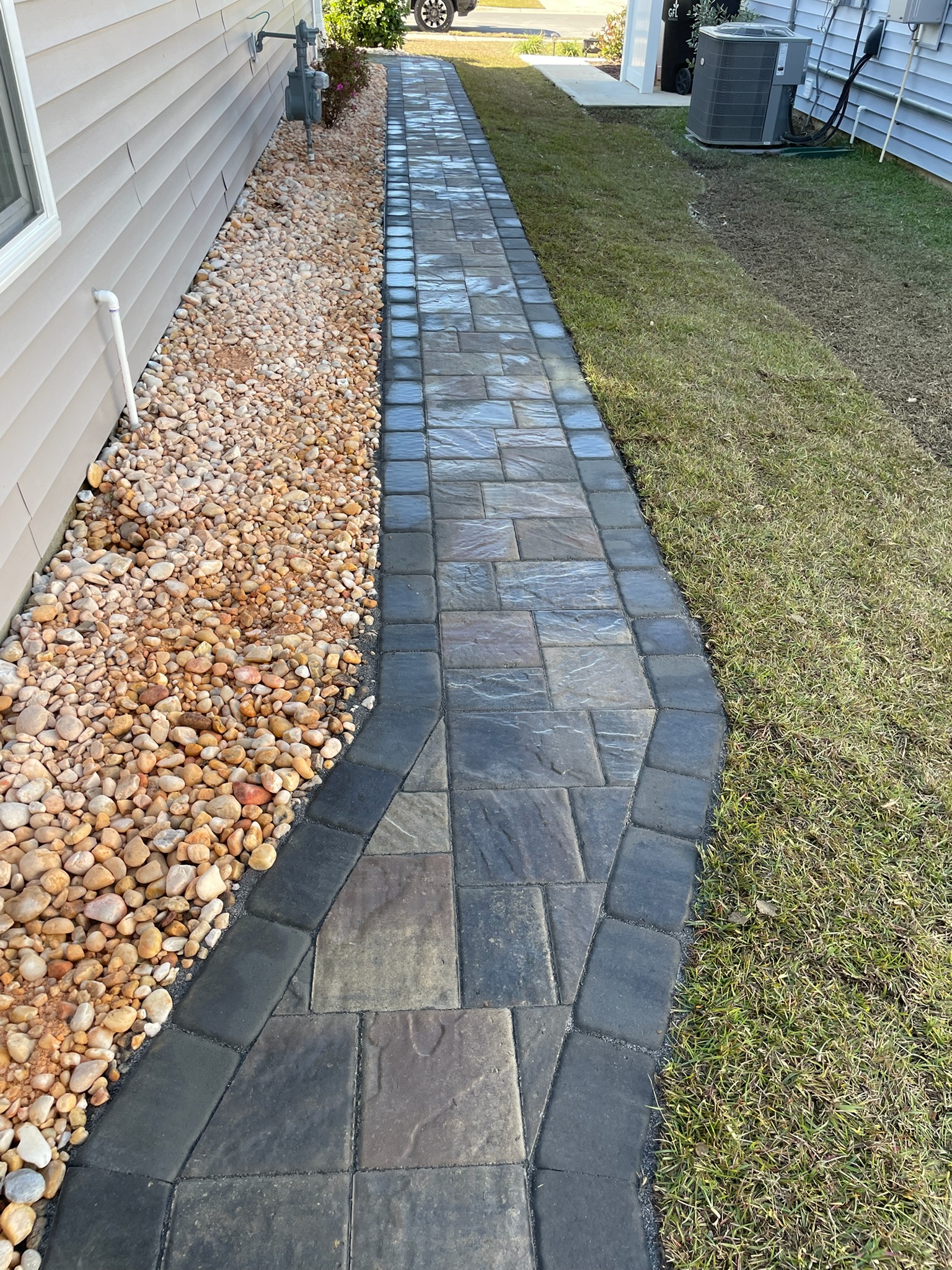
We install foundation rock beds on their own and as part of larger builds. One of our favorite recent combinations paired river rock foundation beds with a paver path down a narrow side yard — the rock manages the two rooflines’ worth of runoff, the path gives the homeowners a clean route front-to-back, and a strip of yard that used to be pure mud now looks like it came with the house. We covered that project in more detail in our paver walkways and side-yard paths article. And when a property has genuine standing-water problems, rock beds integrate cleanly with the dedicated drainage solutions we build — French drains and dry creek beds are usually dressed in the same stone, so the fix disappears into the landscaping.
Where Rock Belongs: Beds, Borders, Side Yards, and Driveway Edges
Foundation Beds
The highest-value placement: rock where roof runoff lands, protecting siding and grade year-round.
Side Yards
Shaded, narrow strips where grass won’t grow become clean rock-and-path corridors that never need mowing.
Driveway & Walk Edges
Rock borders frame new concrete beautifully and take the string-trimmer zone out of your weekend.
Planting Beds & Islands
Stone ground cover around palms, shrubs, and ornamentals — the classic coastal look, zero annual top-up.
A few of these deserve a closer look. Driveway edges are an underrated one: on a recent driveway project, we ran river rock borders down both sides of the new concrete, and the effect is a drive that looks framed instead of just poured — while the rock quietly catches the sheet runoff coming off the slab. (More on that build in our concrete driveways and walkways guide.)
Rock also pairs naturally with natural stone surfaces. We’ve set flagstone stepping surfaces in pea gravel where a full paver path would have been more than the space needed — the big stones carry your feet, the gravel locks them visually into the bed, and the whole corner drains like a sieve. And in planting beds, rock over a proper base keeps its color against dark soil and makes greens and blooms pop in a way faded mulch never does.
Choosing the Right Rock: River Rock, Pea Gravel, and Crushed Stone
River Rock
Smooth, rounded, in warm mixed tones — this is the workhorse of coastal rock landscaping. Mid-size river rock (roughly 1–3 inches) is heavy enough to stay put in a downpour, open enough to drain fast, and handsome enough to be the finished surface everywhere from foundation beds to dry creek beds. It’s what we reach for on most foundation and border work.
Pea Gravel
Small, rounded, and comfortable underfoot, pea gravel is the right call for joint fill between flagstone, informal garden paths, and tight decorative areas. Because it’s light, it needs proper edging to stay contained — a place where professional installation earns its keep.
Crushed Stone & Specimen Boulders
Angular crushed stone locks together underfoot and under wheels, which makes it the structural choice beneath paths and in high-traffic gravel areas. Larger specimen stones and boulders act as anchors in bed design — we bring them in when a landscape needs a few permanent focal points that no storm will ever relocate.
Color guidance is simple: pull from your house. Warm tan-and-brown blends flatter brick and beige siding; gray blends suit coastal blues, whites, and Hardie-board palettes. We bring samples to the site so you’re choosing against your actual walls, not a screen.
Decorative Rock vs. Mulch: The Honest Comparison
We install both, and mulch genuinely wins in a few situations — so here’s the comparison the way we’d give it to you standing in your yard:
Decorative Rock vs. Organic Mulch in Coastal Carolina
| Factor | Decorative Rock | Organic Mulch |
|---|---|---|
| Storm performance | Stays in place; drains through | Floats and washes out in heavy rain |
| Lifespan | Decades; one-time install | Refreshed every 1–2 years |
| Long-term cost | Higher upfront, lower over 10 years | Lower upfront, recurring forever |
| Soil benefit | None (inert) | Adds organic matter as it breaks down |
| Heat around plants | Absorbs/radiates heat; plan plant choice | Cooler, moisture-retaining root zone |
| Best use here | Foundations, borders, side yards, drainage paths | Vegetable gardens, moisture-loving plantings |
The bottom line we give homeowners: use mulch where you’re actively gardening, and use rock everywhere the landscaping is meant to be permanent — foundations, borders, side yards, and anywhere water moves. That split gets you mulch’s soil benefits where they matter and rock’s permanence where mulch keeps failing.
Why Professional Installation Matters
Rock landscaping looks like the simplest job in the world — and the bags-from-the-big-box version usually proves why it isn’t. The failures we’re called to redo share the same shortcuts:
No ground preparation. Rock dumped on unprepared soil sinks into it. Two years later the “rock bed” is half dirt with stones peeking through. We excavate, grade the base to move water the right direction, and install a quality landscape fabric so the stone and the soil stay separated for good.
No edging. Rock without a defined edge migrates into the lawn, where it becomes a mower hazard. Every bed we build gets real containment — steel or paver edging, or a low block border. On beds that deserve it, a proper garden wall turns containment into a design feature.
Wrong depth, wrong size. Too thin and fabric shows through; too thick and the bed looks like a quarry. Stone that’s too small washes; too large reads harsh against foundation plantings. Getting the spec right per location is exactly the kind of judgment that comes from installing this material every week.
There’s also the sheer logistics: rock is heavy. A modest foundation bed can run several tons of stone, and we move it with equipment and crews, protecting your lawn in the process — not with a hundred trips of a homeowner’s wheelbarrow.
Designing Rock Into a Complete Coastal Landscape
Rock is at its best as part of a composition. The projects we’re proudest of layer it with the rest of the landscape: river rock foundation beds meeting a paver walkway, stone borders framing a new driveway, pea-gravel joints around flagstone, block-edged planting islands with palms rising out of clean stone. Each material does the job it’s best at, and the whole yard reads as one design.
If you’re planning bigger — new beds, edging, grading, and sod along with the rock — our article on landscape beds, grading, and sod walks through how we build a yard from the dirt up, and our custom design landscaping page covers the design process itself. You’ll find plenty of finished rock work in the project gallery.
Frequently Asked Questions
Ready to Improve Your Outdoor Space?
If you’re done re-mulching every spring and want rock beds, borders, or a full landscape refresh for a home in Myrtle Beach, North Myrtle Beach, Little River, Longs, Calabash, Sunset Beach, Ocean Isle Beach, or Shallotte, call Matt Jones and get a straight answer on what your yard needs.
Precision Hardscape & Construction LLC — built right the first time.