
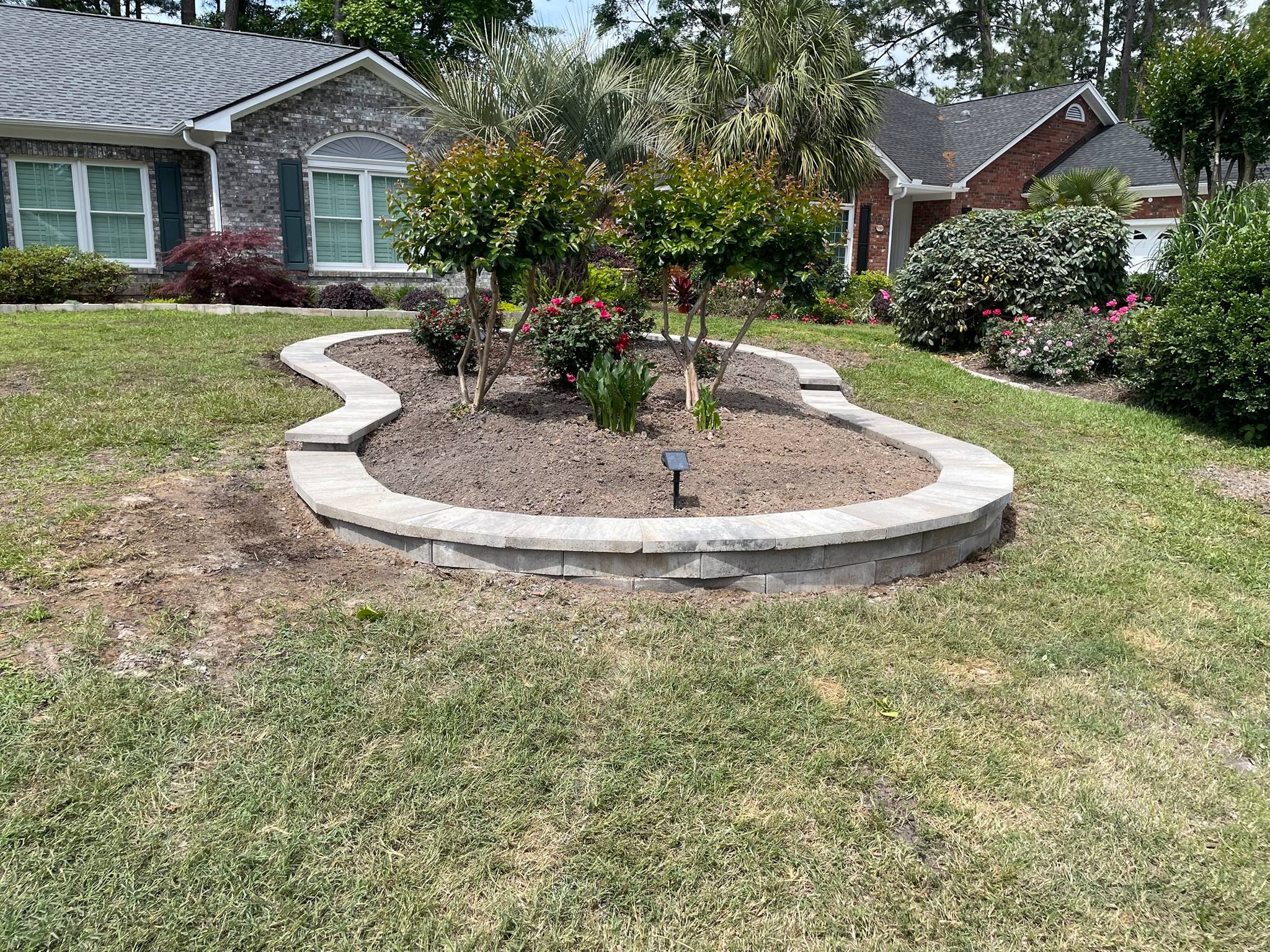
Sandy soil doesn’t hold still. Every heavy rain in the coastal Carolinas moves a little more of your yard downhill — washing out planting beds, exposing foundations, and turning slopes into problems. A properly built retaining wall or garden wall is how you draw a line and make the soil stay on your side of it. Here’s how we build walls that hold up to coastal conditions in Little River, Calabash, Sunset Beach, and the surrounding area.
Most homeowners think of retaining walls as something you only need on a steep hillside. In our part of the Carolinas, that’s not really how it works. The lots here are mostly gentle grades — but the soil is sandy, the rain comes down hard, and the water table sits close to the surface. That combination means even a two-foot slope can erode, slump, and wash mulch into the lawn year after year.
We build walls all over the area for exactly these reasons: low garden walls that hold foundation planting beds in place on sloped lots, raised planter walls that turn a bare patch of front yard into a landscaped focal point, and structural retaining walls that make an unusable grade change into flat, usable ground. This article walks through the different types of walls we install, why coastal soil changes how they need to be built, and what separates a wall that lasts thirty years from one that leans in five.
In This Article
- The Three Kinds of Walls We Build Most in Coastal Carolina
- Why Sandy Coastal Soil Changes How Walls Are Built
- Garden Walls and Raised Planter Beds: Small Walls, Big Curb Appeal
- How Retaining Walls Stop Erosion on Sloped Lots
- What Goes Into a Wall That Lasts: Base, Backfill, and Drainage
- Common Retaining Wall Mistakes Homeowners Should Avoid
- Frequently Asked Questions
The Three Kinds of Walls We Build Most in Coastal Carolina
Not every wall does the same job, and the right design depends on what the wall needs to hold and where it sits on your property. Around Little River, Calabash, and Sunset Beach, the projects we’re called out for usually fall into three categories.
Garden and Border Walls
These are the low walls — usually one to three courses of block — that frame planting beds, hold soil and mulch in place along a foundation, and give landscaping a clean, finished edge. They’re not holding back tons of earth, but they’re doing real work: without them, every downpour pushes mulch onto the lawn and slowly flattens the bed you paid to have built up.
Raised Planter Walls
A raised planter wall turns a flat, forgettable spot in the yard into a feature. We recently built a curved planter wall around an island bed in a front yard near North Myrtle Beach — the wall lifts the plantings up where you can actually see them from the street, defines the shape of the bed permanently, and keeps irrigation water where the roots need it instead of letting it sheet off across the lawn.
Structural Retaining Walls
When there’s a real grade change — a sloped backyard, a raised patio that needs support, a driveway cut into a bank — you need a wall engineered to resist the constant pressure of the soil behind it. These walls use heavier segmental block, geogrid reinforcement on taller builds, compacted gravel backfill, and dedicated drainage. This is where cutting corners shows up fastest, and where professional construction matters most.
Erosion Control
Walls stop sandy soil from migrating downhill with every storm, protecting beds, lawns, and foundations.
Usable Space
Terracing a slope with a retaining wall converts wasted grade into flat ground you can actually use.
Curb Appeal
Raised planter walls and clean bed borders make landscaping look intentional and permanent.
Property Value
Well-built hardscape walls are a permanent improvement buyers notice and appraisers count.
Why Sandy Coastal Soil Changes How Walls Are Built
If you’ve ever dug a hole in a yard in Longs or Ocean Isle Beach, you know what you find: sand, more sand, and water not far below it. That soil profile has real consequences for wall construction.
Sandy soil drains fast, which sounds like a good thing — and for drainage behind the wall, it is. But sand also has very little cohesion. It doesn’t hold a vertical face the way clay does, and it shifts under load if it isn’t confined and compacted properly. A wall base that would be fine in the Piedmont can settle unevenly here, and once a wall starts settling out of level, gravity finishes the job.
That’s why every wall we build starts below grade. We excavate down to undisturbed soil, build a compacted base of crushed stone that’s wider than the wall itself, and bury the first course of block. That buried course is what locks the wall in place — it’s doing invisible work for the life of the wall. On coastal lots we also pay close attention to where roof runoff and irrigation water travel, because moving water is what turns a minor soil problem into a failed wall. If your yard already has standing water or washout issues, a wall project is often the right time to address drainage solutions in the same mobilization.
Garden Walls and Raised Planter Beds: Small Walls, Big Curb Appeal
Some of the most satisfying projects we do are the smallest ones. A curved garden wall around a front-yard bed takes a few days to build, but it changes how the whole house reads from the street.
On one recent project, the homeowners had a beautiful island bed — mature shrubs, seasonal color, a small ornamental tree — but the bed itself was slowly disappearing. Every rain pushed soil and mulch out onto the lawn, and the edge had to be re-cut every season. We built a low, curved block wall following the natural shape of the bed, backfilled it, and topped it with a cap course. The bed is now permanently defined, sits proud of the lawn where the plantings show, and the homeowners haven’t touched the edge since.
The same approach works along foundations. Sloped lots in Calabash and Shallotte often have foundation beds that want to slide toward the lawn. A one- or two-course garden wall holds the bed level, keeps mulch and stone in place, and gives the front of the house a crisp horizontal line that makes everything above it look better. Pair the wall with decorative rock instead of mulch and the bed becomes close to zero-maintenance.
How Retaining Walls Stop Erosion on Sloped Lots
Erosion on a coastal lot is rarely dramatic. You don’t wake up to a landslide — you just notice, year after year, that the slope behind the house is a little more bare, the fence posts are a little more exposed, and the low corner of the yard collects a little more sediment. By the time it’s obvious, you’ve lost inches of grade.
A retaining wall interrupts that process. Instead of one long slope that water accelerates down, you get one or two level terraces with a wall holding each transition. Water slows down, soaks in, and stops carrying soil with it. On a sloped brick home we worked on recently, we ran a low retaining wall along the fence line and a second garden wall along the foundation beds, then installed a connecting paver walkway between them. The slope that used to wash out with every storm is now two stable planting zones with a clean path through the middle — and the fresh sod we laid at the bottom of the yard finally has a chance to establish because it isn’t being buried in sediment.
Terracing also solves a mowing problem. Slopes that are too steep to mow safely become flat beds and lawn panels that take ordinary maintenance. For a lot of our clients in Sunset Beach and Ocean Isle Beach, that alone justifies the project.
What Goes Into a Wall That Lasts: Base, Backfill, and Drainage
Every retaining wall you see is really two walls: the block face you look at, and the hidden system behind it that decides whether the wall is still standing straight in twenty years. Here’s what that hidden system looks like when it’s done right.
The Base
We excavate a trench deeper and wider than the wall, compact the subgrade, and build up a base of crushed stone compacted in lifts. The first course of block is set dead level in that base and buried. Getting the first course perfect is slow work — and it’s the single most important step of the entire build. Every course above it inherits its accuracy.
The Backfill and Drainage
Behind the wall, we backfill with clean angular gravel, not the soil that came out of the trench. Gravel lets water pass down to a drain line at the base of the wall instead of building up hydrostatic pressure behind the block. Water pressure — not soil weight — is what pushes most failed walls over. In a region that can take several inches of rain in an afternoon, skipping the gravel and drain is how you build a wall with an expiration date.
Setback and Reinforcement
Segmental walls are built with a slight lean back into the slope, and taller walls get geogrid — layers of reinforcement mesh that tie the wall face back into the compacted soil behind it. Whether a wall needs geogrid depends on its height, the slope above it, and what’s sitting on top (a patio or driveway adds load). That’s an assessment we make on site, per project, not a guess.
Garden Wall vs. Structural Retaining Wall
| Factor | Garden / Border Wall | Structural Retaining Wall |
|---|---|---|
| Typical height | 6–18 inches | 2 feet and up |
| Main job | Define beds, hold mulch/soil, curb appeal | Hold back a grade change under constant load |
| Drainage system | Gravel base; weep gaps usually sufficient | Gravel backfill + drain line required |
| Reinforcement | Not typically needed | Geogrid on taller walls / loaded walls |
| Timeline | Often 1–3 days | Several days to a week-plus, by size |
Common Retaining Wall Mistakes Homeowners Should Avoid
We get called to repair or rebuild walls more often than you’d think, and the failures almost always trace back to the same handful of shortcuts:
Building on unprepared ground. Blocks stacked on topsoil or loose sand will settle unevenly, and the wall telegraphs every low spot. A compacted stone base isn’t optional in coastal soil.
Backfilling with native soil. Shoveling sandy dirt back behind the block traps water against the wall. The first saturated season, the wall starts to lean.
Ignoring where water goes. A wall changes how water moves across a yard. If the design doesn’t account for roof runoff, downspouts, and irrigation, the wall can create a drainage problem while solving a slope problem.
Going too tall without reinforcement. There’s a reason taller walls involve engineering. Stacking one more course “because we had the block” is how walls end up bowing.
A wall is one of the few landscape features where a mistake doesn’t just look bad — it becomes a demolition-and-rebuild project. Getting it right the first time is genuinely cheaper. You can see finished wall projects alongside our other work in the project gallery, and more of the yard-level context in the before & after page.
Frequently Asked Questions
Ready to Improve Your Outdoor Space?
If you’re considering a retaining wall, garden wall, raised planter bed, or a full slope fix in Little River, Calabash, Sunset Beach, or the surrounding coastal Carolina area — including North Myrtle Beach, Ocean Isle Beach, Shallotte, Longs, and Myrtle Beach — call Matt Jones to walk your property and talk through options.
Precision Hardscape & Construction LLC — built right the first time.