
Every finished yard you’ve ever admired started as dirt and decisions. Where the ground should slope, where the beds should curve, what holds the edges, and what grows where. Grading, landscape beds, and sod are the stage everything else in your landscape stands on — and in coastal Carolina soil, getting that stage right is a craft. Here’s how we do it in Little River, Calabash, Sunset Beach, and the surrounding area.
Hardscape gets the glamour — the patios, the fire pits, the walls. But ask anyone who’s lived with a lumpy, puddle-prone lawn or beds that dissolve into the grass a little more every season: the “soft” side of a landscape is what you look at and live with most. And it’s the part that most often gets done halfway, because on the surface it looks like work anyone with a shovel and a weekend can do.
The difference shows within one rainy season. A yard that was machine-graded to move water, beds that are permanently edged in stone or block, and sod laid over properly prepared ground don’t just look better on day one — they still look that way in year five. This article walks through how we take a rough or tired yard down to the dirt and build it back: grading, bed construction, edging, planting, and sod, in the order the work actually happens.
In This Article
- Grading: The Invisible Work That Decides Everything
- Building Landscape Beds That Keep Their Shape
- Edging Options: Stone, Block, and Paver Borders
- Planting for the Coast: Palms, Shrubs, and What Actually Thrives
- Sod Installation: An Instant Lawn, Done Right
- Putting It Together: One Yard, One Project
- Frequently Asked Questions
Grading: The Invisible Work That Decides Everything
Grading is the least photogenic thing we do and the most important. It’s the shaping of the ground itself — cutting high spots, filling low ones, and setting slopes so that every drop of rain that lands on your property has somewhere sensible to go.
In our area, grading problems announce themselves the same few ways: water standing in the lawn for days after a storm, a soggy stripe along the fence line, grass that drowns in one corner and bakes in another, or — the serious one — water settling against the foundation. Sandy soil drains well vertically, but it still obeys gravity horizontally. If the surface pitches the wrong way, the water goes the wrong way, no matter how sandy the ground is.
We grade with a skid steer and a finish rake, not guesswork: establish the target slopes (away from the house, toward swales or drainage paths), cut and fill to hit them, bring in screened topsoil where the native ground is too lean to grow anything, and compact and fine-grade until the surface is smooth enough to sod. On yards with real water problems, grading works hand-in-hand with the dedicated drainage solutions we install — the grade moves the water, the drains take it from there.
Building Landscape Beds That Keep Their Shape
A landscape bed is a simple idea — a defined area for plants instead of grass — but the difference between a bed that holds its lines and one that melts into the lawn is all in the construction.
We start with the shape. Long, confident curves that follow the house, the lawn, or a walkway read intentional; wiggly edges and sharp little jogs read accidental and are miserable to mow along. We lay the lines out with paint on site so you can see the exact shape from your porch and your curb before a shovel touches ground.
Then the build: strip the grass inside the lines, amend or replace soil where planting needs it, set the edging (more on that below), plant, and finish with the ground cover — mulch where you’ll be gardening actively, or decorative stone where you want the bed permanent and low-maintenance. That choice is worth a whole conversation of its own, and we wrote it: see our guide to decorative rock landscaping for coastal homes for the honest rock-versus-mulch breakdown.
Edging Options: Stone, Block, and Paver Borders
Edging is what separates a landscape from a yard with some plants in it. It draws the line — literally — between bed and lawn, keeps mulch or rock in and grass out, and gives the mower a clean track to follow. The options we install most:
Stone Block Edging
Tumbled block set in a compacted base — substantial, permanent, and handsome around feature beds and palms.
Paver Soldier Borders
A single paver course on edge or flat — ties bed lines visually to a paver walkway or patio nearby.
Raised Planter Walls
When a bed deserves elevation, a low garden wall lifts it into a true feature — and holds slopes while it’s at it.
Steel / Clean-Line Edging
Nearly invisible containment for modern landscapes and rock beds where the material is the show.
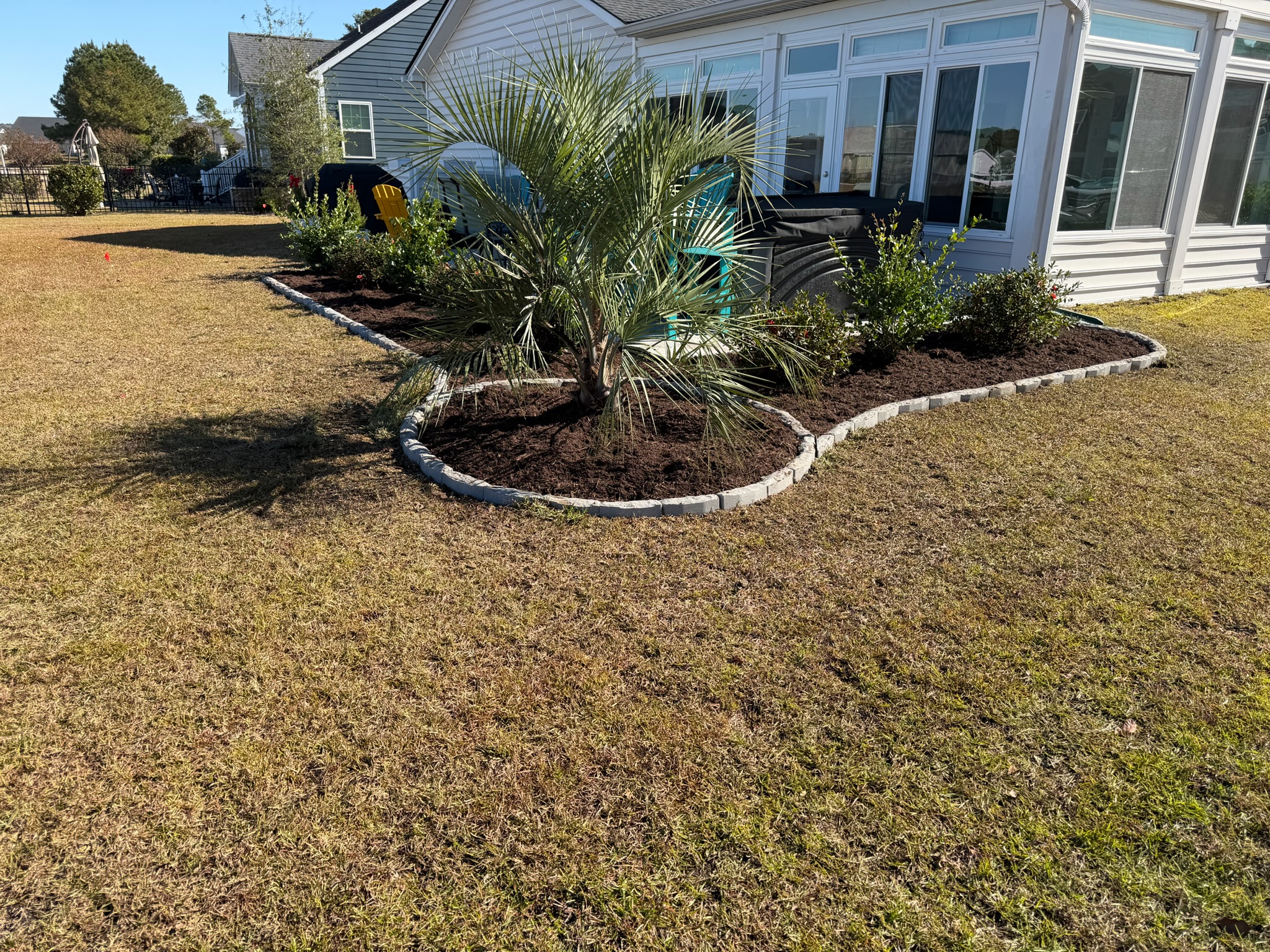
One of our recent bed builds shows the block approach at work: a curved island bed with palms, edged in stacked stone block, with the edging set in a base — not just pressed into the dirt — so it stays level and tight for the long haul. When a bed calls for real height or has a slope behind it, the edging conversation becomes a wall conversation; our retaining walls and garden walls guide covers how those are built.
Planting for the Coast: Palms, Shrubs, and What Actually Thrives
Coastal Carolina planting is its own discipline. The winning plant list here has to handle sandy, fast-draining soil, salt in the air, baking summer sun, and the occasional cold snap — and the list that does is a good one: palms and palmettos for the vertical coastal statement, ornamental grasses that move in the breeze, hollies, junipers, loropetalum, and other tough evergreen structure, with seasonal color worked in where it gets water.
Palms deserve a special note because they’re the signature plant of our area and the one most often planted wrong. Planting depth, root ball handling, staking, and establishment watering all matter — a palm set too deep or left to dry out in its first summer struggles for years or fails outright. We plant them correctly, set them straight, and leave you with a simple watering schedule that gets them established. The palm-and-stone bed combination — palms rising out of clean rock or fresh mulch inside a block edge — is the classic coastal look for a reason: it’s beautiful, and there’s almost nothing to maintain.
Where a project calls for a full design — plant palette, bed layout, hardscape tie-ins — our custom design landscaping process handles the whole picture before installation starts.
Sod Installation: An Instant Lawn, Done Right
Sod is the fastest transformation in landscaping — bare dirt in the morning, a lawn by dinner. But sod is also unforgiving: it shows every flaw in the ground beneath it, and it lives or dies on its first month of care.
The prep is the product. Sod laid over lumpy, compacted, or trash-strewn ground gives you a lumpy lawn with dry seams. Before a single roll goes down, we finish-grade the surface smooth, ensure the soil beneath will actually root grass, and set the grade slightly below adjacent walks and edging so the finished lawn sits flush — a small detail that makes the whole yard look professionally done.
The right grass for here. Warm-season varieties are the coastal Carolina lawn: centipede for low-maintenance yards, zoysia for a denser, finer look, St. Augustine where shade is part of the picture. Which one fits depends on your sun, your irrigation, and how much lawn care you honestly want to do — we’ll tell you straight.
Tight seams, staggered joints, rolled finish. Sod is laid brick-fashion with seams butted tight, trimmed clean along beds and walks, and watered immediately. You’ll get a simple establishment schedule — frequent watering the first couple of weeks, tapering as roots knit down — and inside a month the seams disappear and it’s simply your lawn.
Putting It Together: One Yard, One Project
Grading, beds, edging, planting, and sod aren’t five projects — they’re one project with five phases, and the order matters. Grade first, so water goes where it should. Build and edge the beds while the machine is on site. Plant. Sod last, so the new lawn never gets driven over. Done as one mobilization, the yard comes together in days instead of a season of weekends, and every phase is built to support the next.
It also plays perfectly with hardscape work. Many of our full-yard projects pair this soft-scape package with a new walkway, wall, or patio — the machine work overlaps, and the finished yard reads as one design instead of an accumulation of upgrades. You can see graded-and-sodded yards, edged palm beds, and the hardscape that ties them together throughout our project gallery and before & after page.
Frequently Asked Questions
Ready to Improve Your Outdoor Space?
If your yard needs grading, new landscape beds, stone edging, plantings, or fresh sod — in Little River, Calabash, Sunset Beach, North Myrtle Beach, Ocean Isle Beach, Shallotte, Longs, or Myrtle Beach — call Matt Jones and walk the yard with him. He’ll tell you what it needs and what it doesn’t.
Precision Hardscape & Construction LLC — built right the first time.