
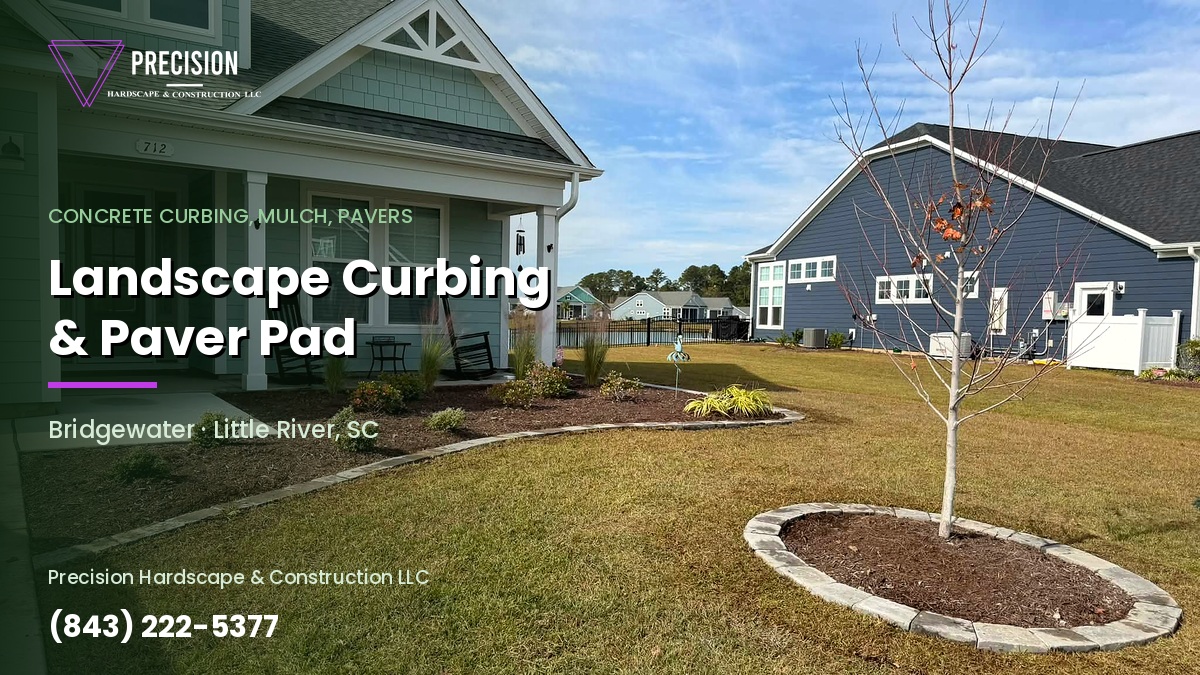
Some of the most useful work a hardscape crew does never gets a dramatic reveal. Nobody throws a party for a bed edge. But ask anyone who has spent a Saturday string-trimming around mulch that has crept into the lawn, or re-cutting a bed line that has gone soft for the third spring running, and they will tell you that the edge is the part of a landscape they fight with most. This project in the Bridgewater community in Little River, South Carolina was a week of fixing exactly that, permanently, around an entire property — and of giving the trash cans somewhere proper to live while the crew was at it.
Matt Jones’s crew ran continuous concrete landscape curbing around every bed on the lot: the front beds by the porch, the long side beds between the house and the lawn, a ring around the young tree in the front yard, and a bed wrapping the utility boxes by the driveway. Behind the new curb the beds were re-cut and freshly mulched. Beside the garage, a new vinyl trash enclosure got a paver pad and a short walkway tying it to the edge of the driveway — grey pavers with a charcoal border. The crew posted three updates on Facebook as the week went on, at the start, midweek and at the finish, and the video below strings those photos together. What follows is what landscape curbing is, why it earns its keep on a coastal lot, and the decisions that went into this one.
A week of curbing, mulch and pavers in Bridgewater, Little River, in the crew’s own photos: the start, midweek, and the finish.
What’s In This Article
- The Project in the Photos
- What Landscape Curbing Actually Is
- Why a Bed Edge Needs to Be Permanent on the Coast
- The Mower Strip: What Curbing Does for Maintenance
- Curbing a Tree Ring
- A Bed Around the Utility Boxes
- The Long Side Beds
- A Paver Pad and Walkway for the Trash Enclosure
- How a Week Like This Is Sequenced
- Curbing on a New-Construction Lot
- Mistakes Worth Avoiding With Landscape Curbing
- Frequently Asked Questions
The Project in the Photos
The first set of photos is a Monday. The crew’s caption was that the boys were starting the week strong, and the pictures bear it out: fresh concrete curbing, still pale and damp, already running along the front beds and down the side of the house; the white vinyl posts of the trash enclosure standing beside the garage with the ground beneath them compacted for a paver pad; a plate compactor sitting on the base; and, as the sun went down over the pond behind the house, a ring of new curb around the young tree in the front lawn with the mulch already in it.
The second set is midweek. The curbing has cured to its finished grey, the beds behind it have been dressed with dark mulch and the grasses and shrubs sit cleanly inside the line. At the garage, the pavers are going down in front of the enclosure, charcoal border first, with the field pavers filling in behind it and the whole pad tying into the edge of the driveway. Coming together, the caption said, and the boys don’t disappoint.
The third set is the finish, on a bright day with the lake behind the house. Every bed on the property has the same crisp concrete edge: the front beds, the tree ring, the long side beds past the air conditioning units and meters, and a generous curbed bed around the green transformer box and the utility pedestals by the street, planted and mulched so that what used to be a cluster of equipment in the lawn now reads as a landscape feature. The trash enclosure stands finished on its paver pad with the hose reel mounted beside it. Another one in the books, the caption said, and another one underway.
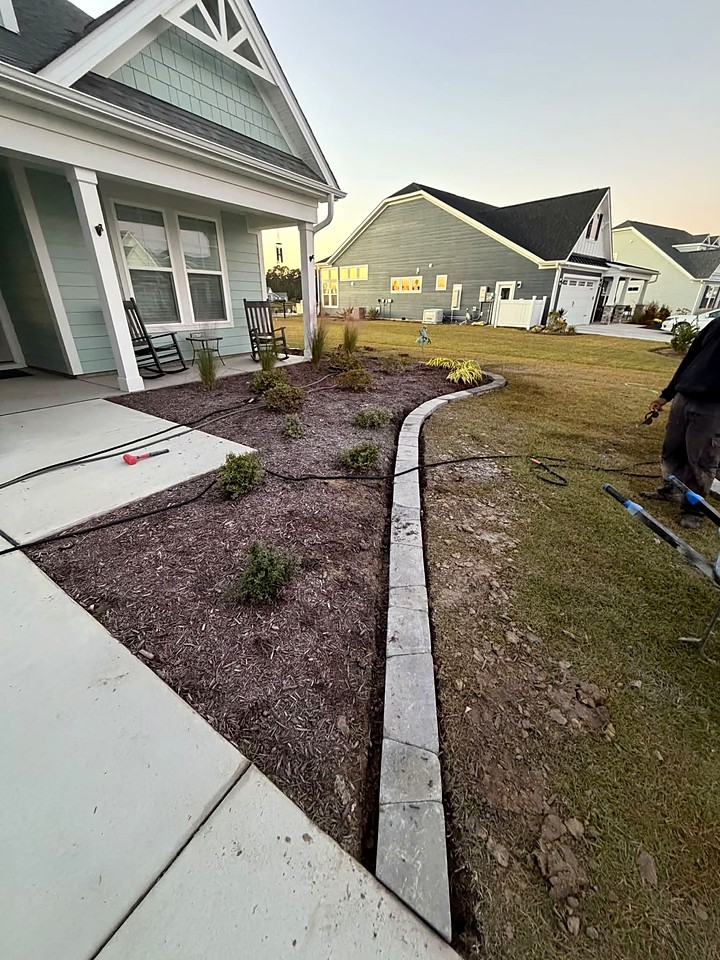
Day one: fresh concrete curbing along the front bed, before the mulch went in behind it.
What Landscape Curbing Actually Is
Landscape curbing is a continuous concrete border, formed in place along the edge of a bed so that it follows whatever line the bed takes — straight runs, sweeping curves, a full circle around a tree — without joints, stakes or pieces. The crew prepares a shallow trench along the marked line, the concrete is placed and shaped into a low, rounded profile a few inches wide and a few inches tall, and the surface is finished and jointed before it sets. Within a day it has firmed up; within a few days it has cured enough to take a mower wheel; and from then on it simply stays there.
That is the difference between curbing and every other way of edging a bed. Plastic edging heaves out of the ground in the first year, shows its black lip above the mulch and gets chewed by the trimmer. Steel and aluminum edging holds a line well but sits nearly flush, so it does nothing to hold mulch back and it rusts or dents. A row of individual brick or paver edgers looks handsome but each piece can settle or tilt on its own, and the joints between them let grass runners through. A spade-cut edge, which is what most beds in Little River and Longs have, is the cheapest of all and has to be re-cut every season or it disappears. Curbing is one solid, continuous piece of concrete. There is nothing to heave, nothing to tilt and nothing to re-cut.
It is also, in the right setting, good-looking. The pale grey curb reads as a deliberate line drawn around the beds, it frames the mulch and planting, and on a house like this one — light siding, clean trim, a newer neighborhood — it matches the tidiness of the architecture. Curbing can be left plain or it can be stamped and colored; here it was stamped with a stone-block pattern, so that from a few feet away it reads as a row of edging stones while still being one continuous piece of concrete with none of the joints that real stones would have. It is a good compromise between the crispness of a plain curb and the softer look of stone, and it suits the mulch and planting behind it.
Why a Bed Edge Needs to Be Permanent on the Coast
We wrote recently, in the context of a front-yard bed renovation in Ocean Isle Beach, that the bed line does more work than the plants do. That is true everywhere, but on the coast there are particular reasons an edge that is merely cut into the soil does not last.
The first is the grass. The warm-season lawns that grow here spread by runners above and below the surface, and a soft edge is an open invitation. Within a season the lawn has crept six inches into the bed, the mulch line is ragged, and the only way to restore it is to cut it back again. The second is the soil. Sandy ground does not hold a cut edge the way clay does; the vertical face slumps, the lawn side settles, and the crisp line you paid for in March is a vague slope by July. The third is the rain. A summer downpour on the coast can put two inches on a yard in an hour, and that water moves mulch. Without a lip to hold it, mulch washes out of the bed and onto the lawn and the driveway, and every storm takes a little more.
A concrete curb answers all three. The runners meet a wall they cannot cross, the edge cannot slump because it is not soil, and the raised profile holds the mulch where it belongs. That is why the beds in the finished photos look as crisp as they did on the day the mulch went in, and why they will look that way next year.
The Mower Strip: What Curbing Does for Maintenance
The homeowner’s version of all this is simpler. With curbing, the mower runs with one wheel along the top of the curb and cuts the lawn right to the edge of the bed. There is no strip of grass left standing against a plastic edge, no bed lip to dodge, and no need to come back with a string trimmer and scalp the grass along the line. For a lawn service it is faster; for a homeowner doing it themselves it removes the most tedious part of the job entirely.
It also protects what is in the bed. A string trimmer run along an unprotected edge nicks every plant stem, every irrigation head and every drip line it passes, and it is the single most common cause of damage to young shrubs we see. Put a curb between the lawn and the bed and the trimmer never needs to go there. The beds on this property are planted with grasses and young shrubs that are going to be far better off for it.
Curbing a Tree Ring
The ring around the young tree in the front lawn is a small thing that solves several problems at once. A tree planted in the middle of a lawn is in competition with the grass for water and nutrients, and it is in daily danger from the mower and trimmer, which is why so many young trees in new neighborhoods have a ring of bark missing at the base. A mulched ring with a curb around it keeps the grass away from the trunk, keeps the mower and trimmer a safe distance off, holds moisture over the roots, and gives the tree a defined space that looks intentional rather than like a sapling someone forgot in the yard.
The ring is sized generously here, which is right. A tree ring that hugs the trunk looks mean and does little; one that extends out toward the drip line of the young canopy gives the roots room and lets the ring grow into the tree as it matures. The curb follows a true circle, which is the kind of line that is easy to spray-paint on grass and very hard to hold with any edging that comes in pieces — and the stamped stone pattern makes the circle look like it was built from blocks without any of the settling that individual blocks would eventually do.
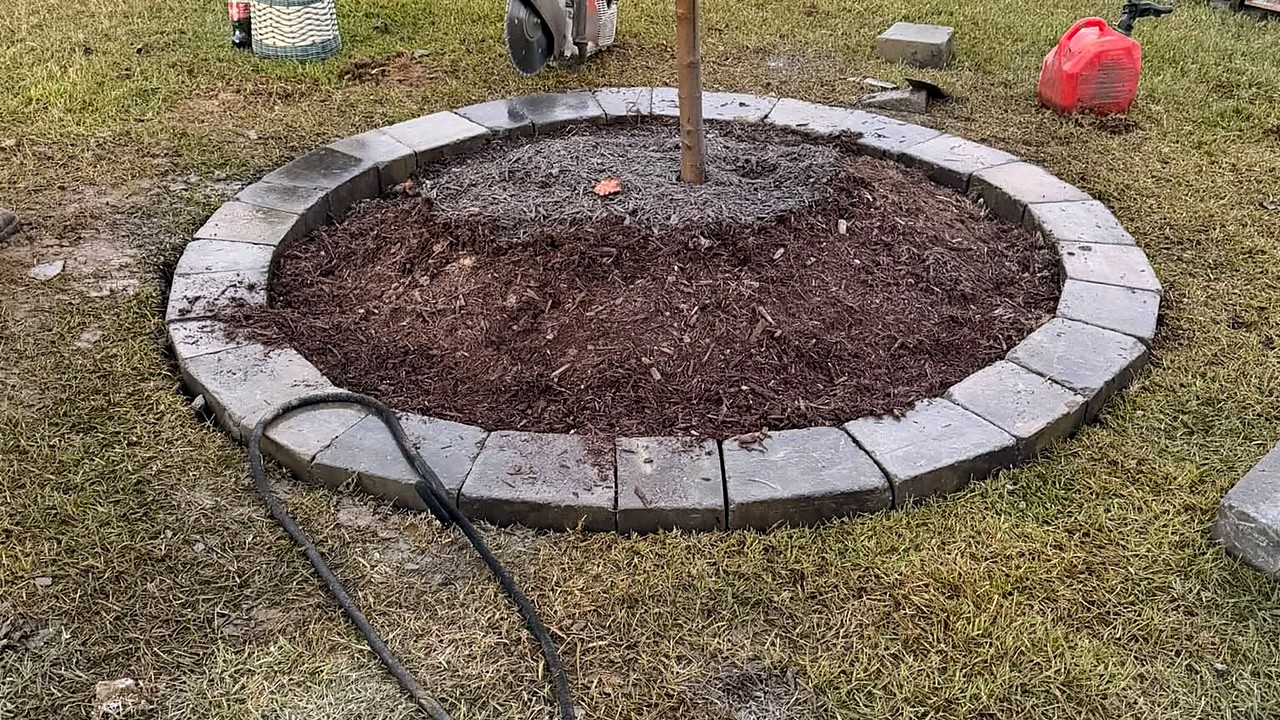
The tree ring on day one: a true circle of curbing, mulched, with the young tree given room to grow into it.
A Bed Around the Utility Boxes
Most lots in a newer neighborhood like Bridgewater have one: a green transformer cabinet and a cluster of pedestals and valve boxes near the street, sitting in the lawn where everybody can see them. The homeowner cannot move them and cannot cover them, and mowing around them is a chore. What they can do is what was done here — build a curbed, mulched bed around the whole group, plant low shrubs between and in front of the equipment, and turn an eyesore into a landscape feature.
There are rules, and the bed respects them. The power company needs clear access to the transformer, particularly at the front where the doors open, and will cut back anything that blocks it, so the planting is kept low and set back from the equipment rather than screening it tightly. Nothing is planted over buried lines. The curb itself sits well clear of the cabinet pad. Within those limits a bed like this does what a lawn cannot: it makes the equipment read as something sitting inside a planting rather than something sticking out of the grass, and the dark mulch and green foliage take the eye away from the green steel. It also means nobody has to mow or trim up against the cabinet again.
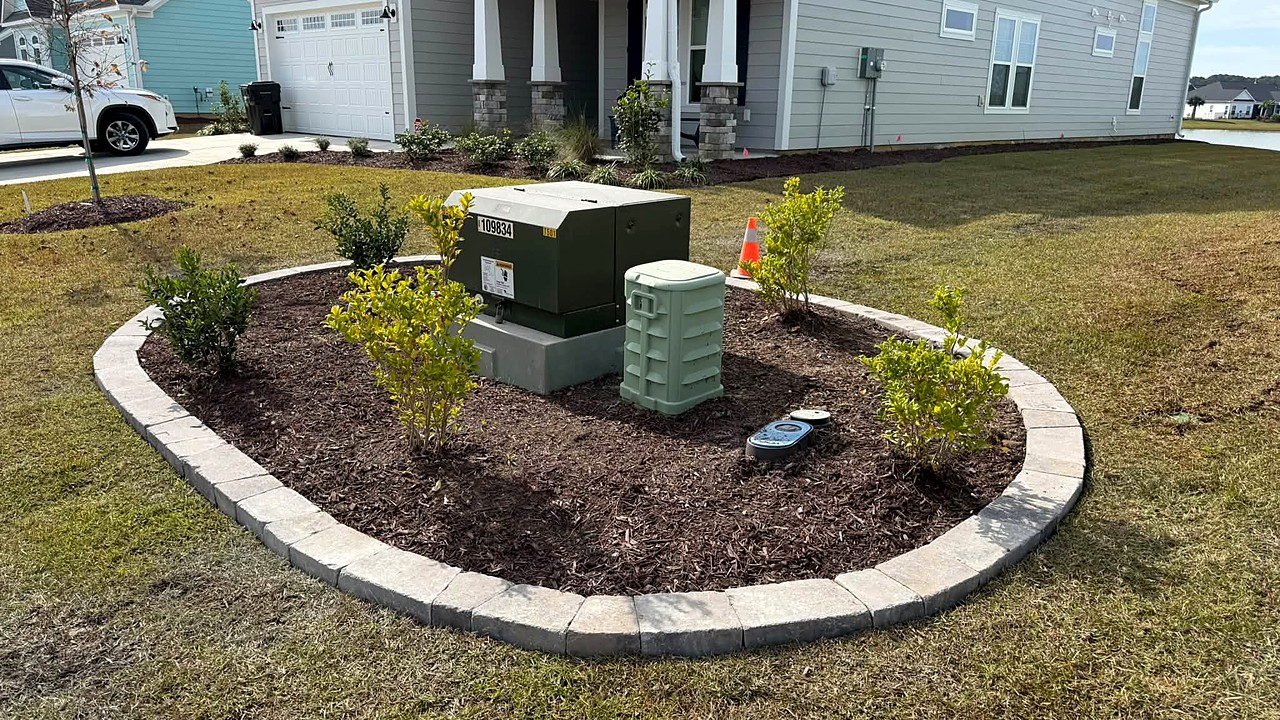
The utility bed finished: curbing, mulch and low shrubs around the transformer and pedestals, with the clearances the utility needs kept open.
The Long Side Beds
Down both sides of the house run long, narrow beds between the siding and the lawn, past the air conditioning units, the meters and the downspouts. These are the beds most homeowners neglect, because nobody sees them from the street, and they are also the beds that cause the most trouble, because they are where the roof runoff lands and where the lawn creeps in unopposed. Curbing them does two useful things. It draws a clean line that makes the side of the house look finished from the backyard and from the neighbor’s lot, and it keeps the mulch in place when water comes off the roof.
The practical detail is the height of the mulch against the siding. Mulch piled up against a house holds moisture against the wall and gives insects a bridge, so the bed behind a curb should be filled to a level that stays comfortably below the bottom of the siding, with the curb lip holding it there rather than letting it drift upward with each top-up. On the lakeside of this house the bed also has to shed water toward the lawn rather than toward the foundation, and the curb is set so that it does.
A Paver Pad and Walkway for the Trash Enclosure
The other half of the week was the trash enclosure beside the garage. Many neighborhoods in Little River and North Myrtle Beach require bins to be out of sight from the street, and a white vinyl enclosure against the side of the garage is the usual answer. What the enclosure usually lacks is a floor. Bins on grass or bare soil sink, tilt and leave a mud patch, and dragging them to the curb on collection day across soft ground gets old quickly.
The crew built a paver pad inside and in front of the enclosure and a short paver walkway from the pad to the edge of the driveway, so the bins roll on a hard, level surface from where they live to where they are collected. The pavers are a grey field with a charcoal border, laid on a compacted base like any walkway and edged so they will not creep. The pad is pitched gently away from the house so water runs off it rather than into the enclosure. It is a small piece of hardscape — a fraction of what a full front walkway involves — but it is the kind that a homeowner uses twice a week for as long as they own the house, and it is worth doing properly.
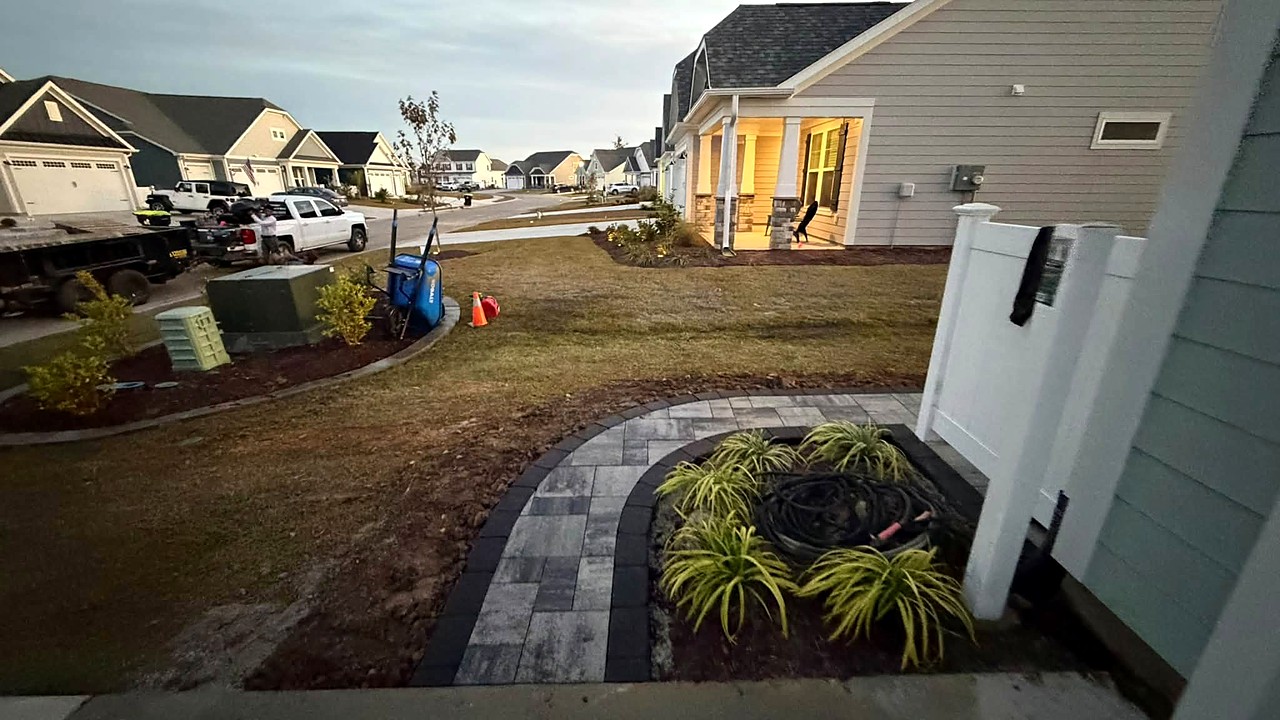
Midweek: the paver pad and walkway going down at the enclosure, charcoal border first, tying into the edge of the driveway.
How a Week Like This Is Sequenced
The three Facebook posts happen to show the order a job like this has to go in. Curbing comes first, because it defines every bed and because it needs time to cure before anything presses against it. While it cures, the crew moves to work that does not touch it: the enclosure posts, the base for the paver pad, the compaction. Once the curb has hardened, the beds behind it are cleaned out, re-cut to the curb line and mulched, and the pavers are laid at the enclosure. The finish photos come a few days after the first, and everything in them is set and ready to use.
Doing it in this order also keeps the lawn intact. A curbing job that is planned well disturbs a strip a few inches wide along each bed line and nothing else, and the lawn on this property looks in the final photos exactly as it did in the first. That is worth asking any contractor about before they start: how much of the yard are you going to be driving over, and what will it look like when you leave?
Curbing on a New-Construction Lot
Newer neighborhoods on the coast have a particular pattern. The builder installs a lawn, a handful of shrubs in a thin bed along the front of the house and a tree or two in the yard, and the beds are edged with a spade or not at all. Within a couple of years the owner has a lawn that has grown into the beds, mulch that has washed out onto the driveway, a tree ring that has disappeared and a transformer standing in the open. Curbing is the single project that addresses all of it at once, and it is far easier to do while the planting is young than after the beds have filled in.
It also plays well with everything that comes later. Beds that are defined by a permanent curb can be replanted, re-mulched or switched to decorative stone without the edge ever changing, and a walkway or patio built against a curbed bed meets a clean line rather than a soft one. Several of the projects we have written up in Bridgewater over the past month — a patio extension and a front walkway — are on lots that would be improved by exactly this kind of edge.
Mistakes Worth Avoiding With Landscape Curbing
The first is curbing a bed line that was never right. Curbing makes an edge permanent, so the line should be walked, adjusted and painted on the grass before anything is poured; a curve that is slightly off in paint is a curve that is permanently off in concrete. The second is curbing beds without re-cutting and re-mulching them at the same time. A crisp new curb around a tired bed makes the bed look worse, not better, and the two jobs belong together.
The third is ignoring water. A continuous curb is a continuous dam, and if a bed sits where runoff needs to cross it, the water will pond behind the curb or scour under it. On this property the beds shed toward the lawn and there is nowhere water needs to break through, but on a lot where it does, the curb needs a gap or a drain at that point, and that has to be planned rather than discovered. The fourth is piling mulch over the curb instead of behind it, which hides the line you paid for and lets the mulch wash straight over. The fifth is driving over it. Curbing takes a mower wheel without complaint; it does not take a truck tire, a trailer or a skid steer, and the one place a curb cracks is where someone cut a corner across it.
Frequently Asked Questions
It is a continuous concrete border formed in place along the edge of a landscape bed, a few inches wide and a few inches tall with a rounded profile, following straight runs, curves or full circles without joints or separate pieces. Once cured it is a permanent line between lawn and bed that holds mulch in, keeps grass out and gives the mower a track to run along. It can be left plain, or stamped and colored, as it was on this project.
Plastic edging heaves, shows above the mulch and gets chewed by trimmers; metal edging sits nearly flush so it does not hold mulch; brick or paver edgers can settle individually and let grass runners through the joints; a spade-cut edge has to be re-cut every season. Curbing is one continuous piece of concrete with none of those failure points, and it is the only option that lets the mower cut right to the bed edge with no trimming.
It firms up within a day and is normally ready for a mower wheel within a few days; full strength comes over the following weeks. Keep foot traffic, pets and sprinklers off it for the first day or so, and never drive a vehicle or equipment across it at any point.
Properly installed curbing is jointed at regular intervals so that any movement happens at the joints rather than as random cracks, and on a stable, compacted base it lasts for many years. The one thing that breaks it is a vehicle, trailer or skid steer driven across it. Hairline cracks at the control joints are normal and not a defect.
Yes, and it is one of the best uses for it. The bed is kept clear of the equipment pads and buried lines, the planting in front of the transformer doors is kept low and set back so the utility retains access, and the curb and mulch turn the cluster of equipment into part of the landscape rather than something standing in the lawn. The utility can still reach everything it needs to.
It can if nobody thinks about it. A continuous curb is a continuous barrier to surface water, so where a bed sits in the path of runoff the curb needs a gap or a drain at that point. On most lots, including this one, the beds shed water toward the lawn and no break is needed. It is one of the things we look at when walking the yard before the line is painted.
Bins on grass or soil sink, tilt and churn the ground to mud, and dragging them across soft ground every collection day is miserable. A compacted paver pad with a short walkway to the driveway gives them a hard, level, well-drained surface, keeps the enclosure clean and makes the bins easy to roll. It is a small job that gets used twice a week for as long as you own the house.
Yes. Landscape curbing, paver pads and walkways, patios, landscaping, decorative stone and drainage across Little River, Longs, Conway, North Myrtle Beach and Myrtle Beach in South Carolina, and Calabash, Sunset Beach, Ocean Isle Beach, Shallotte and Ash in North Carolina. Newer neighborhoods like Bridgewater, where the builder’s beds have started to get away from the lawn, are where we do most of it.
Ready to Improve Your Outdoor Space?
If your beds have crept into the lawn, the mulch washes out every storm, the tree ring has disappeared and the transformer is standing in the open, call Matt Jones and walk the yard with him. He will tell you honestly where curbing earns its keep, where a bed needs re-cutting first, and what a week like this one would take on your lot.
Precision Hardscape & Construction LLC — Matt Jones
Serving Little River, Longs, Conway, North Myrtle Beach and Myrtle Beach in South Carolina, and Calabash, Sunset Beach, Ocean Isle Beach, Shallotte and Ash in North Carolina.
Landscaping · Decorative Stone · Paver Walkways · Paver Patios · Drainage · Contact Us