
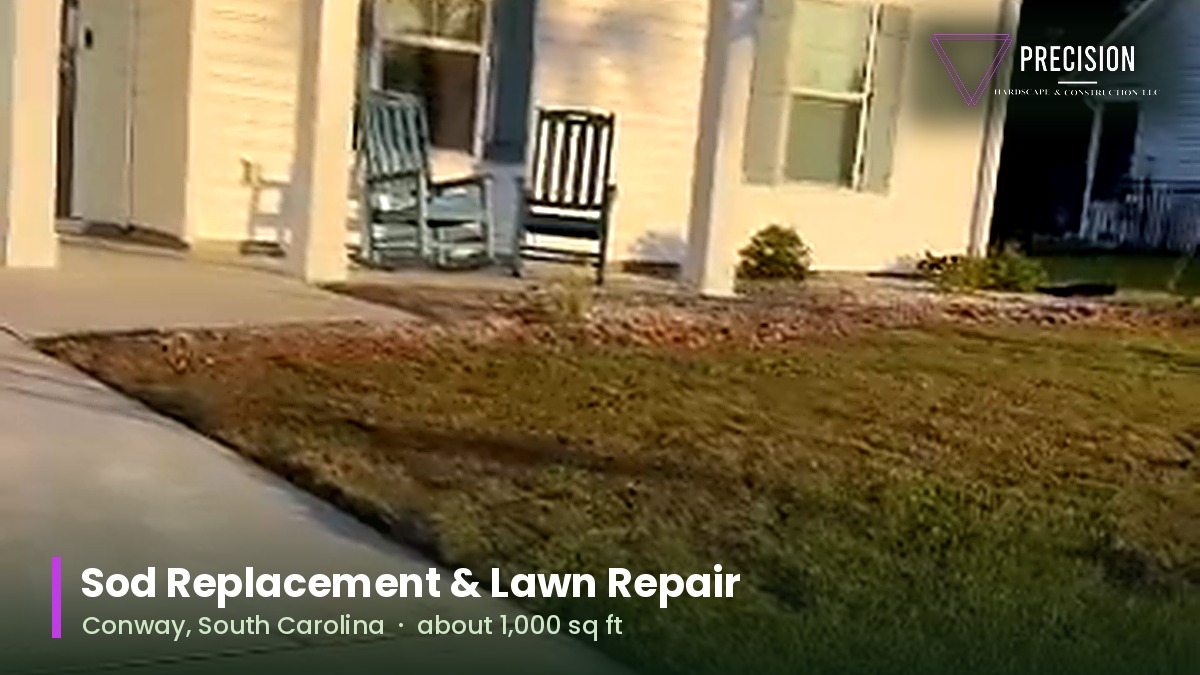
There is a particular kind of lawn that homeowners stop looking at. Not the whole yard — the back is usually fine, and from the street everything reads as normal. It is the side yards, the strip along the fence, the ground around the pool deck. Bit by bit those areas go from thin to patchy to bare, and at some point the owner simply stops walking that way.
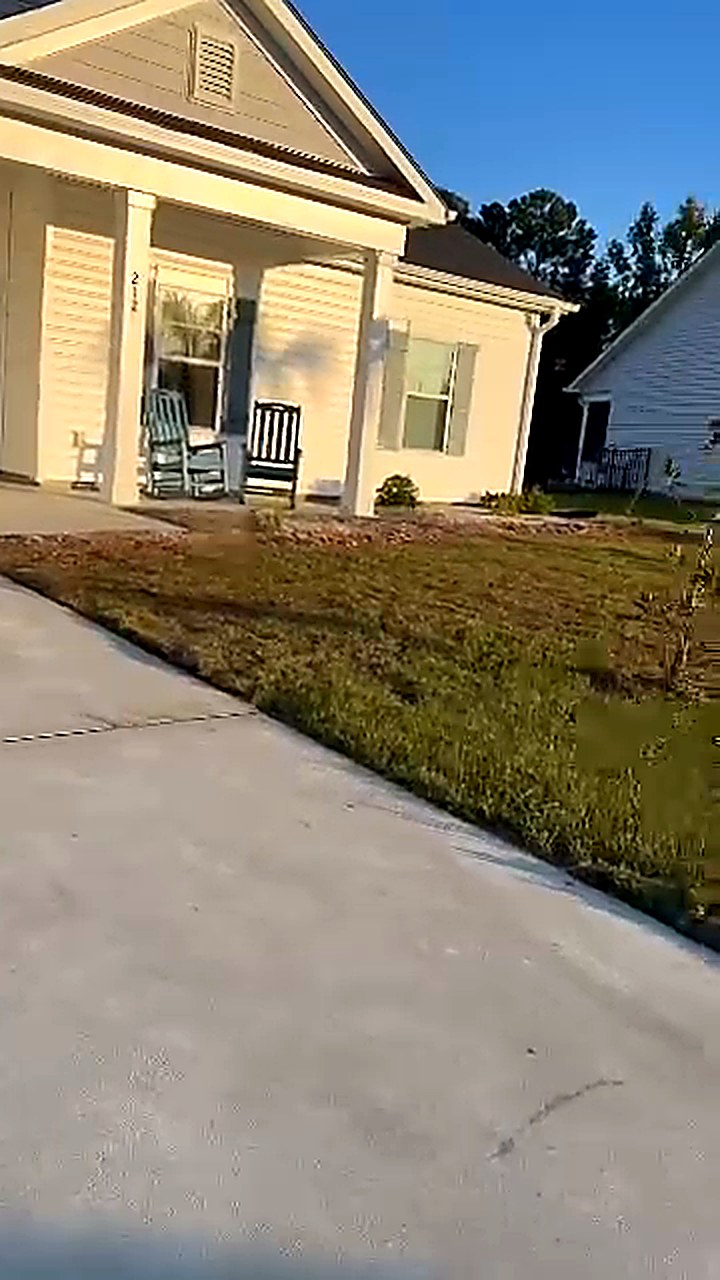
That is roughly the state of the property Matt Jones and the Precision crew went to in Conway, South Carolina. By the end of one day, about a thousand square feet of damaged sod had come out, new soil had gone in, and new sod was down across both side yards, part of the back, and all the way around the pool deck.
Matt walks the job twice — once mid-morning with the old sod stripped out, and again at sunset with the new sod down.
What’s In This Article
- What the Property Looked Like That Morning
- Why the Old Sod Came Out Rather Than Being Patched
- New Soil Before Any New Grass
- Two Side Yards, Which Is Where Most of the Work Was
- The AC Unit, and a Call the Homeowner Made
- Around the Pool Deck
- Making the Join Between Old and New Grass Disappear
- A Thousand Square Feet in a Day
- Photos From the Job
- Frequently Asked Questions
What the Property Looked Like That Morning
Matt opens the first clip with a line that tells you what kind of day it was going to be. “It’s a lawn care Monday. We’re down in Conway today doing some sod repairs.” Then he walks the property and points at each area in turn, and the list keeps going: this side, the other side, some around back, and the strip where the AC unit sits.
This is a newer home in a Conway subdivision, well kept, with a pool and good fencing and mature enough planting that nothing about it reads as neglected. The house is in good order. The lawn simply was not, in several separate places at once, which is a pattern we see constantly on properties of this age across Horry County and down the coast.
The damage was not one dramatic dead zone. It was a collection of tired, thinning, part-bare areas, mostly in the places where lawns have the hardest time — narrow side yards hemmed in between the house and the fence, ground beside mechanical equipment, and the margins around hard surfaces. Any one of them on its own is the sort of thing a homeowner lives with. All of them together is the point at which people call somebody.
If you are trying to work out why your own lawn has gone that way, we wrote a separate piece on reading the causes: why lawns die in patches, and what’s actually underneath them.
Why the Old Sod Came Out Rather Than Being Patched
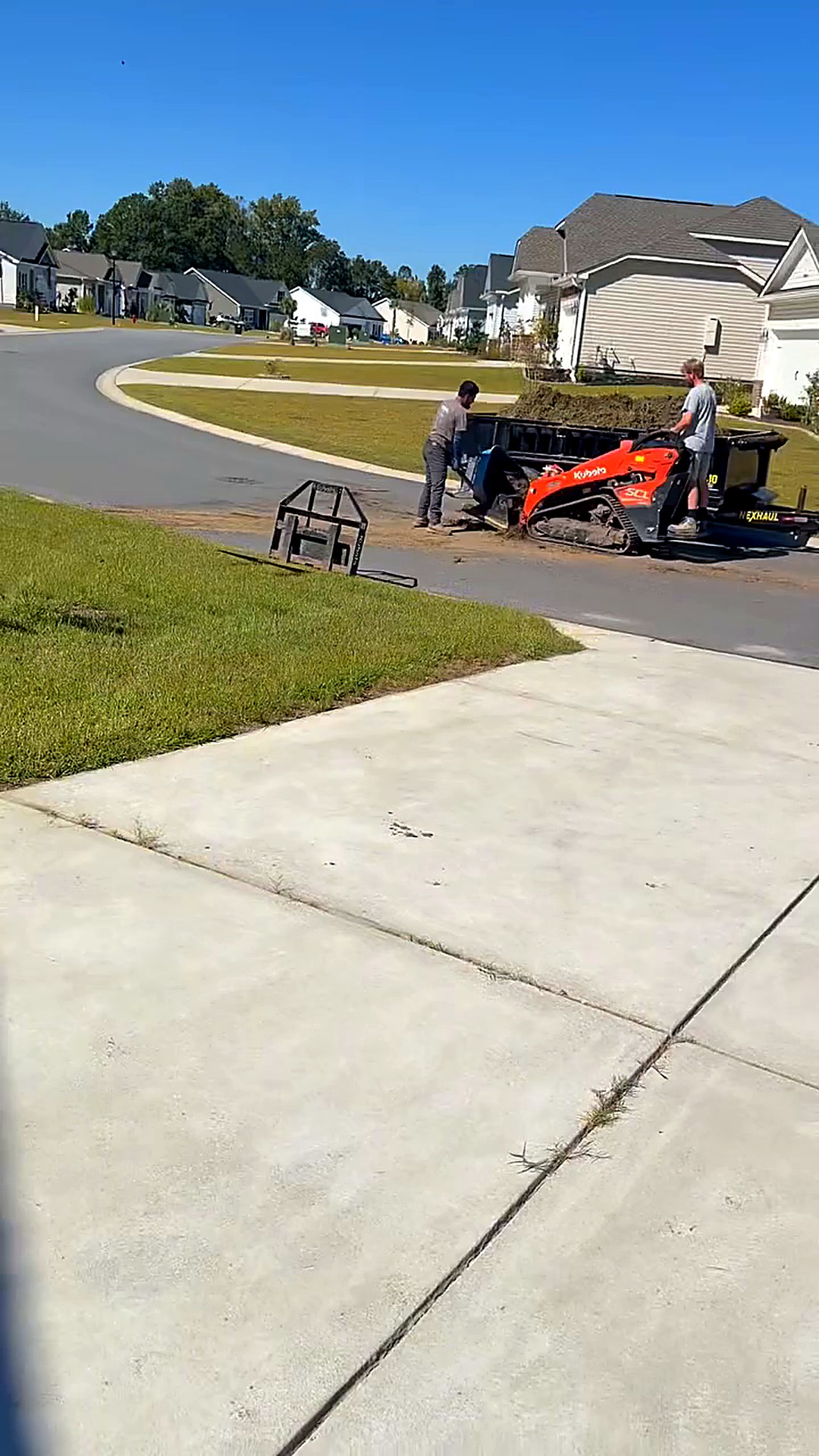
The first real decision on a job like this is whether to work around the damage or take it out entirely. Matt’s answer here was to strip it. “We ripped out all this sod here on this side, put some dirt back in there, get you guys right, so we can put some new sod down.”
Stripping costs more on day one and saves money for years afterwards, for reasons that come down to what is underneath. When grass has failed across a whole area rather than in one spot, the ground under it is usually part of the story — compacted, thin, low, or all three. Laying fresh sod on top of that ground puts new grass into exactly the conditions that killed the old grass, and it fails on the same timetable.
Taking the old sod off also solves a problem people rarely think about until they see it, which is height. Sod is not thin. Lay a new piece on top of an existing lawn and the new area sits proudly above everything around it, so the mower scalps the high edge and the join is obvious from any angle. Strip first and the new grass finishes flush with the old, the mower passes over it without noticing, and the repair stops announcing itself.
There is a judgement call in every one of these, and it is not always to strip. A small bare spot in an otherwise healthy lawn, caused by something that has since been fixed, is a patch job. An area that has been going backwards for years is a replacement. What made this property a replacement was the number of separate areas involved and how consistent the picture was across all of them.
New Soil Before Any New Grass
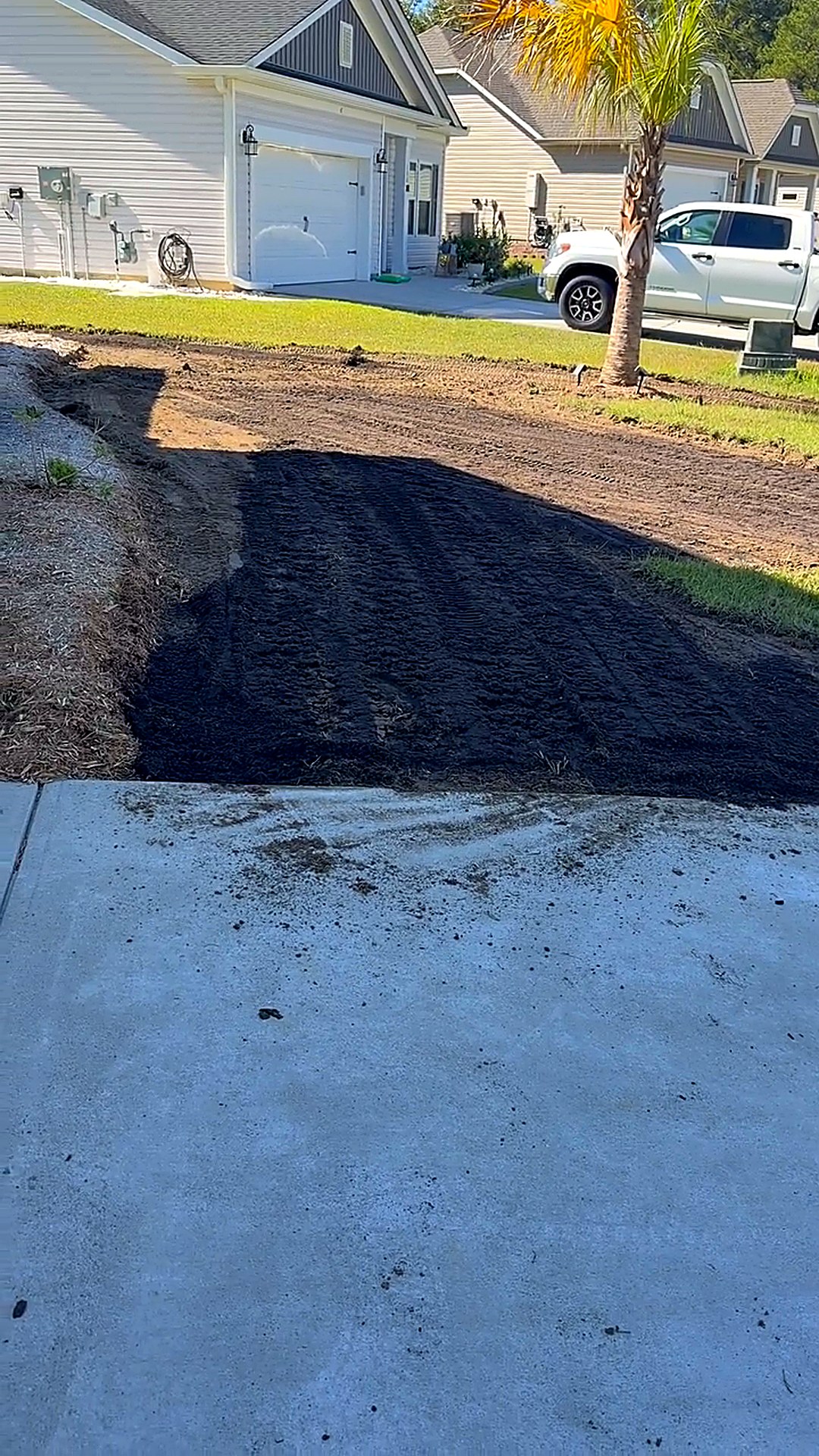
In the evening clip Matt runs through the day in one sentence, and the order of it is the part worth noticing. “Got our sod down, we got it all prepped, we got some new soil down with it, and we got it laid out.” Prepped, then soil, then sod. Nothing was laid onto the ground as the crew found it.
Bringing in new soil does two things at once. It replaces material that was never much good to begin with — on lots like this, what is left after construction is frequently compacted subsoil with very little organic content. And it gives the crew something to grade with, so the finished surface can be brought to the right height and the right fall rather than inheriting whatever contour was there.
That grading matters more than it sounds. The new soil has to finish low enough that the sod on top of it ends up flush with the existing lawn and with the hard surfaces it meets. Too high and you get a lip at every edge. Too low and the area becomes a shallow basin that collects water — which is precisely the condition that kills grass in the first place, rebuilt at the homeowner’s expense.
This is also the point in the job where anything else that needs doing has to be done, because the ground is open and it will not be open again. Drainage corrections, downspout extensions, irrigation adjustments: all of them are straightforward now and disruptive later. That sequencing is a large part of what separates a lawn repair that holds from one that is back on the list in two years.
Two Side Yards, Which Is Where Most of the Work Was
Matt puts a number on it in the evening clip: “We did about a thousand square feet up here among the two side yards.” Side yards are consistently the worst ground on a suburban property and consistently the least considered.
They are narrow, which means the grass is competing with a wall on one side and a fence on the other. They are frequently the route to the back gate, so they carry more foot traffic than any other part of the lawn. They sit in the rain shadow of the roof overhang, so they get less water than the open yard. Irrigation designed for broad coverage rarely reaches tight against a wall. And on a west-facing side, light-coloured siding reflects heat down onto a strip of ground that is already dry.
They are also the access route for every trade that visits the house, which means they take machinery, wheelbarrows and pallets in a way the front lawn never does. A side yard is the part of a property that gets the most abuse and the least attention, and it is genuinely no surprise that it is the first grass to go.
Because side yards are narrow, they are also the part of a lawn repair where the finish shows most. There is nowhere for a bad seam or an uneven grade to hide when the whole area is eight feet across and you walk down the middle of it every time you take the bins out. Getting those two strips right was most of the day, and it is most of what the homeowner now sees.
The AC Unit, and a Call the Homeowner Made
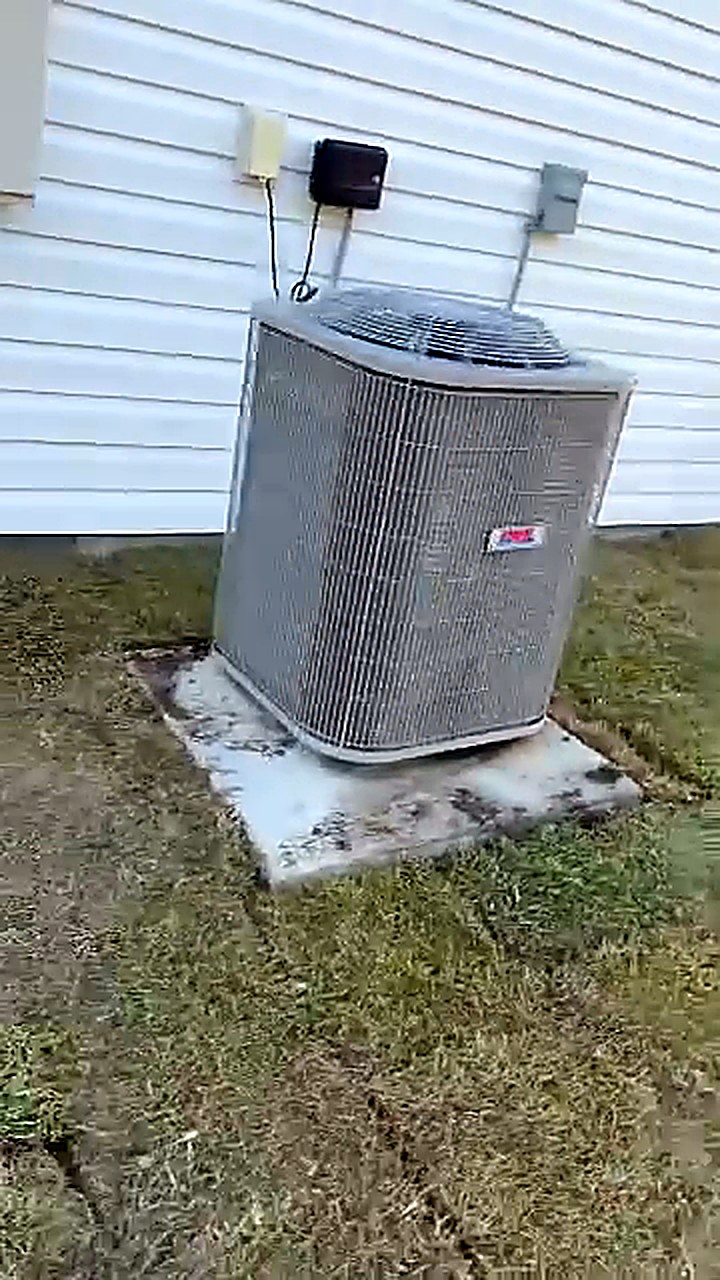
One moment in the first clip is worth pausing on, because it is the sort of thing that usually happens off camera. Matt walks up to the air conditioning unit, points at the ground around it and says, near enough: probably should put mulch there, but they want sod.
He is right on both counts. The ground around a condenser is a difficult place to grow anything. The unit throws warm, dry air across it, the pad interrupts the surface, technicians stand on it whenever the system is serviced, and it is awkward to mow and awkward to irrigate. Mulch or decorative stone in that pocket would be lower maintenance, would look tidy indefinitely, and would never need replacing.
The homeowners wanted continuous lawn, so continuous lawn is what they got. That is entirely their call to make — it is their yard and their view of it, and an unbroken run of grass does look better than a patch of stone if you can keep it alive. What matters is that the trade-off was said out loud before the decision rather than discovered afterwards. They now know that corner will want a bit more water than the rest and may need attention again down the line, which is a completely different experience from watching it fail and wondering why.
That is the version of this conversation we would rather have with every client. Not talking people out of what they want, and not quietly taking the money either — just being clear about which parts of a yard are easy and which parts are going to ask something of you.
Around the Pool Deck
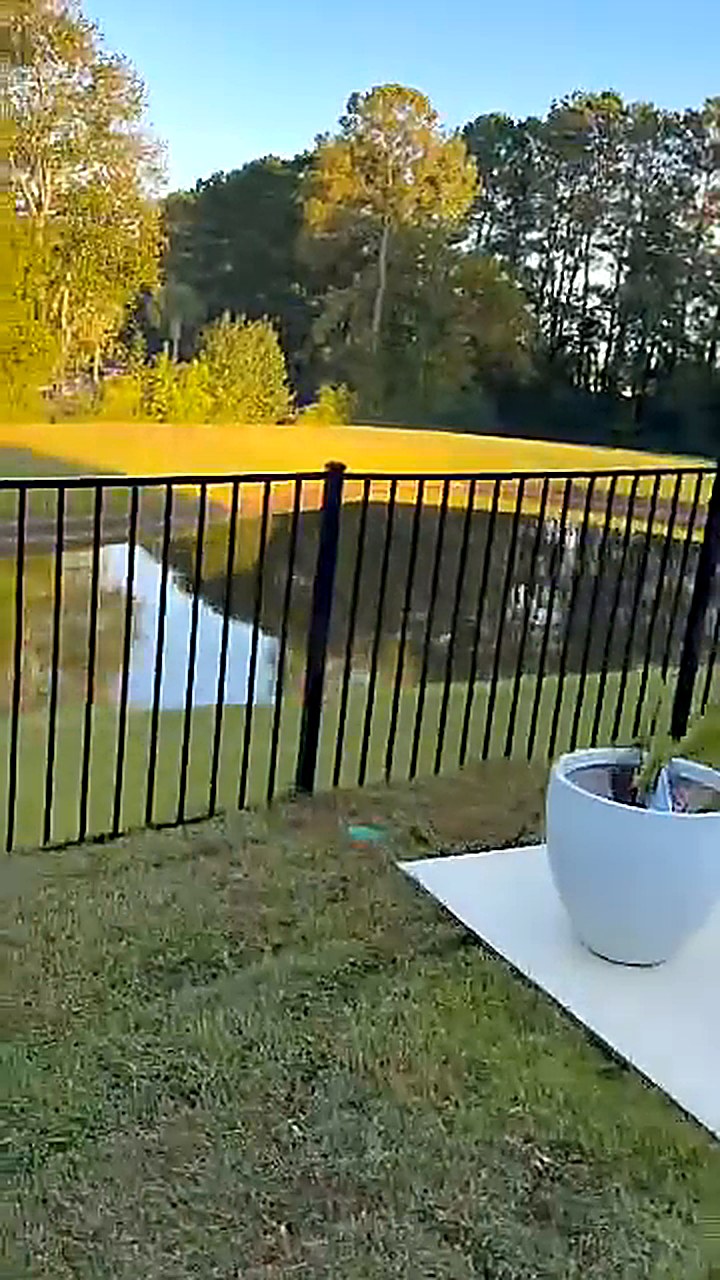
“Came around the backyard here, did around the pool deck.” The strip between a pool deck and a fence is its own small discipline, and it is one of the places where a repair either looks finished or does not.
Grass beside a pool leads a harder life than grass in the open. It gets walked on with wet feet, it catches splash-out, and the deck beside it stores and radiates heat through the afternoon. The strip is usually narrow, so there is no margin for error in the grade, and it is one of the most looked-at parts of the entire property, because people sit there.
The technical requirement is that the sod finishes flush with the top of the deck — not proud of it, which looks unkempt and gets scalped by the mower, and not below it, which leaves a lip that collects clippings and water. Getting that right is a matter of setting the soil height accurately before anything green is laid, which is the same discipline as the rest of the job, just with less room to be wrong.
Where a strip like this keeps failing despite everything, the better long-term answer is often to widen the hard surface or run a band of stone rather than to keep replacing grass. Our paver patios and decorative rock pages cover that route. On this property the ground was worth planting, so we planted it.
Making the Join Between Old and New Grass Disappear
Matt points this out himself in the evening clip: “Did the back — you see nice transition from the old sod to the new.” On a partial replacement, that transition is the detail that decides whether the work reads as a repair or as a lawn.
Three things have to line up. The height has to match, which comes from the soil preparation underneath rather than from anything done to the sod itself. The edge has to be cut cleanly rather than torn, so new grass meets old along a definite line instead of a ragged one. And the two areas need to be close enough in colour and texture that the eye stops noticing within a few weeks, which is a matter of choosing sod that matches what is already growing there.
That last point is worth a homeowner’s attention when quotes are being compared. Lawns in this region are a mix of centipede, zoysia, St. Augustine and Bermuda, and they do not look alike. A patch of the wrong variety will be visible for as long as it lives, no matter how well it was laid. Matching what is already in the ground is not a detail; it is the difference between a repair you forget about and one you see every day.
Give it a few weeks of growing and watering and the seam on a well-matched job stops being findable. That is the actual goal. Nobody wants a lawn that looks repaired — they want one that looks like it was never damaged.
A Thousand Square Feet in a Day
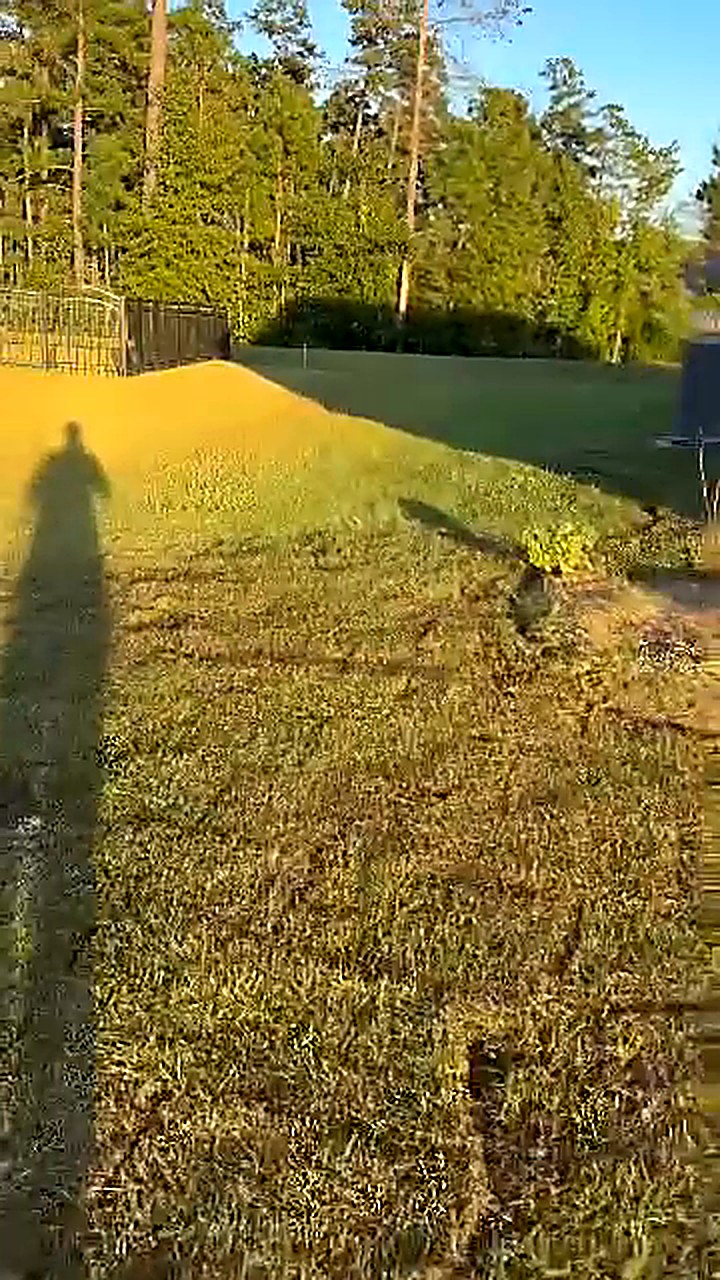
Stripping, hauling, soil in, grading, laying and cutting in around four separate areas, finished the same day. That pace is not about rushing; it is about sod having a clock on it.
Sod is a living product harvested on a farm, stacked on pallets and delivered with its roots cut. From the moment it is cut it is deteriorating, and a warm pallet sitting in a South Carolina afternoon deteriorates quickly — the middle of a stack heats up and the grass yellows from the inside out. The professional standard is to get it down and watered the day it arrives, which means everything else on the job has to be ready before the delivery, not after.
That is why the prep order matters so much and why a crew works the way this one did. Strip and grade first, have every area open and to height, then lay. Anyone who has seen pallets of sod sitting on a driveway for two days has seen a job that was sequenced the wrong way round, and the grass pays for it.
Matt closes the evening clip the way he tends to: “A lot of damaged sod around this property, and we got the majority of it fixed up. So, happy client and another job in the book.” What happens over the following two or three weeks is now largely down to watering, and that part belongs to the homeowner — we cover it in what actually happens when you have sod replaced.
Photos From the Job
Frequently Asked Questions
Whichever the property actually needs. On this Conway job the healthy grass stayed and we replaced about a thousand square feet across the areas that had failed — both side yards, part of the back and around the pool deck. Partial replacement is normal and usually the sensible choice; the thing that makes it work is matching the sod variety to what is already growing and getting the heights to line up so the join disappears.
Two reasons. The ground under failed grass is usually part of why it failed, so laying over it puts new sod into the same conditions and it dies on the same timetable. And sod has real thickness — laid on top of existing lawn, the new area sits high, the mower scalps the edge and the repair is visible from any angle. Stripping first lets the new grass finish flush.
This one was a single day — strip, haul away, bring in soil, grade, lay and cut in around four separate areas. That is driven by the sod itself rather than by ambition: it is harvested with its roots cut and deteriorates on the pallet, so the professional standard is to lay and water it the day it arrives. Everything else on the job has to be ready before the delivery, not after.
For a few weeks, yes, mostly as a difference in colour while the new grass settles. After that it should stop being findable, provided three things were done: the heights match, the edge was cut cleanly rather than torn, and the new sod is the same variety as what is already growing. Mismatched varieties stay visible for as long as they live, which is why matching matters more than most homeowners realise.
Yes, and the height is the whole job. The finished grass should sit flush with the hard surface — proud of it and the mower scalps the edge, below it and you get a lip that traps water and clippings. That comes from setting the soil accurately before anything is laid. Where a narrow strip beside a deck keeps failing regardless, widening the hard surface or running a band of stone is often the better long-term answer.
Mulch or decorative stone is the easier material there. A condenser throws warm dry air across the ground, the pad breaks up the surface, technicians stand on it during servicing, and it is awkward to mow and to irrigate. Sod will grow there, but that corner will always want more attention than the rest of the lawn. On this job the homeowners preferred continuous grass, which is a fine choice to make as long as it is made knowingly.
Conway included — this job was there. We cover the coastal Carolina market on both sides of the state line: Conway, Little River, Longs, North Myrtle Beach and Myrtle Beach in South Carolina, and Calabash, Sunset Beach, Ocean Isle Beach, Shallotte and Ash in North Carolina. If you are not sure whether you are in range, call and ask.
Water, mainly, and on a schedule rather than by eye — new sod is the one landscaping product whose success genuinely sits with the homeowner in the first fortnight. It also needs to be kept off, and the first mow needs to wait until the roots have taken hold. The watering schedule and the rest of the aftercare are set out in our article on what to expect from a sod replacement.
Ready to Improve Your Outdoor Space?
Whether it is a tired side yard, a strip beside the pool that never recovered, or a lawn you have stopped looking at, call Matt Jones and walk it with him. He will tell you honestly what is wrong underneath it and what it takes to build it right the first time.
Precision Hardscape & Construction LLC
Serving Conway, Little River, Longs, North Myrtle Beach and Myrtle Beach, SC
and Calabash, Sunset Beach, Ocean Isle Beach, Shallotte and Ash, NC