
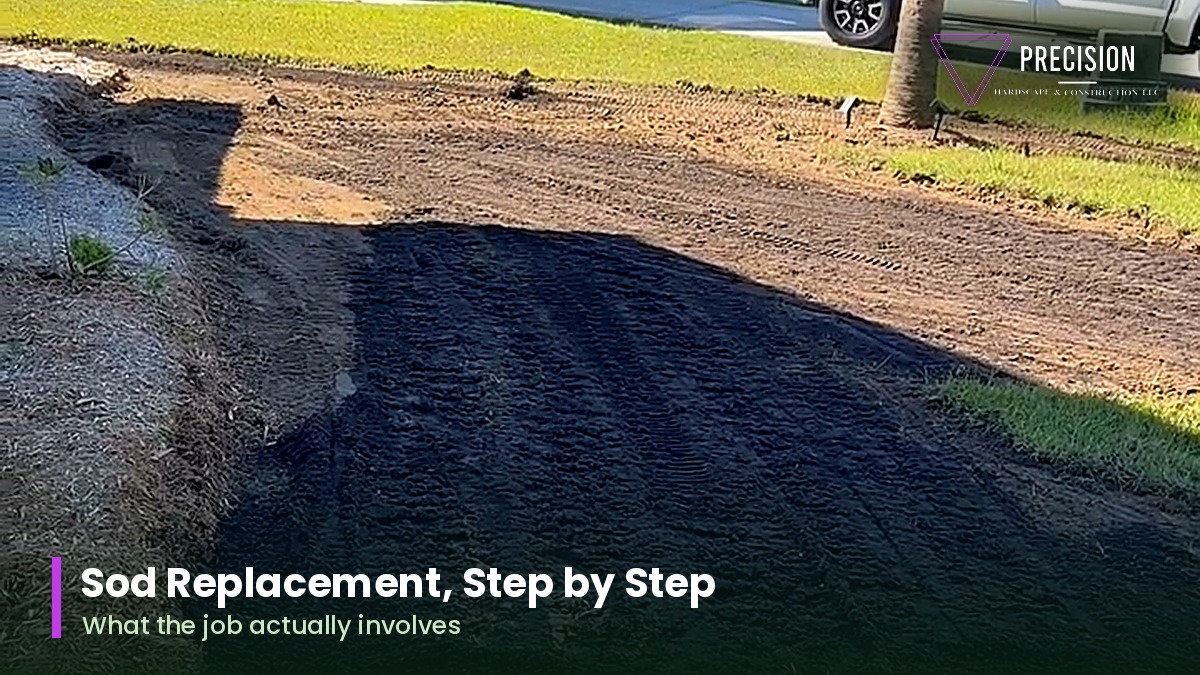
Most people have a rough mental picture of sod replacement that goes something like: a truck arrives, some men roll out grass, the yard is green by teatime. That is not wrong exactly, but it leaves out almost everything that determines whether the lawn is still green a year later.
This is a plain account of what actually happens, in order, from the first site visit to the first mow. It also covers the two questions homeowners most want answered and most hesitate to ask outright — what makes one quote higher than another, and what you are personally on the hook for once the crew drives away.
What’s In This Article
- The Visit That Happens Before the Quote
- Stripping Out and Hauling Away
- Soil and Grading — the Only Chance You Get
- Laying: Seams, Cuts and Why It Gets Rolled
- The First Watering and the Fortnight After
- When You Can Walk On It, and When to Mow
- What Actually Drives the Price
- The Best and Worst Times of Year to Do It
- What Can Still Go Wrong
- Frequently Asked Questions
The Visit That Happens Before the Quote
A contractor who can quote your lawn over the phone from a square footage is quoting you for grass. That is fine if grass is all you need, and it is a warning sign in most other circumstances.
The site visit exists to answer a short list of questions. What is the ground actually like under the failed grass — and the usual test for that is unglamorous, a screwdriver or a probe pushed in at several points to find out where it stops. What grass is already growing, so the new sod can be matched to it. Where the water goes during heavy rain, which is often deduced from what the ground and the edges look like rather than observed directly. How much sun the area genuinely gets. Where a truck can park, where pallets can be set down, and whether there is gated access wide enough for a machine or whether everything is going to be moved by wheelbarrow.
That last one has more effect on the price than most homeowners expect, and it is worth understanding before you compare bids. A back yard reachable only through a narrow side gate can double the labour of moving material, and a contractor who has not looked will either be unpleasantly surprised or will have padded the number to cover the uncertainty.
The other thing the visit should produce is an honest conversation about whether sod is the right answer for every area in question. Some spots should not be planted at all, and a contractor who says so is saving you from paying twice. If you have not yet worked out why your grass failed, start with why lawns die in patches — the cause has to be dealt with before replacement is worth doing.
Stripping Out and Hauling Away
On the day, the first thing that happens is removal, and it is noisier and more disruptive than people picture.
The old turf gets cut and lifted — by machine where there is room, by hand where there is not — and it comes off with an inch or two of soil attached, which means it is heavy and there is a surprising volume of it. A thousand square feet of stripped sod is several tons of material that has to leave the property. Where it goes, and whether hauling is included, is a line worth checking on any quote.
Removal depth matters. The aim is to take off the old grass and its thatch layer without excavating so deep that you are then importing soil to fill a hole you just made. Too shallow and remnants of the old lawn come back through the new one; too deep and the job gets needlessly expensive.
This is also the stage that is hardest on the rest of your property, which is worth mentally preparing for. Wheelbarrows and machinery run across the lawn you are keeping. There will be a period of the day when the yard looks considerably worse than it did when you had a patchy lawn, and that is normal. A good crew protects the routes they use and puts things back, but the middle of the day is not the moment to look out of the window and judge the result.
Soil and Grading — the Only Chance You Get
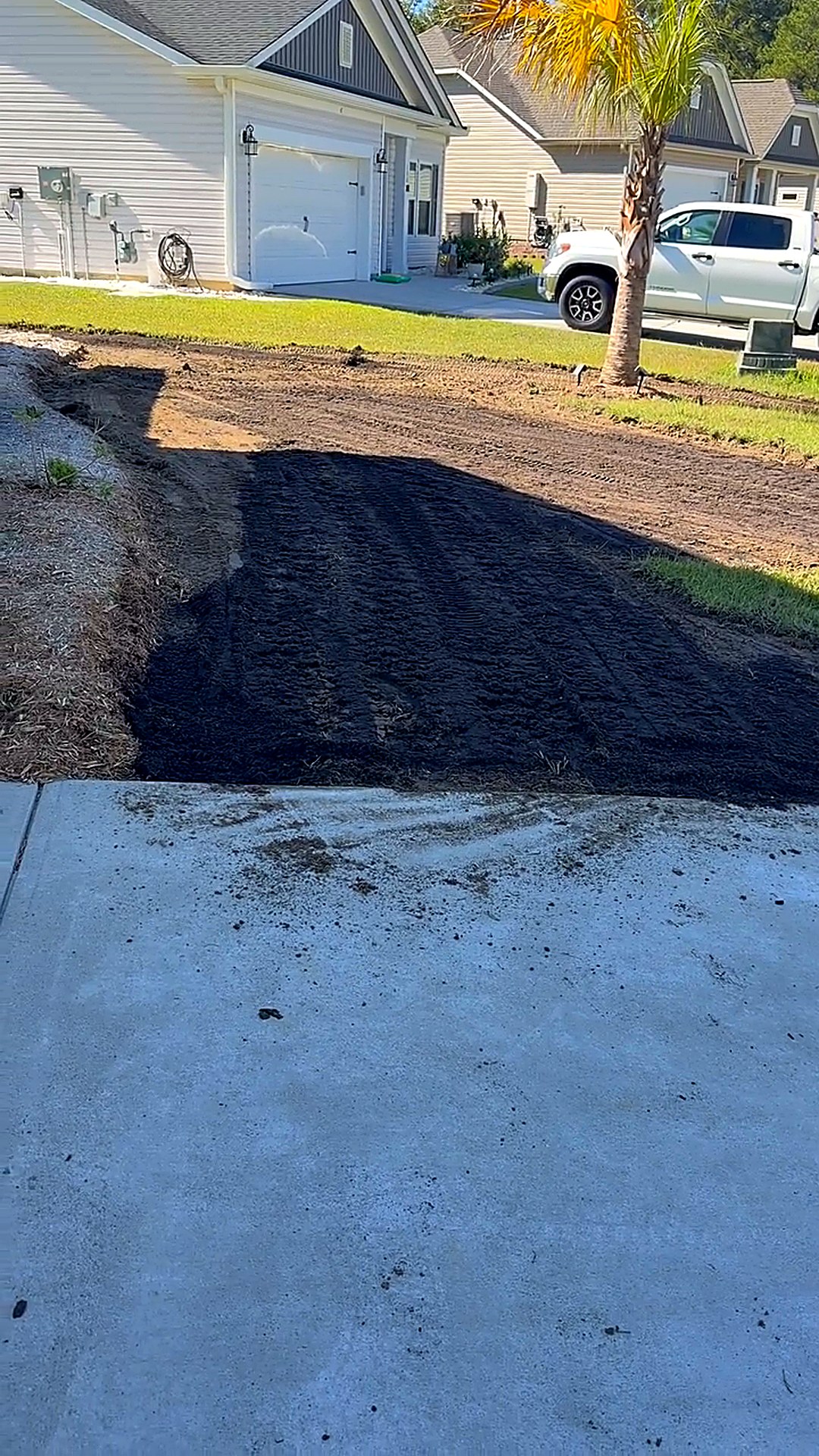
If you take one thing from this article, take this. The soil stage is the whole job. Everything after it is finishing work, and everything before it was preparation for it.
New soil comes in to replace what was poor, to break up compaction, and to give the crew a material they can shape. It gets spread and worked to a consistent depth, then graded — and grading is doing two separate things at once. It sets the finished height, so the new grass will sit flush with the existing lawn and with every hard surface it meets. And it sets the fall, so water runs where you want it to go rather than pooling in the middle of your new lawn.
The height calculation is the part homeowners never see and always notice if it is wrong. Sod is not thin, so the soil has to finish that much below the final level. Get it right and the mower passes over the join without catching. Get it wrong by an inch and you have either a lip along every edge or a shallow dish that holds water.
This is also the moment for anything else that belongs underground, because the ground will not be open again. Extending a downspout, correcting a low spot, adjusting or repairing irrigation heads, putting in a drain where water has been sitting — all of it is straightforward while the area is stripped, and all of it means lifting your new lawn if it is done later. Where drainage is the underlying problem, our drainage solutions page covers what that work involves, and it is worth doing in the same visit.
Laying: Seams, Cuts and Why It Gets Rolled
Laying is the fast, satisfying part, and it is over quickly compared with everything that preceded it. There is still craft in it.
Pieces go down tight against each other with the seams staggered rather than lined up, in the same way bricks are laid, because continuous seams running the length of an area are both visible and a channel for water to run along. The pieces are butted, not overlapped and not gapped — a gap dries out and the edges of both pieces brown off, and an overlap sits high and gets scalped.
Edges get cut to fit rather than folded or forced, which is most of the fiddly work on a job with a lot of hard surfaces, beds, posts and mechanical equipment to go around. On a narrow strip beside a deck or a driveway, this is where the finished look is won or lost.
Afterwards the area is usually rolled. That is not about flattening it for appearance — it is to press the roots into contact with the soil underneath. Sod that is sitting on soil rather than pressed into it has an air gap under it, and roots will not bridge an air gap. They dry out instead, which is one of the more common reasons a perfectly good-looking lawn fails in its third week.
Then it gets watered, immediately and heavily, before the crew leaves.
The First Watering and the Fortnight After
Here is the part that is genuinely yours. New sod is close to the only landscaping product whose success depends more on the client than on the contractor, and the window in which that is decided is roughly two weeks long.
Sod arrives with its roots cut. Until it grows new ones into the soil beneath, it cannot draw water for itself, and it is sitting in the sun with a large amount of leaf area losing moisture. That is the whole problem, and watering is the whole answer.
The broad shape of it is this, though your contractor should give you specifics for your grass, your soil and the time of year. The first watering is heavy — enough to soak through the sod and wet the soil beneath, not just to dampen the blades. For the first week or so it needs water often, typically more than once a day in warm weather, because the goal is that the sod and the soil under it never dry out. Over the second and third weeks the frequency comes down and the depth goes up, which is deliberate: less frequent, deeper watering draws roots downward instead of keeping them at the surface.
Two practical cautions. Watering in the evening in a humid coastal summer leaves grass wet all night, which invites fungal problems; early morning is better. And an irrigation system set for an established lawn is almost never right for new sod, so if you have one, it needs adjusting for those first weeks and then adjusting back.
If new sod is going to fail, this is nearly always where and why.
When You Can Walk On It, and When to Mow
Keep off it as much as you reasonably can at first. Foot traffic on sod that has not rooted shifts the pieces, opens the seams and presses the grass into ground that is deliberately saturated. Children and dogs are the usual difficulty, and a couple of weeks of routing around the area is worth it.
The test for whether it has taken is simple and you can do it yourself. Take a corner of a piece and lift gently. If it comes up like a mat, the roots have not gone down yet. If it resists, it has knitted into the soil below and you can begin easing off the watering frequency and using the area normally.
The first mow waits until that test passes, and then it is done carefully. Blades set high rather than low, so you are trimming the top rather than stressing grass that is still establishing. A sharp blade, because a dull one tears rather than cuts and new grass has no margin for that. And ideally when the ground has dried enough that the mower is not sinking in or shifting pieces that are still loose at the edges.
After the first couple of mows you are simply looking after a lawn, and the normal rules apply.
What Actually Drives the Price
Two quotes for the same lawn can differ substantially, and it is rarely the grass. Sod is close to a commodity; what varies is everything around it. These are the factors that genuinely move a number, so you can ask about them directly.
How much soil work is included
The single biggest variable. A quote that lays sod on existing ground and one that strips, imports soil and regrades are two different jobs wearing the same name. This is the first question to ask about any bid that looks unusually low.
Access
Whether material can be machined in or has to go through a narrow gate by wheelbarrow. On a back yard with tight access this can be the difference between a straightforward day and a long one.
Shape and obstacles
An open rectangle is quick. Narrow strips, curves, trees, posts, beds and mechanical equipment mean cutting, and cutting is time. The same square footage can carry very different labour.
Removal and haulage
Stripped sod is heavy and has to go somewhere. Check whether disposal is in the price or excluded.
Grass variety
Centipede, zoysia, St. Augustine and Bermuda are not priced alike or equally available. On a partial replacement you are constrained to match what is already growing, which removes the choice.
Drainage or irrigation work
If water is the underlying cause, fixing it is part of the job rather than an extra. It costs more now and far less than replacing the lawn twice.
When you compare quotes, compare what is in them rather than the number at the bottom. The cheapest sod quote is usually cheapest because it omits the soil work, and the soil work is the part that makes the lawn last.
The Best and Worst Times of Year to Do It
Sod can be laid across most of the year in coastal South Carolina and southeastern North Carolina, which is a genuine advantage of this climate. That does not make every month equally good.
Spring and early autumn are the easier windows. The soil is warm enough for roots to move, the air is not punishing, and the watering demand is manageable. Warm-season grasses establish willingly in those conditions, and the homeowner’s side of the job is much less onerous.
High summer is entirely possible and it is when a lot of sod goes down, for the simple reason that summer is when people finally lose patience with a bad lawn. It just raises the stakes on watering. In genuine heat, new sod can dry out within hours, and the margin for a missed watering narrows to almost nothing. If you are laying sod in July, be honest with yourself about whether you will be there to water it.
Deep winter is the weakest window. Warm-season grasses go dormant, so sod laid in cold soil will sit there looking unchanged for months, rooting slowly if at all until temperatures come back up. It is not ruinous, but you are paying for grass and waiting a long time to see whether it took.
The practical advice: if you can choose, choose spring or early autumn. If your lawn is bad enough that waiting is not appealing, do it whenever you like and commit properly to the watering.
What Can Still Go Wrong
It is worth naming the failure modes plainly, partly so you can avoid them and partly so you know where responsibility sits when something does go wrong.
Under-watering in the first fortnight is the most common by a wide margin, and it is the homeowner’s to own. Sod that browns off in week two or three has almost always dried out, and once it has gone past a certain point it does not come back.
Sod that sat too long before being laid is the contractor’s. It is harvested with its roots cut and deteriorates on the pallet, heating from the inside of the stack, so it should go down the day it arrives. Pallets standing on a driveway for two days is a sequencing failure, and the grass pays for it.
Sod laid over unfixed problems is a shared failure and the most expensive kind, because everything looks fine for a season. If the ground was compacted, the shade too deep or the water still sitting, the new lawn fails in the same places for the same reasons, and both parties knew or should have known.
Poor seam work — gaps, overlaps, aligned seams — shows up as brown lines within a few weeks. And a mismatched variety on a partial replacement stays visible for the life of the grass, which is why the contractor should be identifying what you already have rather than ordering whatever is on the truck.
For a look at all of this on an actual property rather than in the abstract, our write-up of a Conway job covers a thousand square feet replaced across two side yards, the back and a pool deck in a single day: old sod out, new sod down at a Conway home.
Frequently Asked Questions
Most residential jobs are a single day, including stripping, hauling away, importing and grading soil, and laying. That is dictated by the sod itself: it is harvested with its roots cut and deteriorates on the pallet, so it should be laid and watered the day it arrives. Larger properties or jobs with significant drainage work run to two days, with the ground prepared first and the sod delivered on day two.
Heavily at first, then less often but deeper. The first watering should soak through the sod into the soil beneath. For roughly the first week it typically needs water more than once a day in warm weather, because the sod and the soil under it must not dry out. Over weeks two and three you reduce frequency and increase depth, which encourages roots downward. Water in the early morning rather than the evening, since grass left wet overnight in a humid coastal summer invites fungal problems. Your contractor should give you exact timings for your grass and season.
Keep off it as much as you can for the first couple of weeks. Traffic on unrooted sod shifts pieces, opens seams and compacts ground that is deliberately saturated. The test is to lift a corner gently: if it peels up like a mat the roots have not taken, and if it resists, it has knitted into the soil and normal use is fine.
Once the sod resists being lifted, usually somewhere around two to three weeks depending on season and how well it has been watered. Mow high rather than low so you are trimming the top rather than stressing grass that is still establishing, use a sharp blade because a dull one tears new grass, and wait until the ground is firm enough that the mower is not sinking in or dragging loose edges.
Almost always because of what is included beneath the grass. Sod itself is close to a commodity; stripping the old lawn, hauling it away, importing soil and regrading are not, and a quote that skips them will always be cheaper. Access, the amount of cutting around obstacles, the grass variety and any drainage or irrigation work also move the number. Compare the scope rather than the total.
Spring and early autumn are easiest — the soil is warm enough for roots to move, the heat is manageable and the watering burden is lighter. Summer works and is when a lot of sod goes down, but it narrows the margin for a missed watering to almost nothing. Deep winter is the weakest window, since warm-season grasses are dormant and will sit without rooting until the soil warms.
If either is part of why the lawn failed, yes, and it should happen while the ground is stripped and open. Extending a downspout, correcting a low spot, adding a drain or adjusting irrigation heads is straightforward at that stage and means lifting your new lawn if it is left until later. It is the single best-value decision on most of these jobs.
It should, provided the variety is matched to what is already growing. Centipede, zoysia, St. Augustine and Bermuda look noticeably different from one another, and a mismatch stays visible for as long as the grass lives. Expect a colour difference for a few weeks while the new sod settles; after that, with matched variety, matched height and a cleanly cut edge, the join should stop being findable.
Ready to Improve Your Outdoor Space?
If you are weighing up whether to replace a lawn, call Matt Jones and have him walk it with you first. He will tell you what is actually wrong under the grass, what the job would involve, and where your money is best spent — so it gets built right the first time.
Precision Hardscape & Construction LLC
Serving Conway, Little River, Longs, North Myrtle Beach and Myrtle Beach, SC
and Calabash, Sunset Beach, Ocean Isle Beach, Shallotte and Ash, NC