
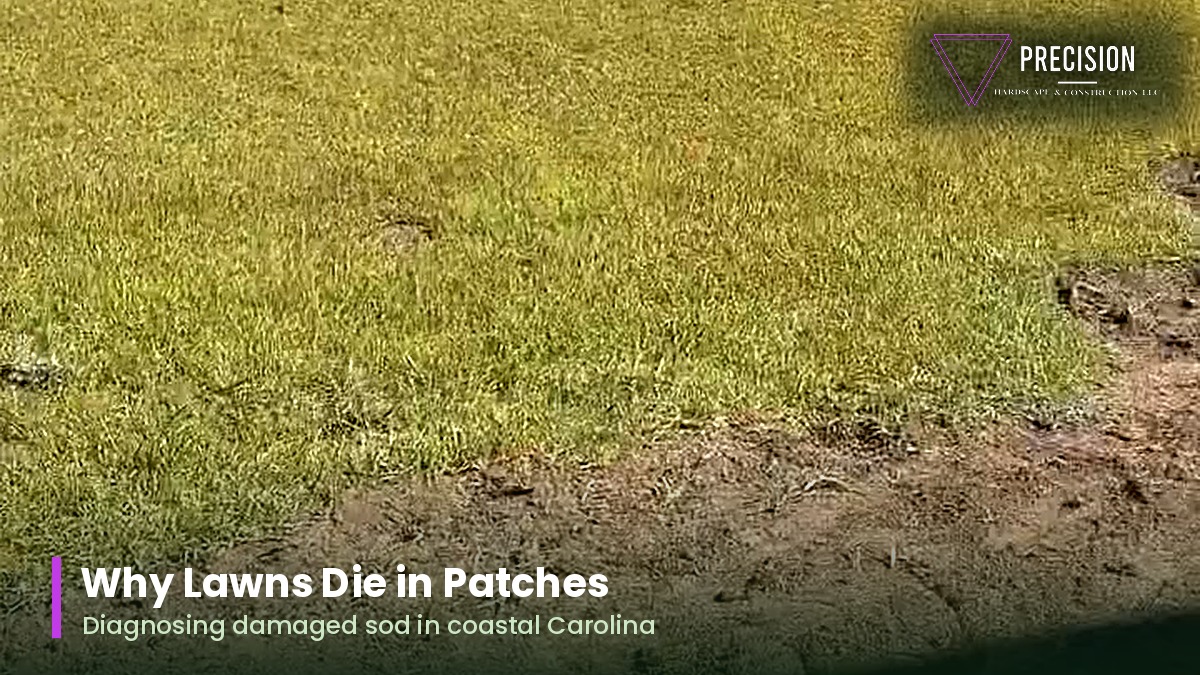
Almost every homeowner who calls us about a patchy lawn has already tried the obvious things. They have watered it more, then watered it less. They have thrown down seed, and fertiliser, and one of those bags that promises to fix everything. The patch either stays exactly where it is or comes back in the same shape a few weeks later, which is the part that tends to be maddening.
Here is the thing worth knowing before you spend another weekend on it. Grass is remarkably difficult to kill by accident. When a patch of lawn dies and stays dead, the grass is almost never the problem — something underneath it or around it is, and until that is dealt with, anything you plant in that spot is going to die the same way.
What’s In This Article
- The Shape of a Patch Tells You Most of It
- The Most Common Cause on the Coast: What’s Under the Grass
- Water That Sits, and Water That Runs Straight Off
- Shade the Grass Simply Cannot Win
- The Paths People and Dogs Actually Use
- Heat, Reflected Glare and the Corner by the AC Unit
- Grubs and Fungus — the Things People Blame First
- How to Tell These Apart in Your Own Yard
- When New Sod Fixes It, and When It Just Dies Again
- Frequently Asked Questions
The Shape of a Patch Tells You Most of It
Before you diagnose anything, stand at an upstairs window or at the far end of the yard and look at the outline of the dead area. Shape is the single most useful clue you have, and it costs nothing to read.
A patch with a hard, straight edge — a rectangle, a strip that runs parallel to a driveway, a line that stops abruptly — is telling you about something buried or something built. Builders’ rubble, a buried slab of leftover concrete, a compacted track where machinery ran, a utility trench. Nature does not draw straight lines, so when you see one, something man-made is underneath.
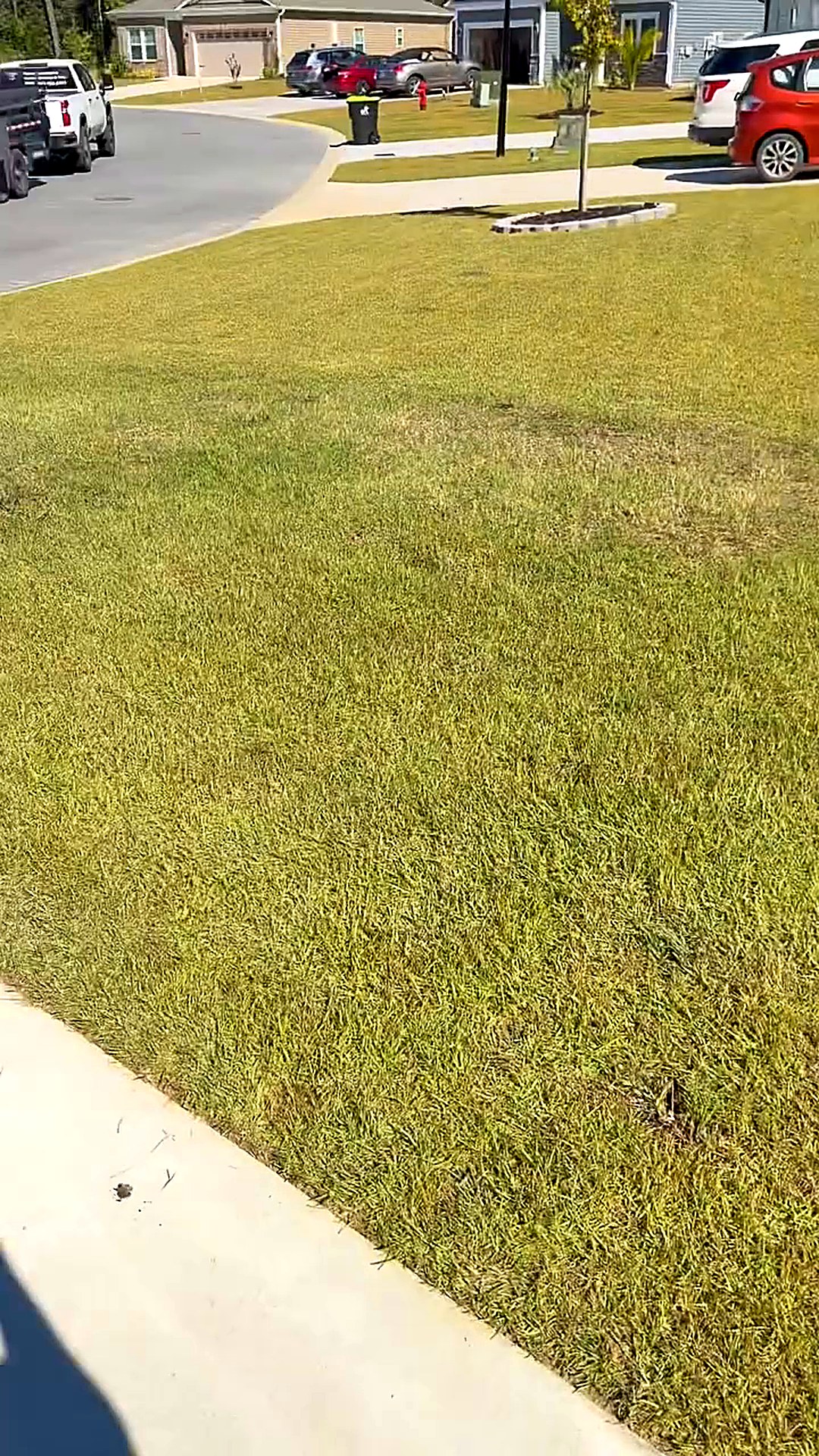
A patch that is roughly circular with a slightly darker ring around it usually points at a fungal problem. A patch that follows the low point of the yard and holds a footprint after rain is a drainage problem. A worn ribbon between the back door and the gate is traffic, not disease. And a broad, vague, irregular area that fades gradually into healthier grass at the edges is almost always soil — the most common cause of all, and the one people investigate last.
On the Conway property in the video below, the damage was spread across multiple areas in exactly that vague, gradual way, which told us before we put a shovel in the ground that we would be dealing with what was under the grass rather than anything living on top of it.
The Most Common Cause on the Coast: What’s Under the Grass
If your home was built in the last fifteen or twenty years anywhere around Conway, Longs, Little River or the Myrtle Beach corridor, there is a good chance the soil your lawn is sitting in is not the soil that was originally there.
A residential lot gets scraped during construction. The topsoil — the biologically active layer that took a long time to become what it is — comes off, and what remains is subsoil that has then been driven over by loaders, delivery trucks and concrete mixers for the better part of a year. When the house is finished, a thin skin of soil goes back down, sod is laid on top of it, and the lawn looks perfect on closing day.
What the grass is actually rooted in, though, may be an inch or two of decent material over a compacted layer that roots cannot penetrate and water cannot pass through. Sod laid on that survives on irrigation and early root growth, and it will often look fine for a season or two. Then a dry spell arrives, or the irrigation gets adjusted, and the areas with the least soil go first. Those are your patches, and they will reappear in the same places every year, because the underlying condition never changed.
You can test this yourself in about thirty seconds with a screwdriver. Push a long screwdriver into a healthy part of the lawn, then into the middle of a patch. In good soil it slides in with steady pressure. Where it stops hard an inch or two down, or will not go in at all, you have found your answer. That difference — not the grass, not the fertiliser — is what you are actually looking at when you look at the patch.
This is also why simply laying fresh sod over a bad spot is such a common and expensive disappointment. New sod arrives with roots an inch deep and a limited window to establish. Drop it onto compacted subsoil and it has nowhere to go. It greens up, holds for a few months on watering alone, and then browns out in the first stretch of real heat, and the homeowner concludes that sod does not work on their property.
Water That Sits, and Water That Runs Straight Off
Grass dies from too much water rather more often than people expect, and around here it dies from both extremes in the same yard.
Standing water is the easier one to spot. If a low area holds a puddle for hours after heavy rain, or the ground stays spongy underfoot for a day or two when the rest of the lawn has drained, the roots in that spot are spending part of their life without oxygen. Turf will tolerate that briefly and not for long. The giveaway is that the dead area matches the shape of the puddle rather than any other feature of the yard, and that it is always the same spot.
The opposite problem is less obvious. On a slope, or on ground compacted hard enough to shed water, rain arrives faster than the soil can absorb it and simply runs off to somewhere else. The grass on that slope can be dying of thirst in a yard that receives plenty of rain, and watering it more does very little, because the extra water leaves as quickly as the rain did. Slopes that brown out first in summer, or that develop small erosion channels, are usually telling you this.
Downspouts deserve their own mention because they concentrate an entire roof plane into one spot. A downspout dumping at the corner of the house will scour the ground there, drown the grass immediately around it, and leave a permanent bare halo that no amount of seed fixes. Extending it to somewhere the water can disperse solves in an afternoon what reseeding never will. We have written separately about extending downspouts properly, and about French drains and catch basins in coastal yards for the cases where regrading alone is not enough.
If you are not certain which of the two you have, our drainage solutions page is the place to start, because the fix for a yard that holds water and a yard that sheds it are close to opposites.
Shade the Grass Simply Cannot Win
Warm-season grasses — the centipede, zoysia, St. Augustine and Bermuda that make up most lawns in this part of the Carolinas — want sun, and most of them want a lot of it. Bermuda in particular is close to hopeless in shade. When a lawn thins out under a mature tree, on the north side of the house, or along a solid fence line, the usual answer is simply that there is not enough light reaching the ground for that species.
What makes shade deceptive is that it moves and it grows. The side yard that had adequate sun when the house was new has a magnolia in it now that is fifteen feet across, and the decline is so gradual that nobody links the thinning grass to the tree. Shade problems also tend to worsen from one year to the next rather than appearing suddenly, which is a useful way to tell them apart from most other causes.
There are three honest options and only three. You can thin the canopy to let more light through, which helps and has limits. You can switch that area to a more shade-tolerant grass, accepting that it will never look like the sunny parts. Or you can stop fighting it and change what is in that space — a planting bed, a mulched area, a stepping stone path, or decorative stone, all of which look deliberate rather than defeated. That last route is often the best outcome, and it is a large part of what our landscape beds, grading and sod work is for.
What does not work is repeatedly sodding a shaded strip. It is one of the few situations where a contractor who agrees to do exactly what you asked is doing you no favours at all.
The Paths People and Dogs Actually Use
Look at where the grass has worn thin and ask whether it is a line rather than a blob. Lawns record human behaviour with some accuracy, and a worn ribbon is a record of where people genuinely walk, as opposed to where the walkway is.
Traffic kills grass in two steps. The blades take the wear, which is visible, and the soil beneath takes the compaction, which is not. Once the ground is packed hard, the grass in that strip cannot recover even if everyone stopped walking there tomorrow, because the roots have nowhere to grow. That is why the worn line between the back door and the gate never comes back on its own.
Dogs produce a distinctive version of the same thing — a patrol route along a fence line, usually worn to bare soil, plus separate small round patches from urine that often show a ring of unusually dark, vigorous grass at the edge. The ring is the giveaway, and it is nitrogen, which is also why those spots resist every attempt to fix them with fertiliser.
The realistic response to a traffic path is to accept the information the lawn is giving you. If people walk there, put something there that is meant to be walked on. A stepping stone path, a gravel run or a narrow paver walkway along the desire line ends the problem permanently and usually looks better than the compromise you had before. Fighting a route that four people and a dog use every day is a losing position.
Heat, Reflected Glare and the Corner by the AC Unit
Some of the hardest ground in any yard is the narrow strip between the house and the property line, and there are several reasons for it stacking up at once.
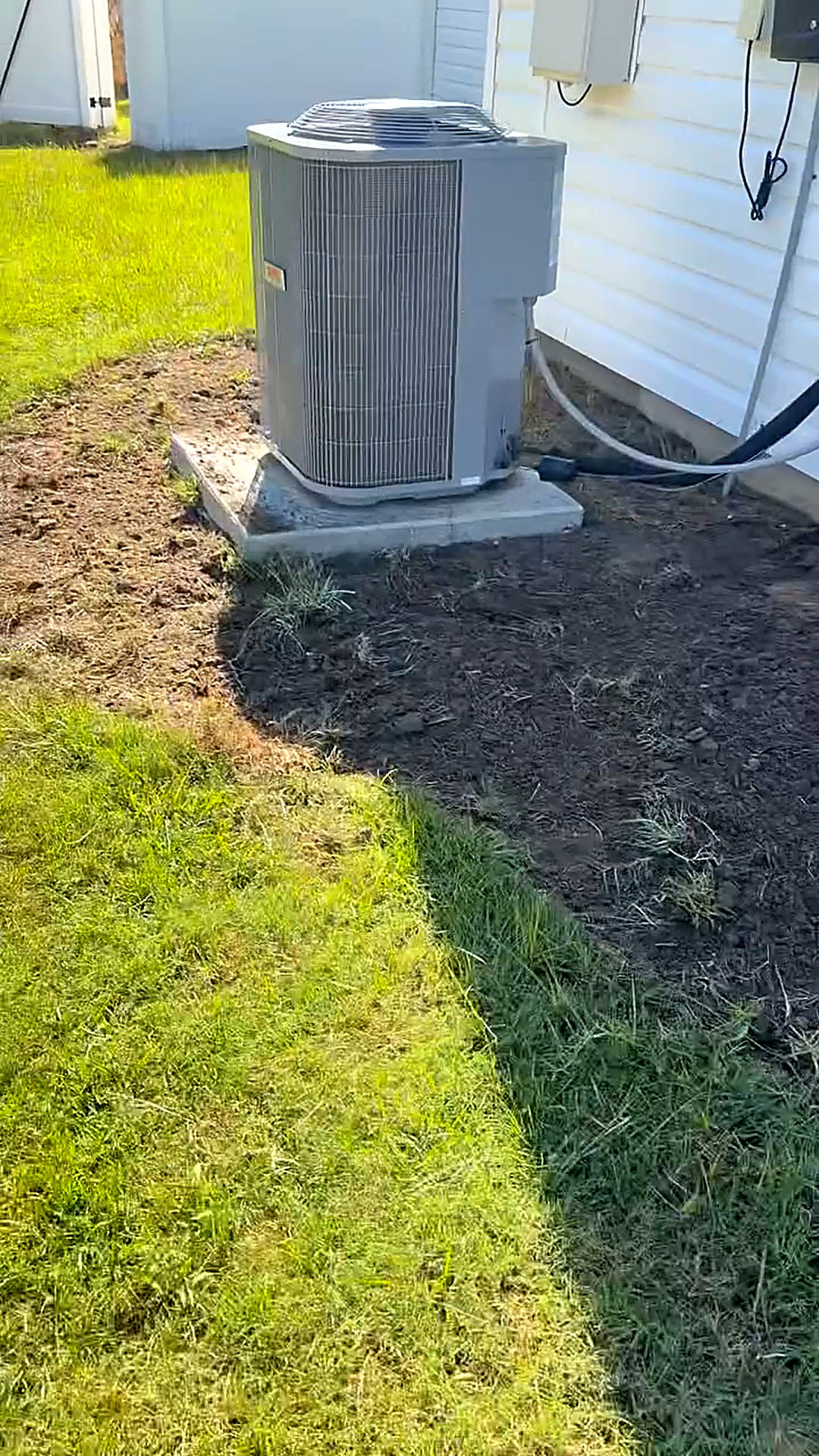
A light-coloured wall reflects a surprising amount of sun and heat onto the ground in front of it, so a south or west-facing strip can run considerably hotter and drier than the open lawn twenty feet away. The roof overhang keeps rain off the first foot or two of that same strip, so it also receives less water. Add irrigation heads that were designed for open lawn and do not reach tight against the wall, and you have a band of ground getting more heat and less water than anywhere else on the property.
Air conditioning units add their own difficulty. The unit occupies space, the pad around it is often bare, and the airflow dries the ground nearby. On the Conway job, Matt pointed at exactly that spot in the video and said plainly that mulch or stone would be the more sensible material there — but the homeowners wanted continuous lawn, so sod is what went down. That is a perfectly reasonable choice to make with your own yard, as long as it is made knowingly rather than by accident, because it is a spot that will need more attention than the rest.
Where a homeowner is open to it, a band of decorative stone or mulch along a hot wall and around mechanical equipment solves the problem permanently, looks tidy, and removes an area that is difficult to mow anyway.
Grubs and Fungus — the Things People Blame First
Pests and disease are usually the first explanation a homeowner reaches for, and they are real, but in our experience they account for a smaller share of persistent bare patches than soil and water do. They are worth ruling in or out early precisely because the tests are quick.
Grubs are simple to check. Take hold of the dead turf and pull. Healthy grass resists; grass whose roots have been eaten lifts away like a piece of carpet, and underneath you will find the larvae, pale and curled. If it does not lift, it is not grubs, and you can stop thinking about them. A secondary clue is birds or armadillos digging at the lawn, since they are after the same thing you are looking for.
Fungal problems look different. They tend to arrive in roughly circular patches, often with a darker or discoloured ring at the margin, and they spread outward over weeks rather than staying put. Humid coastal summers and evening watering both encourage them. A fungal patch usually appears in a season and can be treated within that season, whereas a soil or drainage patch has been in the same spot for years and will be there next year too.
Here is the practical point. If the same patch has been in the same place through multiple summers, it is almost certainly not a pest or a disease. Persistence over years points at something structural, and no amount of treatment will change it.
How to Tell These Apart in Your Own Yard
You can get most of the way to an answer in about twenty minutes with a screwdriver and a bit of attention. This is the sequence we would use walking a property for the first time.
Read the edges
Straight edges mean something buried or built. Soft, gradual edges mean soil. Circular with a ring means fungus. A line means traffic.
Push a screwdriver in
Healthy area first, then the patch. Sharp resistance an inch or two down means compaction, and compaction is the answer until proven otherwise.
Tug the dead turf
If it lifts like carpet, the roots are gone and you are looking at grubs. If it holds, cross them off.
Come back an hour after heavy rain
Note where water stands and where it runs off. Photograph it — that photograph is more useful to a contractor than anything else you can show them.
Watch the light across a day
Check the area mid-morning, at midday and late afternoon. Fewer than four or five hours of direct sun explains a great deal on its own.
Ask how long it has been there
One season suggests something biological. Several years in the same outline is structural, and structural problems need a structural fix.
When New Sod Fixes It, and When It Just Dies Again
Sod is the right answer more often than not, but it is the right answer as the last step rather than the first one. The question to ask is whether the condition that killed the original grass will still be there under the new grass.
New sod works when the problem was the soil and the soil is genuinely being fixed — stripped out, replaced or amended, and regraded before anything is laid. It works when damage came from a one-off event such as construction traffic or a failed irrigation zone that has since been corrected. It works when drainage has been sorted out first and the ground now sheds water the way it should.
Sod does not work, and will not work no matter who lays it, when it goes down onto the same compacted ground that killed the last lot, when the area is genuinely too shaded for the grass being used, when the drainage problem has not been addressed, or when the strip in question is a route that people and dogs are going to keep walking. In those situations the honest recommendation is to change the conditions or change what occupies that space, and any contractor who simply quotes you for sod without asking why the old grass died is not doing the part of the job that matters.
On the property in Conway, the answer was the first category. The damage was spread across both side yards, the back and the area around the pool deck, the old sod came out, new soil went in and was graded, and roughly a thousand square feet of new sod went down on ground that could actually support it. You can watch that job here: 1,000 square feet of new sod at a Conway home. And if you have already worked out that replacement is what you need, what actually happens when you have sod replaced walks through the process, the timing and what drives the price.
Frequently Asked Questions
Because the cause is structural rather than seasonal. Compacted soil, something buried, a low spot that holds water or a slope that sheds it will still be there next spring, so the grass fails in the same outline each time. Pests and disease move around and come and go; a patch that keeps its shape across several years is telling you the problem is under the grass, not in it.
You can, and on a small patch caused by something temporary it sometimes takes. But seed needs the same conditions the original grass needed, so if the soil is compacted, the spot floods or it sits in deep shade, seed germinates and then dies in the same place. Most warm-season lawns here are also grown from varieties that establish far more reliably from sod than from seed, which is why sod is the usual repair in this region.
Push a long screwdriver into a healthy part of the lawn and then into the bare patch. In soil a lawn can live in, it goes in with firm, steady pressure. If it stops hard an inch or two down, or will not enter at all, that ground is compacted and roots are hitting the same wall your screwdriver did. It is the quickest and most reliable test a homeowner can do without any equipment.
Probably not, but it is easy to check. Grab the dead turf and pull. If the roots have been eaten it lifts away like carpet and you will see pale curled larvae underneath. If it stays anchored, grubs are not your problem. Birds or armadillos digging at the lawn is a supporting clue, since they are hunting the same larvae.
Several things stack up in that strip. A light wall reflects heat onto the ground, the roof overhang keeps rain off the first foot or two, irrigation designed for open lawn rarely reaches tight to a wall, and mechanical equipment such as an AC unit dries the ground and gets walked on during servicing. It is genuinely the hardest ground on most properties, which is why a band of stone or mulch there often outperforms grass.
Only if the shade itself changes. Warm-season grasses need sun, and Bermuda in particular struggles badly without it. If a mature tree or a solid fence is keeping direct light off the ground for most of the day, fresh sod will thin out and fail the same way the last grass did. Thinning the canopy helps to a point; beyond that, a bed, mulch, decorative stone or a stepping stone path is the honest answer.
Yes, without exception. Sod laid into ground that holds water suffocates, and sod laid on ground that sheds water dries out before it roots. Both problems are considerably cheaper to correct while the area is already open and stripped than they are afterwards, when fixing them means lifting what you just paid for.
We work across the coastal Carolina market on both sides of the state line — Conway, Little River, Longs, North Myrtle Beach and Myrtle Beach in South Carolina, and Calabash, Sunset Beach, Ocean Isle Beach, Shallotte and Ash in North Carolina. If you are unsure whether your property is in range, call and ask.
Ready to Improve Your Outdoor Space?
If you have a patch of lawn that will not come back no matter what you put on it, call Matt Jones and have him look at what is underneath it. He will tell you honestly whether it is a soil problem, a water problem or something you would be better off not putting grass on at all — and what it takes to build it right the first time.
Precision Hardscape & Construction LLC
Serving Conway, Little River, Longs, North Myrtle Beach and Myrtle Beach, SC
and Calabash, Sunset Beach, Ocean Isle Beach, Shallotte and Ash, NC