
Project at a Glance
Project type: Wraparound backyard paver patio
Material: Belgard Slate pavers in a tan-and-charcoal blend
Design detail: Sweeping charcoal contrast border curving through the field and tracing the perimeter
Layout: Wraps the back of the home and connects to the screened porch
Contractor: Precision Hardscape & Construction LLC — (843) 222-5377
Some patios are a rectangle of pavers behind the house. And then there are patios like this one — an outdoor floor that wraps the back of the home, flows past the screened porch, makes room for the grill, and carries a sweeping contrast border that curves through the surface like a signature. When Matt Jones stepped back to record the walkthrough at the end of this install, his review was short and honest: “Awesome looking project.”
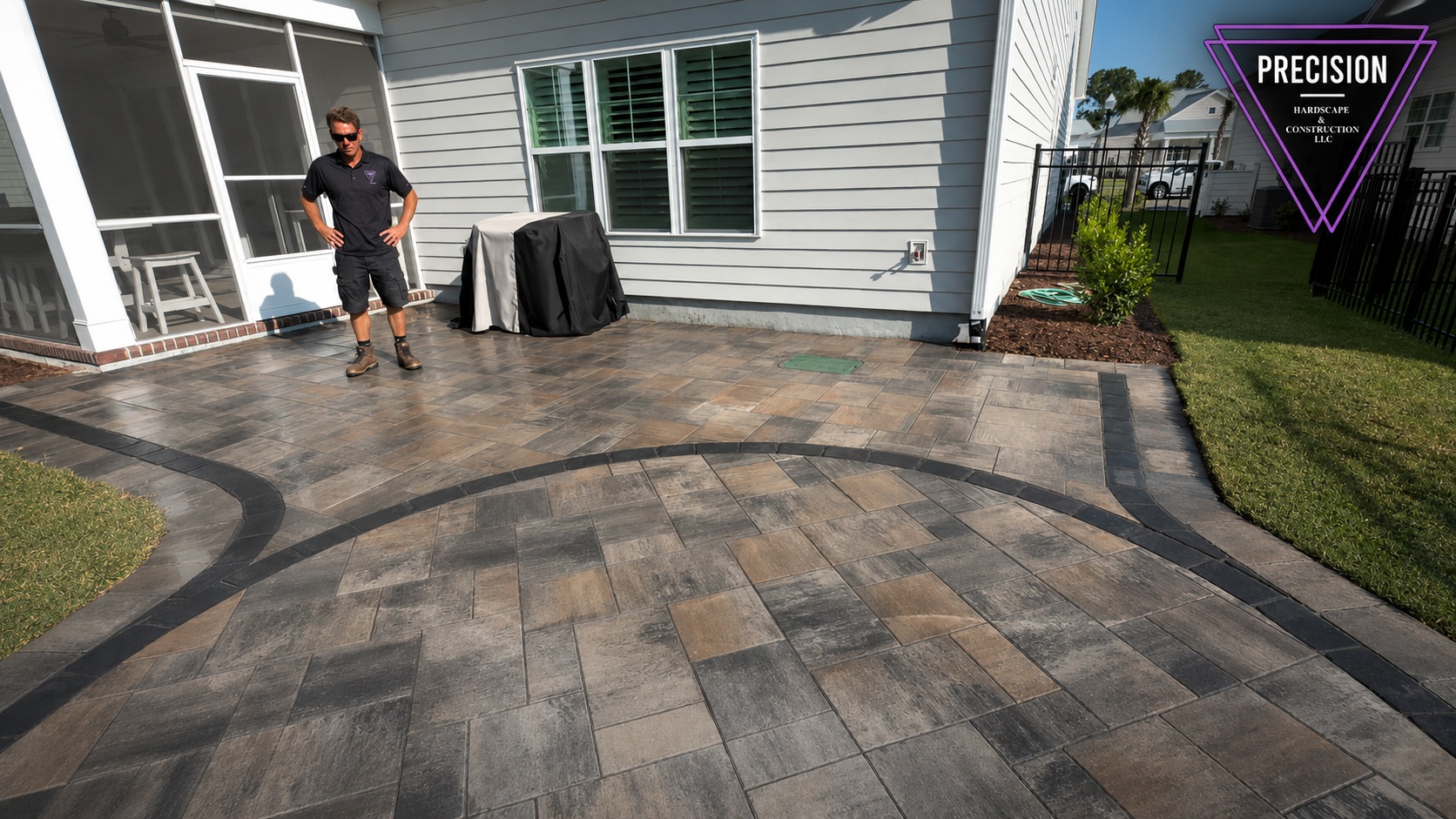
In the video, Matt shows off a just-completed patio built with Belgard Slate pavers — large-format units with the texture of natural stone in a warm tan-and-charcoal blend — finished with a dark border that traces the perimeter and arcs through the field of the patio. It’s a project that shows what happens when quality materials meet deliberate design: a big, functional outdoor space that still reads as crafted rather than poured.
This article walks through the project and the thinking behind it — what Belgard Slate is and why it works so well here, what a curved contrast border adds to a large patio, how a wraparound layout changes the way a backyard gets used, and what coastal Carolina homeowners should know before building a patio of their own.
In This Article
- The Project Matt Walks Through in the Video
- What Is Belgard Slate? The Look of Stone, Engineered
- The Sweeping Contrast Border: Design That Moves
- Why a Wraparound Patio Changes How You Use the Backyard
- Built for Coastal Carolina: What’s Under the Surface
- Paver Patio vs. Poured Concrete: Why Pavers Win Here
- Common Mistakes Homeowners Should Avoid
- Frequently Asked Questions
- Ready to Build Your Backyard Patio?
The Project Matt Walks Through in the Video
“We just wrapped up this nice patio today,” Matt says in the video — and “wrapped” is the right word in more ways than one. The patio doesn’t sit behind the house; it wraps around it, following the back wall past the screened porch and around the corner, so the paved living space serves every door and sightline along the rear of the home.
The field is laid in Belgard Slate — big, slab-style pavers in a blend of tans, browns, and charcoals that shift subtly from unit to unit, the way natural stone does. Running through it is the detail Matt calls out on camera: the dark border “going around the perimeter.” A charcoal band traces the outer edge of the patio and then peels off into a long, sweeping arc that curves straight through the field, dividing the space visually while the surface stays one continuous floor.
Everything about the finished project is practical, too. The grill sits on pavers instead of grass. The screened porch opens onto solid footing instead of a mulch bed. The patio meets the lawn with a clean, defined edge, and the whole space drains away from the house. In the neighborhoods where Precision Hardscape works — Little River, Calabash, Sunset Beach, North Myrtle Beach and the surrounding coastal Carolina communities — that combination of looks and function is exactly what turns a builder-grade backyard into the best room of the house.
What Is Belgard Slate? The Look of Stone, Engineered
Belgard is one of the leading hardscape manufacturers in North America, and the Slate product used on this patio is designed to deliver the look of natural cleft slate in an engineered concrete paver. The surface carries the ridges and texture of split stone, and the color is blended through multiple tones — which is why the finished field reads as warm and varied rather than flat and uniform.
Why choose an engineered slate-look paver over the real thing? Consistency and performance. Natural stone varies in thickness, which makes it slow to lay flat and prone to uneven edges; a manufactured paver is dimensionally consistent, so the finished surface is even underfoot — a real consideration for dining chairs, grills, and bare feet. Concrete pavers are also engineered for outdoor strength, with color through the unit and a surface that stands up to sun, rain, and salt air.
Natural Texture
The cleft-slate surface gives the patio the character of natural stone — and useful slip resistance when the surface is wet.
Blended Color
Tans, browns, and charcoals shift across the field like real stone, hiding everyday dust and pollen far better than a single-color surface.
Large Format
Bigger units mean fewer joints and a calmer, more contemporary surface — well suited to a patio of this size.
Repairable
Any individual paver can be lifted and re-set — for a utility line, a future addition, or a rare settled spot — with no visible scar.
Belgard products also come in coordinated color families, which is what makes details like this project’s charcoal border possible without mixing manufacturers — the border units are as at home in the palette as the field they frame.
The Sweeping Contrast Border: Design That Moves
A perimeter border is standard practice on a quality paver patio — it frames the field, locks in the edge, and gives the surface a finished line where it meets the lawn. What elevates this project is what the border does next: instead of staying at the edge, it launches into a long, sweeping curve that arcs straight through the middle of the patio.
That single curving band does a surprising amount of work. On a patio this large, an unbroken field can feel like a parking pad — the curve breaks up the expanse and gives the eye a line to follow. It also softly zones the space without walls or level changes: the arc suggests where the dining area ends and the open lounge space begins, the way an area rug divides a great room. And because the band is charcoal against a warm field, the geometry stays crisp from every angle — including from inside the house, where the patio is on display through every rear window.
Building it is another story. A curved inlay means every field paver that meets the band must be individually marked and cut to follow the arc — twice, on both sides of the curve. There’s no shortcut; it’s measured, patient saw work, and it’s where an experienced crew shows. A wavering curve or ragged cuts would be visible forever. The clean, continuous sweep you see in Matt’s video is the payoff.
Contrast detailing is something of a Precision Hardscape signature — you’ll see the same thinking in the border on the Techo-Bloc Blu 60 patio, the caps and coping on the raised patio with seat walls, and the lighted border on the walkway with low-voltage lighting.
Why a Wraparound Patio Changes How You Use the Backyard
Most patios are destinations — you walk out to them, use them, and walk back. A wraparound patio is different: it’s circulation and destination at once. By following the rear wall of the home and connecting to the screened porch, this patio links every back exit of the house into one continuous paved surface.
In daily use, that layout eliminates the small frictions that keep backyards underused. Stepping out of the porch, you’re on pavers, not wet grass. The grill lives steps from the kitchen door, on a stable, level, fireproof surface. Moving from one side of the yard to the other doesn’t mean cutting across the lawn — which also means the lawn itself stays healthier, without the worn dirt paths that foot traffic carves into coastal turf.
A wraparound layout also solves a maintenance problem hiding in plain sight: the strip of ground tight against the house. Grass struggles there, mulch washes onto walkways, and bare soil splashes mud onto the siding in every storm. Paving that zone — properly pitched away from the foundation — replaces the most annoying strip of the yard with the most useful one.
For homeowners planning in phases, a wraparound patio is also the perfect backbone. It’s the connective tissue that future features plug into — a pergola, an outdoor kitchen, a fire feature, or a walkway out to the rest of the yard.
Built for Coastal Carolina: What’s Under the Surface
Every patio photo shows the surface. What determines whether that surface still looks this good in ten years is everything underneath it — especially in coastal Carolina.
The sandy soils around Little River, Longs, Calabash, and Sunset Beach drain quickly but shift easily. A patio here starts with excavation to the right depth and a structural base compacted in controlled lifts, so the ground under the pavers behaves like one solid mass instead of loose fill. The bedding layer is screeded flat, the field is laid, and the edges are restrained so the surface can’t creep outward over time. Joints are finished with polymeric sand, which cures firm to resist washout in heavy rain and keeps weeds and ants from colonizing the joints through the long growing season.
Pitch is the other invisible essential. A patio that wraps the house has to shed water away from the foundation along its entire length — a grading puzzle that gets more complex with every corner it turns. Done right, rain sheets quietly off the patio edge and into the lawn; done wrong, it ponds against the slab and finds its way toward the crawl space. On lots where water is already a problem, patio construction pairs naturally with dedicated drainage solutions like French drains and downspout management.
None of this shows up in the finished photos — which is exactly why homeowners should ask about it before hiring anyone. The visible beauty of this project is a direct product of the invisible work.
Paver Patio vs. Poured Concrete: Why Pavers Win Here
The most common alternative homeowners weigh is poured or stamped concrete, which usually carries a lower upfront price. In coastal Carolina, that math tends to flip within a few years — and this project is a good illustration of why.
Concrete is one continuous slab, and in shifting sandy soil, slabs crack. Once a slab cracks, the repair options are cosmetic at best; the crack is permanent, and stamped color patterns make patches even more obvious. A paver surface is thousands of individual engineered units in a flexible system — it accommodates minor ground movement without failing, and if a spot ever settles, those pavers come up, the base gets corrected, and the same pavers go back down invisibly.
Design range isn’t close, either. The curved charcoal inlay on this patio simply cannot be done in poured concrete with this crispness — and it will still be crisp when a stamped pattern would be fading. Color in a quality paver runs through the unit; the surface texture is manufactured in, not troweled on. Add the repairability, and pavers are the smarter long-term investment for this climate, which is why they’re at the core of what Precision Hardscape builds.
Common Mistakes Homeowners Should Avoid
Sizing the patio to the leftover budget instead of the layout. A patio’s footprint should come from how you’ll use it — dining, grilling, circulation — not from what’s left over. An undersized patio gets rebuilt; a well-planned one gets used every day.
Comparing bids without comparing base specs. Two quotes for “the same patio” can describe very different structures underground. Ask every bidder about excavation depth, base material and compaction, edge restraint, and jointing sand — the answers predict how the patio ages.
Ignoring the water plan. Any patio that touches the house needs deliberate pitch and a plan for where roof and surface water go. This is doubly true for wraparound layouts.
Playing it too safe with design. A border in the same color as the field, no curves, no contrast — the result is fine, and forgettable. Details like this project’s sweeping charcoal band cost a fraction of the project and carry most of its visual identity.
Forgetting the view from inside. You’ll see your patio through the windows far more hours than you’ll sit on it. Design the geometry — like this curve — to look right from the kitchen and living room, not just from the lawn.
Frequently Asked Questions
Belgard Slate is an engineered concrete paver from Belgard, one of North America’s leading hardscape manufacturers, designed to replicate the cleft texture and blended color of natural slate. It delivers the stone look with the dimensional consistency, strength, and repairability of a manufactured paver — well suited to outdoor living surfaces in coastal climates.
For long-term performance, yes. Sandy coastal soils shift, and continuous concrete slabs respond by cracking — permanently. A paver system flexes with minor ground movement, and individual pavers can be lifted and re-set if a spot ever settles. Pavers also keep their color and texture far longer than stamped and stained concrete surfaces exposed to coastal sun and rain.
The curve is laid out first, then the border band is set along the arc, and every field paver meeting the band is individually marked and saw-cut to follow the curve on both sides. It’s precision work — the quality of those cuts is permanently visible, which is why intricate inlays like this are best left to experienced installation crews.
Most residential paver patios take roughly a few days to a couple of weeks depending on size, access, site conditions, and design complexity — details like curved inlays add cutting time. The sequence is consistent: excavation, base construction and compaction, bedding, laying the field and borders, cutting, edge restraint, and joint sanding. Precision Hardscape provides a schedule with every quote.
Very little. Rinse or sweep the surface as needed, refresh polymeric sand in the joints if gaps ever appear, and address the rare settled paver by having it lifted and re-set. There’s no sealing requirement for the patio to perform, though optional sealers can deepen color. Compare that to concrete, which demands crack management from its first year.
Yes — as this project shows, a wraparound patio is one of the most useful layouts a backyard can have, linking porches, doors, and outdoor zones into one continuous surface. It does require careful grading so the entire run pitches away from the foundation, which makes professional design and installation especially important for this layout.
Absolutely. Paver construction is phase-friendly: pavers can be removed cleanly for footings or utilities and reinstated without visible repair. Many Precision Hardscape clients build in stages — patio first, then a pergola, fire feature, outdoor kitchen, or walkway in a later phase, each designed to integrate with what’s already built.
Ready to Build Your Backyard Patio?
If you’re picturing a Belgard paver patio, a wraparound outdoor living space, a walkway, or a complete backyard transformation in Little River, Calabash, Sunset Beach, North Myrtle Beach, or the surrounding coastal Carolina area, Matt Jones and the team at Precision Hardscape & Construction will design it and build it right — from the compacted base you’ll never see to the contrast border everyone will.
Call Matt today to talk through your project and get a quote.
Precision Hardscape & Construction LLC
(843) 222-5377
Serving homeowners in Little River, North Myrtle Beach, Myrtle Beach, Longs, Calabash, Sunset Beach, Ocean Isle Beach, Shallotte, and surrounding coastal Carolina communities.