
Project at a Glance
Project type: Backyard paver walkway with integrated lighting
Key feature: Low-voltage lights built into both borders of the walkway
Landscaping: Reshaped berm, new soil, and fresh mulch beds
Still to come: Decorative rock and final fine-tuning
Contractor: Precision Hardscape & Construction LLC — (843) 222-5377
A walkway has one job during the day: get you from the patio to the back door without tracking through the yard. But after sunset, an unlit path becomes a guessing game — and in a backyard that gets used in the evenings, that’s exactly when you need it most. That’s why, on this coastal Carolina project, the lighting wasn’t an afterthought or a box of stake lights from the hardware store. It was built directly into the walkway itself.
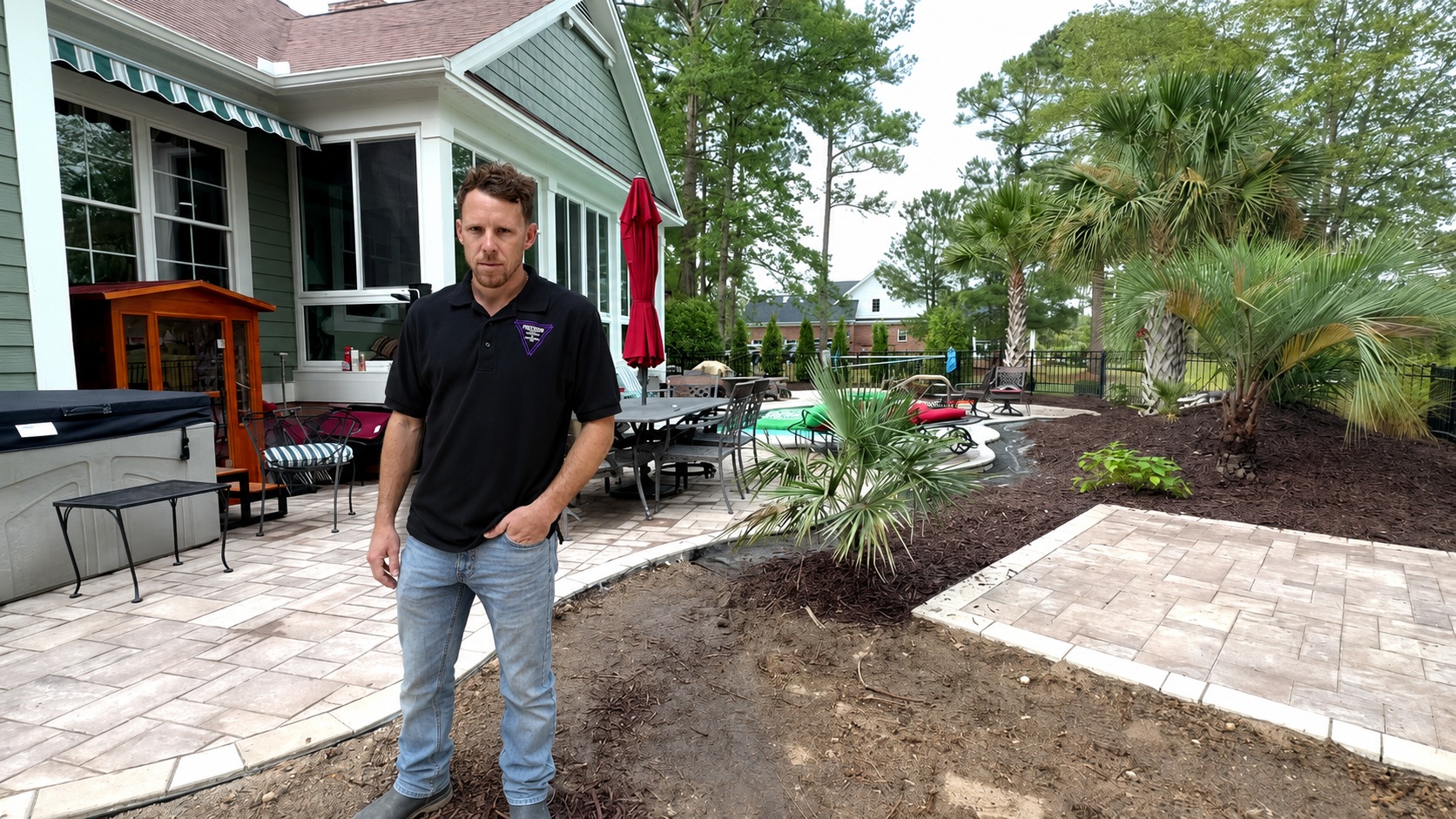
In the video above, Matt Jones of Precision Hardscape & Construction walks through the day’s progress: a new curved paver walkway, fully installed, with low-voltage lights running along the outside of the border on both sides. Behind it, the crew reshaped the existing berm, brought in new soil, and set fresh mulch beds around the palms — with one more day of decorative rock and fine-tuning still to go before the finished reveal.
This article breaks down what went into this stage of the project — why the lights live in the border instead of beside it, how low-voltage lighting actually works, what makes a curved walkway hold its shape in sandy coastal soil, and why the landscaping around a walkway matters as much as the walkway itself.
In This Article
- The Project Matt Walks Through in the Video
- Low-Voltage Lighting Built Into the Walkway Border
- How Low-Voltage Landscape Lighting Works
- Building a Curved Paver Walkway That Lasts
- Reshaping the Berm: Landscaping That Works With the Hardscape
- What’s Left: Decorative Rock and Final Fine-Tuning
- Why Walkway Lighting Makes Sense in Coastal Carolina
- Common Mistakes Homeowners Should Avoid
- Frequently Asked Questions
- Ready to Light Up Your Own Walkway?
The Project Matt Walks Through in the Video
The video is a quick end-of-day update Matt recorded on site. “We got our walkway installed,” he says, pointing along the new path. “You see right here along the perimeter, we’ve got these lights — they’re going along the outside of the walkway, and on the other side as well.”
The walkway itself is a curved paver path connecting the main patio and pool area to the steps at the back of the house. Instead of a straight shot across the yard, the path sweeps in a gentle arc, framed by a lighter border course that outlines the walkway against the blended tones of the field pavers. Set into that border, at regular intervals on both sides, are low-profile, low-voltage light fixtures — flush with the surface, out of the way of feet and lawn equipment, and positioned to wash the path in light after dark.
The walkway is one piece of a larger backyard transformation. In the same walkthrough, Matt shows the reshaped berm behind the path, where the crew added soil and installed fresh mulch around the palms, and a separate paver pad set into the landscape bed. The decorative rock and the last round of fine-tuning were scheduled for the following workday — so, as Matt puts it, “you’ve got to stay tuned and see the completed project.”
It’s the kind of mid-project snapshot that shows how a well-run job actually comes together: hardscape first, landscape shaping second, finishing materials last. Every stage sets up the next one.
Low-Voltage Lighting Built Into the Walkway Border
Most walkway lighting you see in residential yards is the stake-in-the-ground variety: plastic or aluminum fixtures pushed into the lawn beside the path. They work — for a while. Then they get clipped by the mower, knocked crooked by kids and pets, heaved by wet soil, and within a season or two half of them are leaning like fence posts after a storm.
Building the lights into the walkway border solves all of that at once. The fixtures on this project sit flush along the border course on both sides of the path. Because they’re part of the hardscape rather than sitting next to it, they can’t be kicked over, they don’t interfere with mowing or edging, and they hold their aim — the light lands on the walking surface every night, exactly where it’s supposed to.
There’s a design payoff, too. At night, a pair of lighted borders reads like a runway: the curve of the path is traced in light, which makes the whole backyard feel intentional and finished. During the day, the fixtures all but disappear into the border. Compare that to a row of stake lights, which are visible — and vulnerable — 24 hours a day.
The catch is that integrated lighting has to be planned before the walkway is built. The wire runs are set during construction, and the fixtures are placed as the border goes down. That’s the real difference between a contractor who installs lighting as part of the hardscape and a homeowner adding lights after the fact: one is built in, the other is bolted on.
How Low-Voltage Landscape Lighting Works
“Low voltage” isn’t a marketing term — it describes how the system is powered. A small transformer plugs into a standard outdoor outlet and steps household current down from 120 volts to a much lower voltage, typically 12 volts. That low-voltage current runs through buried cable to each fixture along the walkway.
That design has three practical benefits for a homeowner:
Safety
A 12-volt system carries far less risk than line voltage — a real consideration for lighting near a pool area, around kids and pets, and in a climate where the ground is often wet.
Efficiency
Modern low-voltage LED fixtures sip electricity. A full walkway of lights typically draws less power than a single old-style flood light, so running them every evening costs very little.
Simplicity
Transformers can run on timers or photocells, so the walkway lights itself at dusk and shuts off on schedule — no switches to remember, no wiring inside the house to modify.
LED lamp life is measured in tens of thousands of hours, which translates to many years of nightly use before a fixture needs attention. And because the cable is buried and the fixtures are secured in the hardscape, there’s very little for weather to grab hold of — an important detail in a region that sees heavy rain and the occasional tropical system.
Building a Curved Paver Walkway That Lasts
A curved walkway looks effortless when it’s finished — which hides how much more demanding it is to build than a straight one. Every curve means cut pavers, a border that has to sweep smoothly without kinks, and edge restraint that holds its line under years of foot traffic and weather.
Under the surface, the fundamentals are the same ones Matt applies to every patio and walkway Precision Hardscape builds: excavate to the right depth, build up a properly compacted base, screed a consistent bedding layer, and lock the field in with a solid border and edge restraint. In coastal Carolina, that base work matters even more than it does inland. The sandy soil around Little River, Calabash, and Sunset Beach drains fast but shifts easily, so a walkway that skips base preparation will telegraph every soft spot as a dip or a wobble within a couple of seasons.
Grade matters, too. A walkway needs a subtle pitch so rainwater sheets off instead of ponding on the surface — the same thinking behind the permeable patio project in Sunset Beach, where drainage drove the entire design. On this project, the walkway ties into the existing pool patio at one end and the home’s back steps at the other, which means the elevations at both connections were fixed before the first paver went down. Making a curved path meet two fixed elevations smoothly, while still draining correctly, is exactly the kind of problem that separates professional installation from a weekend project.
The contrast border earns its keep here as well. Just like the border treatment on the Techo-Bloc Blu 60 patio project, the lighter border course gives the walkway a crisp, defined edge — and on this project it doubles as the mounting line for the lighting.
Reshaping the Berm: Landscaping That Works With the Hardscape
In the video, Matt points past the walkway to the landscape work: “We reshaped this berm, we added some dirt and put some mulch in here.” It’s one sentence, but it represents a stage of the project that most homeowners underestimate.
A berm — a raised, sculpted mound of soil — does several jobs in a backyard like this one. It creates privacy and visual depth along the fence line, gives the palms and plantings a healthy raised bed to grow in, and helps direct water where it should go instead of letting it sit. But a berm only works if it’s shaped deliberately. Once the new walkway went in, the existing berm needed to be reworked so its contours flowed with the new path instead of fighting it.
The crew brought in additional soil, regraded the mound, and dressed the beds with fresh mulch around the palms. The result — visible even at this in-progress stage — is a backyard that reads as one composition: the walkway curves, the berm answers the curve, and the planting beds tie the hardscape into the landscape. That integration between built elements and living ones is the heart of good landscape design, and it’s why Precision Hardscape treats the two as one project instead of two trades that never talk to each other.
It’s the same philosophy behind the multi-phase pool patio and privacy berm project featured earlier on this blog — hardscape and landscape planned together, built in the right order.
What’s Left: Decorative Rock and Final Fine-Tuning
Matt closes the video with what’s still ahead: one more day to install decorative rock and handle the final fine-tuning before the project wraps.
Decorative rock is a finishing material that pulls real weight in a coastal yard. Where mulch eventually breaks down and can float or wash in a hard rain, stone stays put. It suppresses weeds, defines the transition zones between walkway, beds, and lawn, and gives the ground plane a clean, low-maintenance finish that stands up to coastal weather year after year. Used alongside mulched planting beds — rock in the high-traffic and high-water areas, mulch around the plantings — you get the best of both materials.
The “fine-tuning” Matt mentions is the unglamorous last mile of every quality project: final grading touch-ups, cleaning the paver surface, aiming and testing every light after dark, and walking the whole yard the way the homeowner will. It’s the difference between a job that’s technically done and one that looks finished from every angle.
Why Walkway Lighting Makes Sense in Coastal Carolina
Backyards in this part of the coast get used hard, and they get used late. Between the long warm season and the way people live here — pools, patios, dinners outside, neighbors stopping by — an outdoor space in Little River, North Myrtle Beach, or Ocean Isle Beach earns its keep well after sunset. Lighting is what makes that possible safely.
A lit walkway is first and foremost a safety feature. Steps, grade changes, and path edges are exactly where evening trips and stumbles happen, and a soft, even wash of light along the walking surface removes the guesswork for family and guests of every age. Around a pool area, that matters twice over.
The coastal environment also rewards doing lighting right the first time. Salt air, humidity, and driving rain are tough on cheap fixtures — bargain-bin lights corrode, cloud up, and fail quickly here. Quality low-voltage fixtures, properly installed with protected connections and buried cable, are built for exactly these conditions. And because the system runs at 12 volts, the frequent wet ground that comes with coastal storms isn’t the hazard it would be with line-voltage wiring.
There’s also the simple matter of value. Outdoor lighting consistently ranks among the most noticeable upgrades a home can get from the curb — and in neighborhoods from Calabash to Shallotte where outdoor living is a selling point, a professionally lit walkway and landscape reads as a premium feature the moment a visitor pulls in after dark.
Common Mistakes Homeowners Should Avoid
After years of building — and repairing — walkways and lighting in the coastal Carolinas, the same handful of mistakes show up again and again:
Adding lighting after the hardscape is finished. Once the pavers are down and the edges are locked in, running wire cleanly becomes far harder. If there’s any chance you’ll want a lit walkway, plan the lighting with the walkway — even if the fixtures come later, the conduit and wire paths should go in during construction.
Buying fixtures by price alone. In salt air, the cheap fixture is the expensive one. Corrosion-resistant materials and sealed connections cost more upfront and far less over ten years.
Over-lighting the path. Good walkway lighting is a soft, even wash — not a row of glaring hot spots. Fixture spacing, brightness, and placement should be designed, not guessed.
Skipping base prep to save budget. A walkway is only as good as what’s under it. In sandy coastal soil, an under-built base means dips, wobbles, and joint failure — and no lighting can dress that up.
Treating landscape and hardscape as separate projects. When the walkway crew and the landscaping crew never coordinate, you get beds that drain onto pavers, mulch that washes across the path, and a yard that looks assembled rather than designed. Plan it as one project.
Frequently Asked Questions
Quality low-voltage LED fixtures are rated for tens of thousands of hours of use — typically many years of nightly operation. The fixtures themselves, when made from corrosion-resistant materials and installed with sealed connections, routinely last a decade or more even in coastal conditions. Transformers and timers are simple components that can be serviced or replaced individually without disturbing the walkway.
Yes — that’s one of the main reasons it’s the standard for landscape lighting. The system steps household power down to roughly 12 volts, which dramatically reduces electrical risk compared to line voltage. Combined with buried cable and fixtures secured in the hardscape, it’s well suited to backyards with pools, children, and pets, and to a climate where the ground is frequently wet.
Often, yes — pavers can be lifted and reinstated cleanly, which is one of the advantages of paver construction over poured concrete. That said, it’s always easier and cleaner to plan lighting during the original build, when wire runs can be placed before the borders are locked in. If you’re building a walkway now and even think you might want lights later, have the wiring pathway installed during construction.
Barely. Modern low-voltage LED fixtures draw only a few watts each, so an entire walkway of lights typically uses less electricity than a single traditional flood light. Run on a timer or dusk-to-dawn photocell, the real-world monthly cost is usually a matter of pocket change.
Very little. Rinse the walkway surface periodically, keep fixture lenses clear of debris and mulch, and check the timer settings a couple of times a year as the seasons change. Because the fixtures are set into the border rather than staked in the lawn, there’s no straightening, re-aiming, or mower damage to deal with.
A berm — a shaped, raised mound of soil — adds privacy, visual depth, and healthy planting elevation, and it helps manage where water goes in the yard. In coastal Carolina’s flat, sandy landscapes, berms are one of the most effective ways to give a backyard structure and screen a fence line, especially when planted with palms and dressed with mulch or decorative rock.
Yes. On this project the walkway, the border lighting, the berm reshaping, the mulch, and the decorative rock are all one coordinated scope handled by Matt and his team. Designing and building hardscape, lighting, and landscape as a single project is what makes the finished yard feel cohesive — and it means one call, one plan, and one crew responsible for the result.
Ready to Light Up Your Own Walkway?
If you’re thinking about a paver walkway, low-voltage landscape lighting, decorative rock, or a complete backyard transformation in Little River, Calabash, Sunset Beach, North Myrtle Beach, or the surrounding coastal Carolina area, Matt Jones and the team at Precision Hardscape & Construction can design it and build it right — hardscape, lighting, and landscaping as one seamless project.
Call Matt today to talk through your project and get a quote.
Precision Hardscape & Construction LLC
(843) 222-5377
Serving homeowners in Little River, North Myrtle Beach, Myrtle Beach, Longs, Calabash, Sunset Beach, Ocean Isle Beach, Shallotte, and surrounding coastal Carolina communities.