
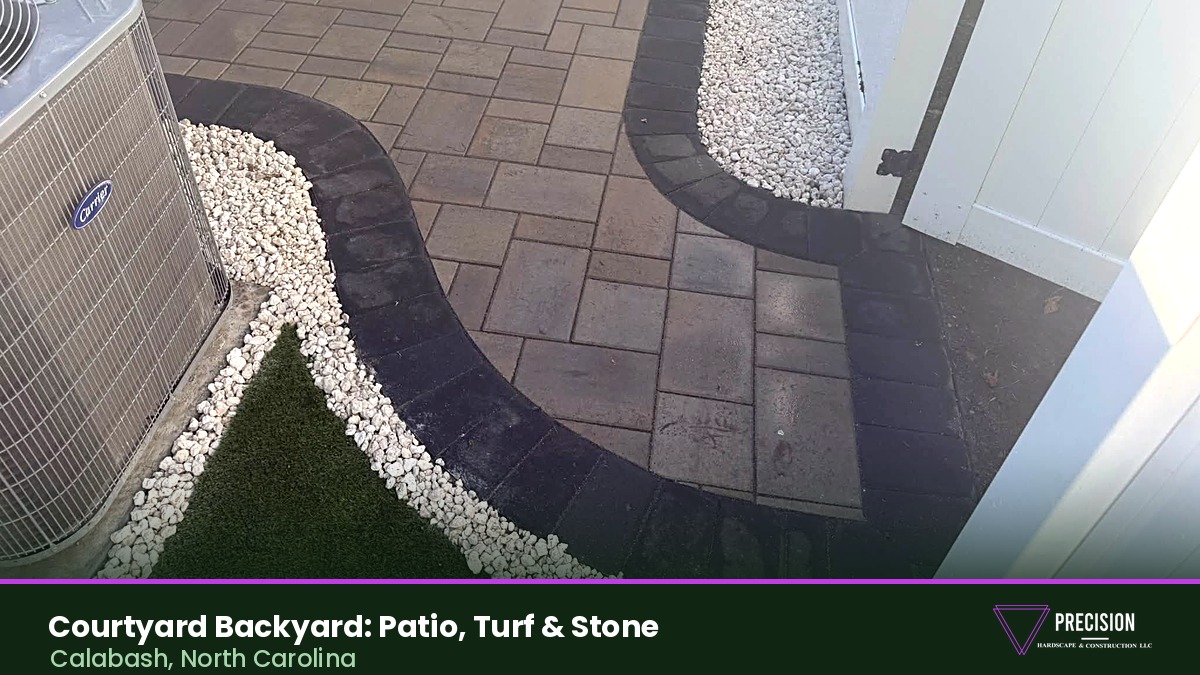
The backyard behind this townhome in Calabash was about as small as a backyard gets. Four vinyl fence panels on three sides, a sliding door at one end, an air conditioning unit taking up a corner, and in between a patch of bare dirt that had never really been anything. It is the kind of space most people write off as too small to bother with, and then spend five years walking past.
Matt Jones and the crew gave every square foot of it a job. A paver patio with a curved walkway running out to the gate, a charcoal border following the whole perimeter, pet-friendly synthetic turf for the homeowner’s dog, and a band of white decorative stone along the fence line doing the drainage work. The video below shows it three times over — bare ground with the layout marked in paint, the pavers going down, and the finished courtyard — and what follows is an account of how a space this size gets planned, and why small yards are harder to get right than large ones.
Day one with the courtyard marked out, the pavers going in, and the finished space.
What’s In This Article
- What This Courtyard Started As
- Why a Small Enclosed Yard Is Harder, Not Easier
- Zoning It: Giving Every Square Foot a Job
- Why the Walkway Curves Instead of Running Straight
- The Paver Field and the Charcoal Border
- Why Real Grass Was Never Going to Survive Here
- Pet-Friendly Synthetic Turf, and What Installing It Involves
- The White Stone Perimeter and the Drainage It Does
- Working Around the AC Unit and the Fence Line
- Getting Materials Into a Yard With One Gate
- What Keeping It Looking New Actually Takes
- Mistakes Worth Avoiding in a Small Courtyard
- Frequently Asked Questions
What This Courtyard Started As
In the first clip Matt is standing on bare ground with the outline of the patio sprayed out in white paint at his feet. He describes it plainly enough: a townhome complex in Calabash, a courtyard-style backyard, a paver patio and a small walkway, synthetic turf going in on one side and decorative rock around the perimeter. At that point in the day he was still weighing up whether the path would be stepping stones or a continuous paver walkway, depending on how much material was left once the patio was down.
That small uncertainty is worth noticing, because it is how real jobs are run. The patio was the part that had to be right; the walkway could be decided once the crew could see what they had. It ended up as a continuous curved walkway, which is the better answer, and the reason it was affordable is covered further down.
The constraints were all fixed before anyone picked up a shovel. The fence was already there and was not moving. The air conditioning unit was already there and was definitely not moving. The sliding door set the only entry point from the house, and a single gate set the only entry point from outside. Everything that followed had to be arranged around those four things.
It is also worth saying that this is a different job from the paver patio extension we wrote up in Calabash recently, even though the two are only a few minutes apart. That one was about adding to an existing concrete slab. This one had no slab, no grass worth keeping and no obvious starting point — the whole footprint was up for grabs, which sounds like freedom and is actually the harder brief.
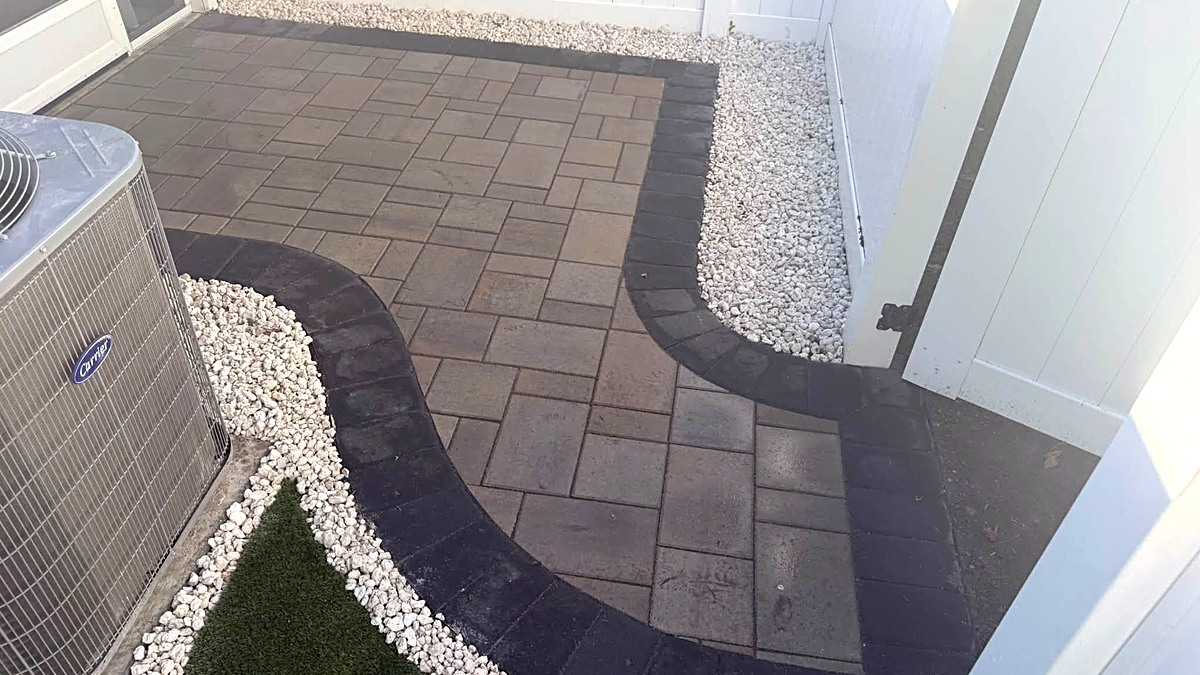
The finished courtyard. Patio, walkway, border, stone and turf, all inside a space you could cross in six paces.
Why a Small Enclosed Yard Is Harder, Not Easier
People assume a small yard is a small job, and in hours on site that is often true. In design terms it is the opposite. A large backyard forgives a vague plan, because there is leftover space to absorb anything that does not quite work. A courtyard has no leftover space at all. Every decision is visible from every other point in the yard, and there is nowhere for a mistake to hide.
The proportions work against you too. In any paved area, the perimeter is where the labour lives — the cutting, the border course, the edge restraint, the transitions into whatever sits beyond. On a large patio that perimeter is a modest fraction of the total. On a courtyard it is most of the job. Put a curve in it, as this one has, and effectively every paver along both edges goes on the saw.
Then there is the fact that you see the whole thing at once. On a big property you experience a hardscape in sections as you move through it, and a line that drifts by half an inch over twenty feet goes unnoticed. In a courtyard you stand at the door and take in the entire space in a single view, with four straight fence panels behind it acting as a reference grid. Anything out of true is obvious immediately and permanently.
The last difficulty is that small spaces are easy to make feel smaller. Break a courtyard into too many elements, or use a busy small-unit paver across the whole floor, and the eye starts counting edges instead of reading the space. The way out of that is not fewer materials but clearer zones, which is what the next section is about.
Zoning It: Giving Every Square Foot a Job
The principle behind this courtyard is simple to state and surprisingly rare to see done: no part of the yard is left undecided. There is no strip of indeterminate ground along the fence, no awkward triangle behind the AC unit, no patch that is grass only because nobody thought about it. Every area is paving, turf or stone, and each of those has a reason.
The paving takes the part of the yard you actually stand on — the area off the sliding door, and the route from the door out to the gate. That is the surface that has to work in every weather, carry furniture, and take the traffic of people coming and going. The turf takes the remaining open area, which is where the dog goes and where the space gets its colour and softness. The stone takes the margins: the narrow band against the fence, and the ground around the AC unit, where nothing would thrive and nothing needs to.
What that achieves is a courtyard that reads as designed rather than filled in. Three materials is the right number for a space this size — enough to give the eye definition and distinguish one zone from another, few enough that it does not become a patchwork. Add a fourth and it starts to look like a display yard at a garden centre.
The zoning also does practical work. The turf has a clean hard edge on every side, which is what stops synthetic grass from looking like a rug thrown onto the ground. The stone band gives the fence posts and panels breathing room, so nothing green grows up against the vinyl and stains it. And the paving reaches the door, so you step straight out onto a hard, dry surface rather than onto something that will be wet for a day after rain.
Why the Walkway Curves Instead of Running Straight
A straight path from the door to the gate would have been quicker to build, cheaper, and worse. The curve is the single decision that does most to make this courtyard feel larger than it is.
The reason is to do with how you read a space. A straight line from one point to another tells you immediately how far apart those points are, and in a small yard that is not information you want to volunteer. A curve conceals its own length. The eye follows it around the bend rather than measuring it, and the walk takes longer than the distance suggests, which makes the space feel more generous than the tape measure says it is.
A curve also lets the two zones meet properly. A straight edge between paving and turf produces a hard rectangle of grass, which looks like what is left over rather than something chosen. The sweeping line here gives the turf a shape of its own, and that shape is what stops the lawn area from reading as a remainder.
What it costs is labour. Every paver along a curve on both edges has to be cut to an angle that changes continuously along the run, and the border course has to be set so the joints stay even as the radius turns. There is also sustained outward pressure on a curved edge that a straight one never experiences, which is why the edge restraint underneath matters more here than almost anywhere else. We have written about the mechanics of this at length in our piece on laying out curves on a paver walkway, which covers marking, mirroring and cutting in detail.
The Paver Field and the Charcoal Border
In the second clip Matt says the plan is a contrasting border around the perimeter, and that is exactly what went down: a charcoal soldier course following every edge of the paving, with a large-format paver in a warm grey-brown filling the field between.
The field paver is doing quiet work. Large units lay in a repeating pattern with broad faces and comparatively few joint lines, which reads as calm. In a courtyard that is worth a great deal, because a busy small-unit pattern in a confined space makes the floor the loudest thing in the yard. Here the paving sits back and lets the border and the turf do the talking.
The border is the opposite — it is the loudest line in the space, deliberately. A dark course running the full perimeter does three things at once. It draws the shape of the paved area so you read it as an intentional form rather than a surface that stopped where the material ran out. It hides the cuts, because the border is where every awkward angle resolves. And it provides the contrast that stops a monochrome courtyard from looking flat under grey coastal light.
Choosing light for the field and dark for the border, rather than the reverse, matters in this climate. Light, warm-toned pavers run noticeably cooler underfoot in July than charcoal does, and this is a surface someone will cross barefoot between the door and a chair. They also hide the pale dust that sandy soil and salt air deposit, which a dark field shows up constantly. Putting the dark tone in the border gives you all the definition with none of the heat or the visible dust.
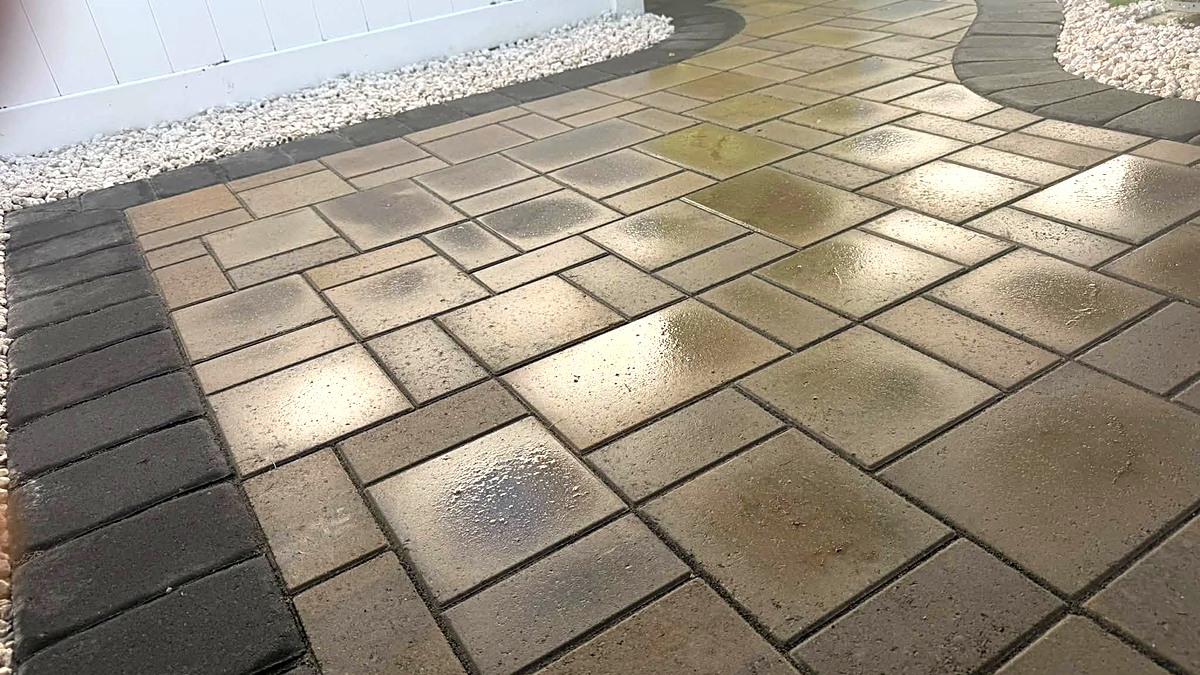
Light field, dark border. The contrast is what makes the paved area read as a defined shape.
Why Real Grass Was Never Going to Survive Here
It would be easy to read the synthetic turf as a style choice. It is not. In a courtyard like this one, real grass is being asked to do something it cannot do, and the failure is predictable rather than bad luck.
Start with light. A yard enclosed by six-foot fence panels on three sides and a two-storey wall on the fourth spends most of the day in shade, and the shade moves rather than sitting still, so no part of the lawn gets a reliable share. Warm-season grasses of the sort that grow in coastal Carolina are the least shade-tolerant grasses there are. They do not sulk in low light, they thin out and then go.
Then add traffic. In a small yard every trip across it follows roughly the same line, because there is only one sensible route from the door to the gate. That is a wear pattern concentrated into a few square feet, on soil that gets compacted a little more each time, in light too poor for the grass to recover. Our article on why lawns die in patches around here goes into what is actually happening under the surface when this occurs.
Then add the dog. Dogs in small yards use the same spots, wear the same routes, and their urine burns the grass in concentrated patches that real turf in full sun struggles to recover from and shaded turf simply cannot. Put those three together and you are not maintaining a lawn, you are replacing one — every year, at a cost that adds up quickly, for a result that never looks good for long. Replacing sod in this situation buys a season. We know, because sod replacement is a job we do often, and the honest advice in a yard like this one is not to.
Pet-Friendly Synthetic Turf, and What Installing It Involves
Matt calls it pet-friendly synthetic turf in the first clip and comes back to it in the last one — “we got a pet-friendly carpet over here for the dog.” The pet-friendly part is not marketing language, it refers to a specific construction, and the difference between a turf installation that works with a dog and one that becomes unpleasant within a year is almost entirely underneath.
What matters first is drainage. Pet-rated turf is manufactured with a fully permeable backing so liquid passes straight through rather than pooling in the backing or running off to the lowest corner. That only helps if what sits beneath it can take the water away, which is why the base is the real job. The ground is excavated and replaced with compacted aggregate that drains freely, graded to fall the way the rest of the yard falls. Done properly, rain and anything else the dog contributes goes down and away, and the surface is usable again within minutes of a downpour.
The second thing is the infill — the granular material brushed into the fibres to hold them upright and weight the turf down. For a yard with a dog, that choice is different from a yard without one. Silica sand is standard and perfectly fine in general use, but it holds odour; coated or antimicrobial infills are the ones to use where a dog is a daily user. It is a small line on a quote and the thing most likely to determine whether the owner is happy with the installation in two years.
Then there is the perimeter, which in a courtyard is most of the installation. Synthetic turf has to be anchored at every edge, and every edge here meets something different — the paver border on one side, the stone band on another, the concrete pad under the AC unit on a third. Each junction has to hold the turf flat and tight, because a synthetic lawn that lifts at a corner never settles back down. The clean hard edges you can see in the photographs are not only an aesthetic decision; they are what keeps the turf where it was put.
What the homeowner gets in return is a surface with no mowing, no mud, no seasonal brown period and no annual argument with the shade. In a yard this size, where a mower would be awkward to use and tedious to store, that is worth more than it would be on a quarter-acre lot. If you are weighing it up for your own yard, our synthetic turf page covers what we install and where it makes sense.
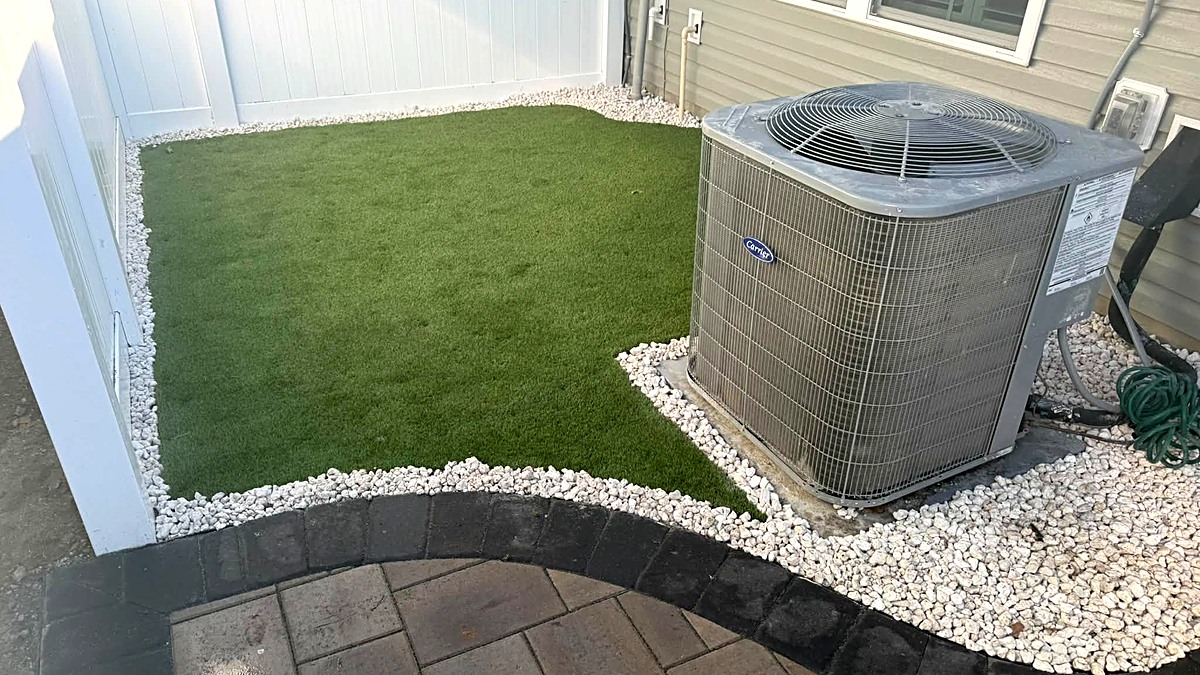
Every edge of the turf meets something solid. That is what stops synthetic grass lifting at the corners.
The White Stone Perimeter and the Drainage It Does
Matt mentions the rock twice, and both times he gives the same two reasons: drainage and aesthetic, in that order. That order is correct.
The fence line is the hardest ground in any enclosed yard. Water sheets off the fence panels onto a narrow strip that gets very little sun and almost no air movement, so it stays wet longest and dries slowest. Anything planted there struggles, anything paved there is awkward to cut in, and bare soil in that position turns to mud and then washes against the fence. A band of washed stone solves all of it at once: water passes straight through and disperses into the ground below instead of running along the surface, and the strip stays clean in any weather.
It earns its place visually too. White stone against a white vinyl fence gives a bright margin that makes the courtyard feel wider rather than hemmed in — a dark mulch in the same position would have closed the space down. It also gives a clean line for the turf and the paver border to finish against, which is a quietly important job: without it, both would have to die into bare soil, and bare soil never stays where it is put.
Worth knowing for anyone considering the same thing: decorative stone is not maintenance-free, it is maintenance-different. It does not need mowing or edging, but it does want the occasional rinse to keep it bright, and it benefits from a proper barrier underneath so the stone does not gradually work its way into the soil. Our piece on decorative rock landscaping for coastal homes covers material choice and depth in more detail, and the decorative stone service page lists what we carry.
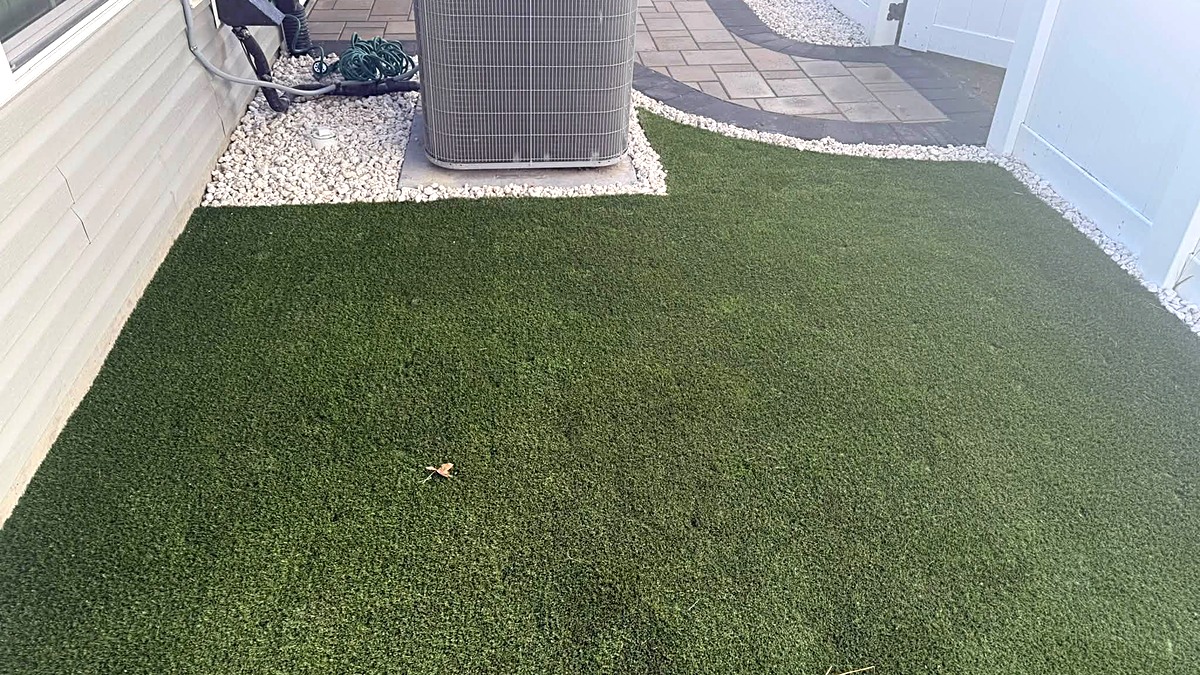
The stone band takes the wettest, shadiest strip in the yard and turns it into the brightest line in it.
Working Around the AC Unit and the Fence Line
The air conditioning condenser sits in a corner of this courtyard and occupies a meaningful share of a space this small. It cannot be moved for a landscaping project, and it cannot be treated as a nuisance to be hidden — it has to keep working, and somebody has to be able to service it.
What it needs is clear air on all sides and a clean, dry surface underneath. Planting around a condenser is a bad idea, because foliage restricts airflow and leaf litter gets drawn into the coil. Running turf tight to the pad is also a bad idea, because the unit sheds condensate and the turf edge stays permanently damp. Stone around it answers both: air moves freely, nothing grows into the fins, condensate drains straight down, and a technician has somewhere solid to stand.
The same thinking applies to everything else living in the first few feet off the house and the fence. The hose bib has to stay reachable. The condensate line has to discharge somewhere sensible rather than onto new paving, where it will leave a stain within a year. The fence posts need the ground around them left free-draining, because a post sitting permanently in wet soil is a post that moves. None of this is visible in a finished photograph, and all of it is the difference between a courtyard that still looks right in five years and one that needs attention in two.
This is the part of the trade that gets least credit. Anyone can lay pavers in an open field. What a small, cluttered, fully enclosed yard tests is whether the installer thought about what else lives there.
Getting Materials Into a Yard With One Gate
There is a practical reality behind a courtyard job that rarely makes it into the finished photographs, and it is worth understanding if you are getting quotes for one: everything that goes into the yard, and everything that comes out of it, travels through a single gate.
That changes the shape of the work. Excavated soil has to be barrowed out rather than dug straight into a truck. Base aggregate, bedding material, pavers and stone all have to come in the same way, a barrow at a time, from wherever the truck could get to. Machinery that would make short work of an open yard either will not fit through the gate or cannot turn once it is inside, so a good deal of the job is done by hand.
This is why a courtyard costs more per square foot than a large open patio, and it is a better explanation than most quotes give. It is not the paving that costs more — it is the handling. When you are comparing a price for a small enclosed yard against a per-square-foot figure from somebody’s much larger job, that difference is most of the gap, and it is real work rather than a markup.
In this case the economics worked in the homeowner’s favour, because Matt was able to use materials already sitting at the shop. In his words: “We were able to recycle some of the materials from the shop and work out a good price for her on the project as well.” That is a genuine advantage of a small job — the quantities involved are often within what a contractor already has on hand from larger projects, and the saving goes to the customer. It is worth asking about if your yard is small.
What Keeping It Looking New Actually Takes
One of the real arguments for a courtyard built this way is how little it asks of the owner afterwards, but “low maintenance” is not the same as “no maintenance”, and it is worth being specific about the difference.
The paving wants its joints kept full and the surface rinsed occasionally. Polymeric sand in the joints resists weeds and washout, and topping it up every few years is a short afternoon rather than a project. On the coast, the thing to watch for is a green film on paving that sits in shade — that is algae living on moisture rather than damage to the paver, and a gentle wash deals with it. Pressure washing on a high setting does more harm than good, because it strips the joints out faster than the weather does.
The turf wants brushing and rinsing. Fibres flatten along the routes people walk; a stiff broom against the lay of the pile lifts them again and keeps the surface looking even. With a dog using it, a periodic rinse keeps the infill fresh, and any solid waste should be picked up as it would be from real grass. Leaves want clearing before they break down into the pile, which is the one way a turf lawn can start to grow actual weeds.
The stone wants the least of all — an occasional rinse to bring the white back, and a check every year or two that nothing has thinned out where water runs across it. Topping up a band of decorative stone is cheap and quick.
Add it up and a courtyard like this asks for perhaps a couple of hours a year, against a real lawn in the same space wanting mowing through the season, watering through the summer, and replacing when it fails anyway. For a small yard behind a townhome, that arithmetic is the whole argument.
Mistakes Worth Avoiding in a Small Courtyard
The errors we see in small enclosed yards are consistent, and all of them are cheaper to avoid than to correct.
Leaving part of it undecided. The strip along the fence, the corner behind the AC, the patch that is too awkward to pave. In a yard this size there is no such thing as a neutral area — every undecided square foot becomes mud, weeds or both, and it drags the rest down with it.
Using too many materials. Three is right for a courtyard. Five turns a small space into a sample board, and the eye reads clutter rather than design.
Laying turf on inadequate base. Synthetic grass over scraped soil drains badly, develops hollows where it is walked, and holds odour when a dog uses it. The base under turf is as important as the base under paving, and for the same reasons.
Skipping edge restraint on the curves. A curved paver edge is under constant outward pressure. Without restraint holding it, the outer course migrates, the joints open and the line you paid for goes soft within a few seasons.
Running the whole yard flat. Enclosed does not mean exempt. Water still has to leave, and in a courtyard the only places it can go are the stone band and whatever drainage sits beyond the fence. Fall has to be built in from the subgrade up, slight enough to be invisible underfoot and definite enough to work.
Crowding the AC unit. Plants, turf or paving tight against a condenser costs you airflow, serviceability, or both. Give it stone and give it room.
Frequently Asked Questions
Pet-rated turf is made for it. The backing is fully permeable so liquid drains straight through rather than sitting in the material, the fibres are non-toxic, and the right infill resists odour rather than holding it. What decides the outcome is the base underneath — compacted, free-draining aggregate graded to fall the right way — and the choice of infill. Turf laid on poor base with standard sand infill will eventually smell; turf laid properly with a coated or antimicrobial infill does not.
It runs warmer than real grass in direct sun, as any solid surface does. In a courtyard like this one it is less of an issue than you would expect, because an enclosed yard surrounded by six-foot fencing spends much of the day in shade. If a yard is in full sun and the turf will be used barefoot in the middle of the day, a rinse cools it quickly, and lighter-coloured fibres and cooling infills both help. It is a fair question to ask before you commit, and the answer depends on your particular yard.
A few days on site rather than a week. The paving, the turf base and the stone all have to be excavated, built up and compacted in sequence, and in an enclosed yard most of the material is moved by hand through one gate, which takes longer than the square footage suggests. Rain is the usual variable, since base material cannot be compacted properly when it is saturated.
Mostly handling and cutting. Getting a crew, a truck and equipment to your address costs the same whatever the size of the job, materials come in set quantities that a small job rarely uses neatly, and in an enclosed yard everything in and out goes through a single gate by barrow. Cutting works against you too: the proportion of edge to field rises sharply as an area gets smaller, and curves put nearly every edge paver on the saw. The whole price for a small job is still well below a large one — it just is not proportional.
Yes. It changes how the work is sequenced rather than whether it can be done. We will look at the access before quoting, because the gate width determines what equipment can get in and therefore how much is done by hand, and that shapes both the timeline and the price. It is worth mentioning when you call so we can plan for it.
In most communities around Calabash, Sunset Beach, Ocean Isle Beach and the newer parts of Little River and Longs, yes. Architectural review usually covers hard surfaces and anything visible from shared areas, and some associations have specific rules about synthetic turf. Submissions with real dimensions and named materials go through far more smoothly than vague descriptions, which is a good reason to have the layout marked out on the ground before you file anything.
A proper barrier underneath and enough depth of stone. Laid straight onto bare earth, stone works its way down and soil works its way up, and within a couple of years you have a muddy gravel rather than a clean band. Installed over a suitable base with an edge to contain it, a stone bed stays where it was put and needs little more than an occasional rinse and the odd top-up.
Yes, and this one is a good example of why they are worth doing — a yard that was unusable became the best room in the house. We serve both sides of the state line: Calabash, Sunset Beach, Ocean Isle Beach, Shallotte and Ash in North Carolina, and Little River, Longs, Conway, North Myrtle Beach and Myrtle Beach in South Carolina. If you are not sure whether your property is in range, call and ask.
Ready to Improve Your Outdoor Space?
If you have a small backyard you have given up on — too shaded for grass, too awkward to mow, too small to seem worth the trouble — call Matt Jones and walk it with him. He will tell you honestly what the space needs and where the money is best spent, whether that is a paver patio, synthetic turf, decorative stone, drainage or the whole courtyard at once.
Precision Hardscape & Construction LLC — Matt Jones
Serving Calabash, Sunset Beach, Ocean Isle Beach, Shallotte and Ash in North Carolina, and Little River, Longs, Conway, North Myrtle Beach and Myrtle Beach in South Carolina.
Paver Patios · Walkways · Synthetic Turf · Decorative Stone · Drainage · Contact